
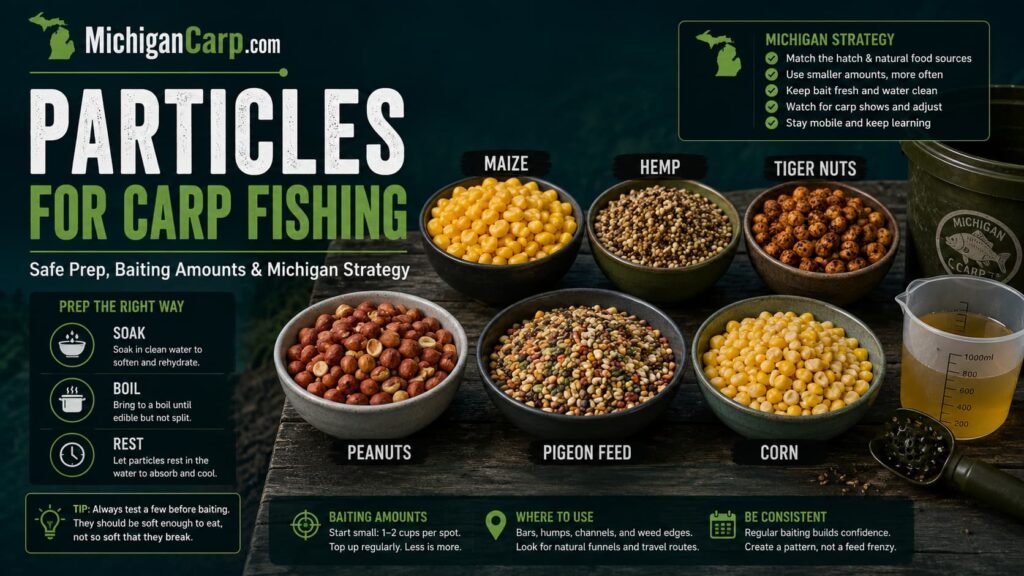
Particles for carp fishing are one of the most useful bait categories in carp fishing.
They are also one of the easiest to misuse.
Used properly, particles for carp fishing can hold carp in an area, create natural browsing, build feeding confidence and work extremely well on Michigan lakes, impoundments, channels and public-water swims.
Used badly, they can overfeed fish, attract nuisance species, spread carp away from the hookbait, create messy baited areas and become unsafe if they are prepared or stored poorly.
That is why this guide matters.
Particles for carp fishing are not just cheap bait to throw in by the bucket.
They are a feeding tool.
They are a feeding tool.
A good particle approach begins with four questions:
Are the particles prepared safely?
Are carp actually using this area?
How much bait does the swim need?
What hookbait will stand out inside the feed?
If those questions are ignored, even good particles can become bad carp fishing.
For the broad bait decision page, use Carp Bait Guide.
For practical bait prep, storage, liquids and testing, use The Bait Shed.
For boilies, use Boilie School.
My particle rule is:
PREPARE THEM SAFELY.
START LIGHTER THAN YOU THINK.
USE THEM WHERE CARP ALREADY WANT TO FEED.
MAKE THE HOOKBAIT EASY TO FIND.
That is the difference between feeding carp and catching carp.
Table of Contents
Quick Start: Particles for Carp Fishing
Use this table as the practical starting point.
| Particle | Main Job | Best Use |
|---|---|---|
| Sweet corn | Quick acceptance and visibility | Short sessions, cold water, simple fishing |
| Maize / field corn | Cheap bulk feed and hookbait match | Warm water, longer sessions, controlled feeding |
| Hemp | Small-item browsing and grubbing | Supporting feed, weed edges, silt and natural feeding areas |
| Tiger nuts | Tougher, more selective hookbait and feed item | Nuisance fish, longer sessions, selective particle fishing |
| Peanuts | Rich high-fat hookbait or small mix component | Use carefully and sparingly |
| Pigeon feed | Mixed particle base | Warm-water feeding, longer sessions, campaign use |
| Chickpeas / maples | Larger particle hookbait options | Selective feeding and hookbait matching |
| Pellets with particles | Fast signal support | Shorter sessions and warm-water traps |
The safest beginner approach is:
- start with corn;
- learn safe preparation;
- add hemp or maize only when the session justifies it;
- use tiger nuts carefully;
- avoid heavy particle baiting until fish response proves it is needed.
What Are Particles in Carp Fishing?
Particles are small food items used to encourage carp to browse, search and feed over an area.
Common carp particles include:
- sweet corn;
- maize;
- hemp;
- tiger nuts;
- wheat;
- barley;
- pigeon feed;
- maple peas;
- chickpeas;
- peanuts;
- mixed seeds;
- properly prepared beans and pulses.
The main thing that separates particles from boilies is feeding behavior.
Boilies are controlled food items.
Pellets break down and release attraction quickly.
Particles create searching and browsing.
They encourage carp to keep working the area, picking up one item after another.
That is why particles can be so effective when used correctly.
They fit the way carp naturally feed around:
- weed edges;
- silt;
- margins;
- reedlines;
- shallow shelves;
- transition zones;
- natural food areas.
But that same strength can become a weakness.
If there are too many particles, carp may feed for a long time without ever needing to pick up the hookbait.
The goal is not just to make carp eat.
The goal is to create a feeding situation that leads to a pickup.
The Non-Negotiable Rule: Prepare Particles Safely
Dry particles must be prepared correctly.
Do not throw dry maize, tiger nuts, peanuts, beans, pulses or hard particle mixes into the lake.
Do not guess.
Do not assume every seed, grain, nut and bean can be treated the same way.
Many particles swell.
Some need long soaking.
Some need proper boiling.
Some need resting.
Some can spoil if stored badly.
Some are too rich to use heavily.
Canned sweet corn is ready to use.
Many dry particles are not.
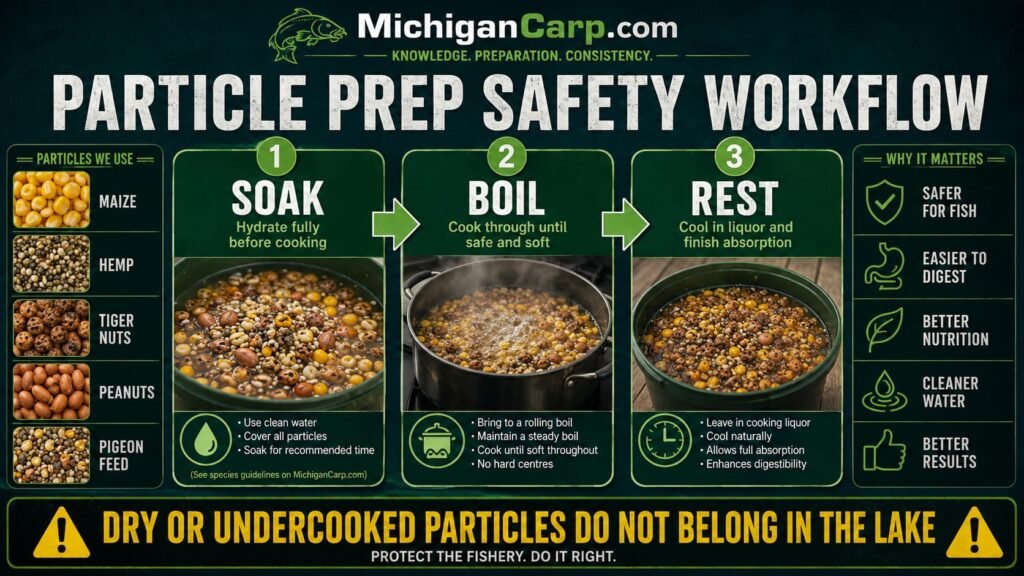
The basic particle preparation sequence is:
SOAK → BOIL → REST → COOL → STORE SAFELY
That sequence is not decoration.
It is part of responsible carp fishing.
Why Soaking Matters
Soaking allows dry particles to absorb water before cooking.
This helps:
- swell the particle;
- soften the interior;
- reduce dry hardness;
- prepare the bait for proper cooking;
- prevent uncontrolled swelling after introduction.
Why Boiling Matters
Boiling or simmering fully cooks the particle.
It helps create a safer, softer, more digestible bait.
Hard or undercooked particles should not be used.
Why Resting Matters
Resting the particles in their liquor allows them to cool and finish absorbing moisture.
The cooking liquor may also become part of the bait signal.
Do not automatically rinse everything away unless you have a specific reason.
Why Storage Matters
Prepared particles are wet food.
They can sour, ferment, mold or spoil if mishandled.
Cool them properly.
Store them cleanly.
Freeze what you are not using soon.
If bait smells rotten, looks wrong, feels slimy in a bad way or seems unsafe, do not fish it.
For practical bait handling, use The Bait Shed.
General Particle Preparation Guide
The exact preparation time depends on particle size, age, product form and supplier.
Use these as practical starting points, not blind rules.
| Particle | Soak | Boil / Simmer | Rest |
|---|---|---|---|
| Sweet corn | Ready from can | Not needed | Not needed |
| Maize / field corn | 24–48 hours | 45–90 minutes | Overnight |
| Giant maize | 24–48 hours | 60–90 minutes | Overnight |
| Hemp | 12–24 hours | 20–30 minutes | Yes |
| Wheat / barley | 12–24 hours | 20–40 minutes | Yes |
| Maple peas | 12–24 hours | 30–60 minutes | Yes |
| Chickpeas | 24 hours | 45–75 minutes | Yes |
| Tiger nuts | 24–48 hours | 30–60 minutes | 24 hours or more |
| Peanuts | 24 hours | 30–60 minutes | Yes |
| Mixed pigeon feed | Usually 12–24 hours | 30–60 minutes | Yes |
Always cook until the particle is properly softened and consistent inside.
Do not rely only on the clock.
Check the bait.
Different batches behave differently.
Sweet Corn for Carp
Sweet corn is the easiest particle-style bait for carp.
It is:
- ready to use;
- bright;
- soft;
- cheap;
- accepted quickly;
- easy to hook or hair rig;
- good for beginners;
- useful in cold water.
Sweet corn is strongest when:
- the session is short;
- carp are already nearby;
- you want a quick response;
- you are fishing simply;
- you need a low-cost bait;
- water is cool or cold.
Sweet corn is weaker when:
- nuisance fish clear it quickly;
- turtles, birds or crayfish are a problem;
- you need a durable all-night hookbait;
- you want more selectivity;
- you need to avoid small fish.
Corn is not weak bait.
It is simple bait.
Use it when simple is the correct answer.
For the broader bait decision guide, read Carp Bait Guide.
Maize and Field Corn
Maize is one of the classic carp particles.
It can provide:
- cheap feed;
- visible food items;
- hookbait matching;
- longer feeding activity;
- useful bulk in warm water.
Maize is stronger when:
- the water is warm enough;
- carp are feeding confidently;
- you are fishing longer sessions;
- you want to feed a small area repeatedly;
- you can prepare and store it properly.
Maize is weaker when:
- water is very cold;
- fish are inactive;
- the session is short;
- nuisance fish dominate;
- it is underprepared;
- too much is introduced.
Maize needs proper soaking and boiling.
Do not throw dry field corn into a lake.
Practical Use
A good maize approach is often modest.
Use enough to create feeding activity, not enough to turn the spot into a grain pile.
A maize hookbait can work well over mixed maize, hemp and smaller particles.
Hemp for Carp
Hemp is one of the best small-particle support baits.
It is not usually a hookbait.
Its job is to keep carp browsing.
Hemp can be useful because it creates:
- small food items;
- grubbing behavior;
- prolonged searching;
- confidence around the feeding area.
Hemp is strongest when:
- carp are already feeding or browsing;
- the water is warm enough;
- you are fishing near weed, silt or natural food;
- you want to support corn, maize, tiger nuts or boilies;
- you want a small-item particle signal.
Hemp is weaker when:
- you use too much;
- the water is cold;
- nuisance fish dominate;
- the hookbait gets lost in the feeding activity.
A little hemp can do a lot.
Do not use it just because it appears in every particle mix.
Use it because you want carp to keep searching the area.
Tiger Nuts for Carp
Tiger nuts are one of the most useful selective particle baits.
They are:
- tough;
- durable;
- different from soft grains;
- useful as hookbaits;
- useful as chopped feed;
- useful in moderation as free offerings.
Tiger nuts are strongest when:
- nuisance fish are a problem;
- corn is being cleared too quickly;
- you want a tougher hookbait;
- you are fishing longer sessions;
- carp recognize or accept them;
- you want particle-style fishing with more selectivity.
Tiger nuts are weaker when:
- carp have not encountered them;
- you overfeed them;
- they are prepared badly;
- you expect them to work instantly everywhere;
- they become the whole plan without support.
Tiger nuts should be soaked, boiled and rested correctly.
They can also benefit from controlled fermentation in their liquor, but fermentation must be intentional, clean and monitored.
Use Tiger Nuts for Carp Fishing for a deeper tiger-nut guide.
Peanuts for Carp
Peanuts are rich, oily and useful, but they need restraint.
They can be effective as:
- hookbaits;
- chopped additions;
- small mix components;
- occasional selective feed items.
They should not usually be used as heavy bulk feed.
Peanuts are strongest when:
- used in small amounts;
- used as a hookbait or chopped support;
- carp already accept them;
- the water and feeding situation justify richer bait.
Peanuts are weaker when:
- overfed;
- used as cheap bulk;
- poorly prepared;
- stale or rancid;
- added to an already rich baiting plan.
Because peanuts are high-fat, they should be treated differently from maize or wheat.
A few peanuts in a mix can be useful.
A carpet of peanuts is not a sensible default.
Pigeon Feed and Mixed Particles
Pigeon feed can be a useful mixed particle base.
It may include:
- maize;
- wheat;
- peas;
- milo;
- small seeds;
- grains and pulses depending on the blend.
The exact mix matters.
Read the bag.
Do not assume every pigeon feed is the same.
Pigeon feed is strongest when:
- prepared safely;
- used in warm or active feeding conditions;
- fished in longer sessions;
- introduced accurately;
- paired with a clear hookbait.
Pigeon feed is weaker when:
- used in cold water;
- used too heavily;
- the mix contains many hard items and is undercooked;
- the angler cannot identify what is in the blend;
- the hookbait gets lost in the feed.
Mixed particles should have a purpose.
Do not use variety just for the sake of variety.
Chickpeas, Maples, Beans and Pulses
Chickpeas, maple peas and some beans can be useful larger particles.
They may work as:
- hookbaits;
- free offerings;
- selective feed items;
- additions to mixed particle blends.
They must be prepared correctly.
Many dried beans and pulses need proper soaking and cooking.
Do not shortcut this.
These particles are strongest when:
- carp are feeding confidently;
- you want larger particle items;
- you want a hookbait that matches the feed;
- the water is warm enough;
- the session gives fish time to find and accept them.
They are weaker when:
- cold water limits feeding;
- they are used in large amounts too early;
- preparation is poor;
- nuisance fish or turtles dominate.
Use larger particles deliberately.
They are not just filler.
Particles and Boilies Together
Particles and boilies can work very well together because they do different jobs.
Particles create:
- browsing;
- grubbing;
- searching;
- feeding activity.
Boilies provide:
- durable hookbaits;
- larger food items;
- more control;
- repeatable bait identity;
- selectivity.
A good particle-and-boilie approach might use:
- hemp and maize to create browsing;
- chopped boilies for food signal;
- whole boilies for larger items;
- a boilie or tiger nut hookbait.
The mistake is adding too much of everything.
If particles dominate the feeding situation, the hookbait may become less important.
Use boilies and particles together when each has a job.
For boilie strategy, use How to Fish Boilies for Carp.
Particles and Pellets Together
Particles and pellets can also work together.
Pellets break down and create faster attraction.
Particles last longer and keep fish searching.
This combination can be useful in warmer water when carp are feeding.
It can also be useful in PVA bags or small traps.
But be careful.
Pellets plus particles can become a lot of food very quickly.
Use this combination when:
- fish are active;
- you want quick signal and longer browsing;
- the session length justifies it;
- nuisance species are manageable.
Avoid heavy particle-and-pellet use when:
- water is cold;
- fish are inactive;
- nuisance fish are a problem;
- you are testing a new swim.
Particles in Cold Water
Particles can work in cold water, but they require restraint.
Cold-water carp usually feed less and move less.
Heavy particle baiting can easily overfeed the swim.
In cold water, think in tiny signals:
- a few grains of corn;
- a pinch of hemp;
- a single tiger nut hookbait;
- a tiny PVA trap;
- a near-single hookbait approach.
Avoid large beds of maize, pigeon feed or mixed particles unless you have strong evidence that carp are feeding.
In early spring, corn is often safer than a heavy particle mix.
Use Best Carp Bait for Cold Water for broader cold-water bait decisions.
Particles in Spring
Spring is a transition.
Early spring is still cold-water fishing.
Use particles lightly.
Carp may move into shallows before they feed heavily.
Good early spring options include:
- sweet corn;
- very small amounts of hemp;
- tiny particle traps;
- single tiger nut or maize hookbait;
- light crumb around the hook.
Later spring can be different.
As water warms and carp feed more actively, particles become more useful.
Good later spring particle areas include:
- warming margins;
- reed edges;
- sheltered bays;
- shallow shelves near deeper water;
- areas with visible feeding signs.
Use Spring Carp Fishing in Michigan for seasonal context.
Particles in Summer
Summer is usually the strongest particle season.
Carp feed more actively.
Natural food is abundant.
Particles can match the browsing behavior carp already use.
Good summer particle options include:
- maize;
- hemp;
- tiger nuts;
- pigeon feed;
- mixed prepared particles;
- boilies added as larger food items.
But summer still punishes careless baiting.
Watch for:
- low oxygen;
- heavy weed;
- nuisance fish;
- turtles;
- crayfish;
- boat disturbance;
- warm-weather spoilage;
- overfeeding.
Warm water does not mean unlimited bait.
Use what the swim needs.
For broader seasonal detail, use Summer Carp Fishing in Michigan.
Particles in Fall
Fall can be excellent for particles.
Early fall often supports stronger feeding.
Carp may feed hard before colder water.
Good fall options include:
- maize;
- hemp;
- tiger nuts;
- pigeon feed;
- boilies mixed into particles;
- controlled campaign feeding.
As water cools, reduce bait amounts.
Late fall becomes closer to cold-water fishing.
The best fall particle plan changes with temperature trend, not just the calendar.
Use Fall Carp Fishing in Michigan for seasonal planning.
Particles in Winter
Winter particle use should usually be minimal.
Most winter carp fishing is about location, timing and restraint.
If using particles in winter, think small:
- a few grains of corn;
- one tiger nut hookbait;
- tiny amounts of hemp;
- no large beds of bait.
Heavy particle baiting is rarely the best winter starting point.
Find the fish first.
Use Winter Carp Fishing in Michigan if you fish outside the main season.
Best Places to Use Particles on Michigan Waters
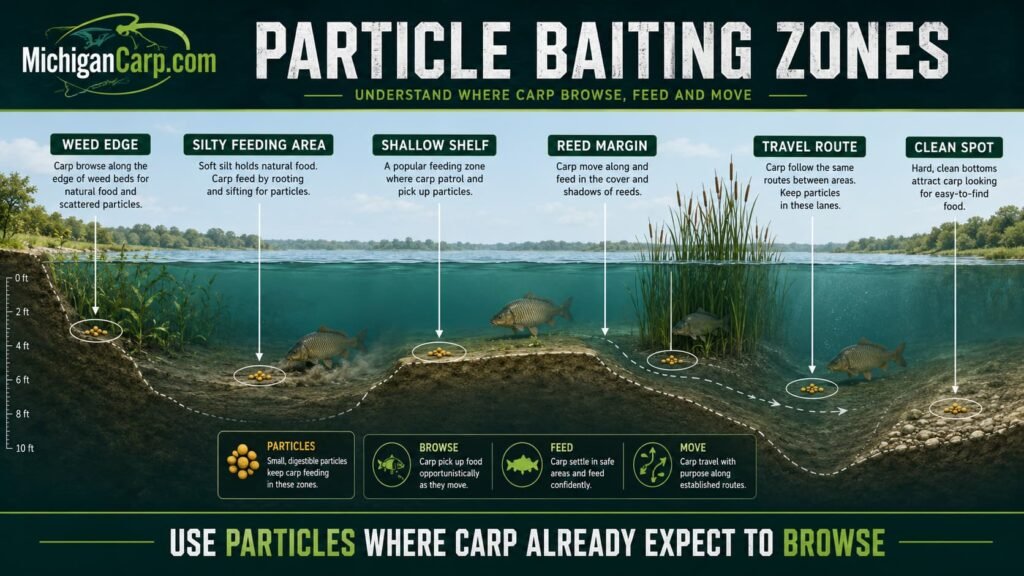
Particles work best where carp already expect to browse.
Good areas include:
- weed edges;
- clean spots beside weed;
- reed margins;
- silt beds with natural food;
- shallow shelves;
- protected bays;
- river mouths;
- current seams;
- transition zones between firm and soft bottom;
- margin patrol routes.
Particles are weaker in random open water unless carp are clearly feeding there.
On many Michigan lakes, the best particle spots are not always the cleanest-looking spots.
They are the places carp naturally search for food.
Use Reading a Lake Like a Carp Angler and How to Locate Carp Before You Cast before committing bait.
Particles Near Weed
Weed beds can be excellent particle areas.
Carp use weed for:
- food;
- cover;
- patrol routes;
- oxygen-rich areas;
- natural feeding.
Particles can work well beside weed because they fit natural browsing behavior.
Look for:
- clean holes;
- weed edges;
- thinner weed;
- open water beside vegetation;
- firm spots near weed;
- routes along reedlines.
Do not throw particles deep into unfishable weed and then place a rig where it cannot work.
Particles should help you fish the edge.
They should not bury your presentation.
Particles on Silt
Silt can be very good or very bad.
Clean feeding silt can hold natural food.
Dead, foul, black sludge is different.
Particles can work well on clean silt because carp are already used to grubbing there.
Useful particle choices include:
- hemp;
- corn;
- small grains;
- chopped tiger nuts;
- light mixed particles.
The presentation still has to be fishable.
If the hook is masked or the hookbait is buried, the baiting does not matter.
Use wafters, balanced hookbaits, tiger nuts or suitable rigs when needed.
Particles on Hard Spots
Hard spots can also work well, especially when they are close to softer feeding areas or weed.
A hard spot gives presentation confidence.
Particles add feeding activity.
Useful options include:
- corn;
- hemp;
- small prepared particles;
- chopped tiger nuts;
- a boilie or tiger nut hookbait.
Hard spots are strongest when they are part of a route or feeding area.
A clean hard spot with no carp nearby is still just a clean hard spot.
How Much Particle Bait Should You Use?
Use less than you think at first.
Particle amount depends on:
- water temperature;
- fish activity;
- fish numbers;
- session length;
- nuisance species;
- water size;
- bait type;
- whether you are trying to catch one fish or hold a group.
Short Session
Use tiny amounts.
A few grains, a small handful or a tight trap may be enough.
Day Session
Start with a modest patch.
Top up only when fish activity justifies it.
Overnight Session
Use a planned starting amount, but do not assume night requires heavy bait.
Top up after signs, liners or fish.
Multi-Day Session
Particles can become a proper holding bait.
Build the swim gradually.
Do not dump bait blindly just because the session is longer.
Campaign Feeding
Feed little and often if the water, rules and access allow it.
The goal is recognition and confidence, not waste.
For broader baiting logic, use Baiting Strategy: How Much, How Often and Why.
When to Top Up Particles
Top-ups should be based on evidence.
Good reasons to top up include:
- you catch a fish;
- liners continue;
- fizzing or clouding appears;
- carp are visibly feeding;
- bait is being cleared;
- a known feeding window is opening.
Poor reasons include:
- boredom;
- panic;
- copying another angler;
- assuming more bait is always better;
- trying to fix a poor location with feed.
A particle spot can keep fish busy for longer than expected.
Do not keep adding bait just because time has passed.
Ask what the swim is telling you.
Hookbaits Over Particles
The hookbait must stand out enough to be found, while still fitting the feeding situation.
Good hookbaits over particles include:
- sweet corn;
- artificial corn;
- maize;
- giant maize;
- tiger nuts;
- chickpeas;
- maple peas;
- small boilies;
- wafters;
- balanced hookbaits;
- snowman presentations.
Corn Hookbait
Best when the feed includes corn or maize and nuisance fish are manageable.
Tiger Nut Hookbait
Best when you want toughness and more selectivity.
Boilie Hookbait
Best when you want a larger, more controlled food item over smaller feed.
Wafter or Balanced Hookbait
Best when fish are browsing cautiously and you want easier pickup.
The hookbait should be important.
If you feed so many particles that the hookbait becomes just another item in a huge pile, the rig may lose its edge.
Particle Baiting Patterns
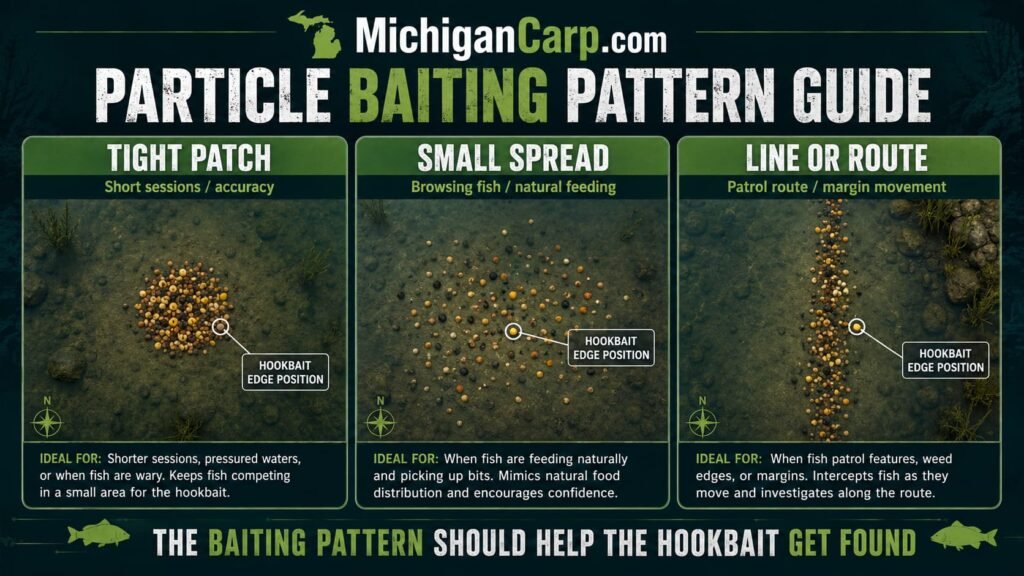
Tight Patch
Useful for:
- short sessions;
- accurate hookbait placement;
- clear spots;
- cold or uncertain conditions.
Small Spread
Useful for:
- browsing fish;
- weed edges;
- silt;
- slightly larger feeding areas.
Line or Route Baiting
Useful when:
- carp are moving along a margin;
- you know a patrol route;
- you want to intercept fish.
Edge Hookbait
Useful when:
- bigger fish hang back;
- the center of the feed is too busy;
- fish are cautious.
Do not bait randomly.
The pattern should match the way fish are likely to enter and feed.
Particles in PVA Bags and Sticks
Wet particles are normally not PVA-friendly.
Water dissolves PVA.
If using particle-style bait with PVA, think carefully.
Options include:
- towel-dried particles;
- crushed dry-safe ingredients;
- pellets;
- ground boilie;
- dry crumb;
- PVA-safe liquids;
- tiny particle additions mixed into dry materials.
Do not assume wet corn or wet hemp can go straight into PVA.
Test it first.
For small traps, pellets, crushed boilies and dry crumb are often easier than wet particles.
Storing Prepared Particles
Prepared particles should be treated like wet food.
Short-term options include:
- fridge storage in liquor;
- clean sealed tubs;
- cool storage for short periods;
- working tubs for the session.
Longer-term options include:
- freezing in session bags;
- freezing in liquor;
- labeling with date and contents.
Avoid:
- warm storage;
- dirty buckets;
- repeated warming and cooling;
- long storage when unsure;
- using bait that smells rotten or unsafe.
Intentional fermentation is different from uncontrolled spoilage.
Do not confuse the two.
For storage and bait handling, use The Bait Shed.
Three Practical Particle Mixes
These are starting points, not fixed recipes.
Simple Corn and Hemp
Best for:
- beginners;
- short sessions;
- spring and summer;
- clear baiting.
Basic idea:
- prepared corn or maize;
- prepared hemp;
- corn or maize hookbait.
This is simple, visible and easy to understand.
Maize, Hemp and Tiger Nut
Best for:
- longer sessions;
- summer;
- tougher hookbait fishing;
- nuisance fish situations.
Basic idea:
- prepared maize;
- prepared hemp;
- small amount of chopped tiger nut;
- tiger nut or boilie hookbait.
This gives browsing plus a tougher food item.
Pigeon Feed with Boilie Support
Best for:
- warm-water sessions;
- longer fishing;
- holding carp;
- campaign-style feeding.
Basic idea:
- properly prepared pigeon feed;
- chopped boilie;
- whole boilies or tiger nuts as hookbait support.
This is stronger feed and should not be used heavily in cold water or uncertain swims.
Common Particle Mistakes
Feeding Too Much
Particles are cheap, but overfeeding still ruins swims.
Using Dry or Undercooked Particles
This is unacceptable.
Prepare particles properly.
Baiting Before Finding Carp
Particles work best where carp already want to feed.
Losing the Hookbait
A big particle bed can make the hookbait harder to find.
Using Too Many Large Items
Big particles, nuts and beans can overfeed or reduce urgency if used carelessly.
Treating Tiger Nuts Like Maize
Tiger nuts are tougher and more selective.
Use them differently.
Treating Peanuts as Bulk Feed
Peanuts are rich.
Use carefully.
Ignoring Cold Water
Cold water needs restraint.
Storing Wet Bait Badly
Spoiled bait is not a feature.
It is a problem.
Changing the Mix Every Session
If the mix keeps changing, you cannot learn what works.
Michigan Notes
Particles for carp fishing in Michigan work best when they match natural browsing areas such as weed edges, silty bays, reedlines and shallow shelves.
Particles fit many Michigan carp waters because our fish often browse naturally.
Weed edges, silty bays, shallow shelves, reedlines and transition zones can all suit particle fishing.
But Michigan waters also punish lazy baiting.
Many are:
- large;
- public;
- weedy;
- full of natural food;
- affected by boat traffic;
- shared with other users;
- lightly understood for carp movement.
That means particles should be used with watercraft.
On some waters, a small corn-and-hemp approach may be perfect.
On others, tiger nuts or boilies over particles may give better selectivity.
On big lakes, the key may be finding the route before introducing much bait.
On cold-water sessions, a few grains can be more useful than a bucket.
My practical Michigan view is simple:
PARTICLES ARE BEST WHEN THEY FIT NATURAL FEEDING BEHAVIOR.
Do not use them to guess your way into fish.
My Practical View
Particles are powerful because they change how carp feed.
They make carp search.
They make carp browse.
They can hold fish longer than a few large food items.
But that strength has to be controlled.
The best particle anglers are not the ones who feed the most.
They are the ones who know when to feed little, when to build, when to stop and how to keep the hookbait important.
My rule is:
USE PARTICLES TO CREATE FEEDING BEHAVIOR.
USE THE HOOKBAIT TO CATCH THE FISH.
That is the balance.
FAQ
What are particles in carp fishing?
Particles are small food baits such as corn, maize, hemp, tiger nuts, pigeon feed, chickpeas and prepared grains used to make carp browse and search a feeding area.
What is the best particle for carp?
There is no single best particle. Corn is the easiest starting bait, hemp is excellent for browsing, maize is useful bulk feed and tiger nuts are tougher, more selective hookbaits.
Do particles need to be soaked and boiled?
Most dry particles do. Maize, tiger nuts, peanuts, beans, pulses and many particle mixes should be soaked and boiled properly before fishing. Canned sweet corn is ready to use.
Can I feed dry particles to carp?
No. Do not feed dry or underprepared particles. Prepare them safely before use.
Is corn a particle bait?
Yes. Corn is one of the simplest and most useful particle-style carp baits.
Are tiger nuts good for carp?
Yes. Tiger nuts can be excellent as tough, selective hookbaits and controlled free offerings, but they must be prepared properly and used in moderation.
Is hemp good for carp?
Yes. Hemp is a useful small particle that encourages browsing and grubbing. It is usually a support bait rather than a hookbait.
Are peanuts safe for carp?
Peanuts should be used carefully, prepared properly and fed sparingly. They are rich and should not be treated as bulk feed.
How much particle bait should I use?
Start lighter than you think. Use tiny amounts in cold water or short sessions, modest patches for day sessions and larger amounts only when fish activity justifies it.
Can I use particles in cold water?
Yes, but use very small amounts. A few grains of corn, a pinch of hemp or a single tiger nut hookbait may be enough.
Can I use particles with boilies?
Yes. Particles can create browsing activity while boilies provide durable hookbaits and larger food items.
Can I use wet particles in PVA bags?
Usually not directly. Wet particles can melt PVA. Use towel-dried bait, dry crumb, pellets, crushed boilies or PVA-safe liquids if using PVA.
How should I store prepared particles?
Cool them properly, keep them clean, refrigerate short-term or freeze in session bags. Do not use bait that smells rotten or looks unsafe.
What is the biggest particle mistake?
Feeding too much before you know carp are present and feeding. Particles should create opportunity, not bury the hookbait in free food.
Next Steps
Use these routes next:
- Carp Bait Guide
- The Bait Shed
- Tiger Nuts for Carp Fishing
- Spring Particles for Carp
- Baiting Strategy: How Much, How Often and Why
- Boilie School
- How to Fish Boilies for Carp
- How to Locate Carp Before You Cast
- Michigan Carp Guide Library