

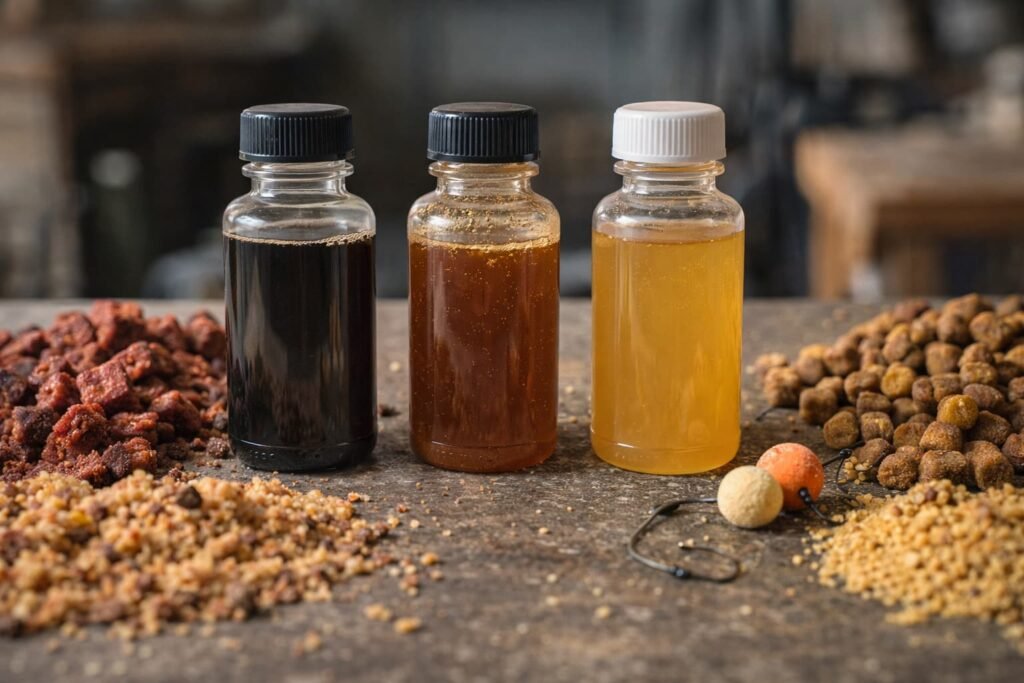
A lot of anglers know what bait liquids are, but still struggle with when to use them.
That is where most of the confusion starts. One angler uses a rich hydrolysate in cold water and wonders why the bait feels too much. Another uses a sweet liquid when the bait really needs a stronger food signal. Another keeps switching between bottles without ever learning what actually helped.
The truth is simple. Different liquids suit different jobs. Once you understand that, the whole subject becomes easier.
This page is the practical decision guide. It sits alongside What Fermented Bait Liquids Really Do, Cheap Carp Bait Liquids That Actually Work, Best Liquids for Carp Fishing in Cold Water, and The Bait Shed.
Quick Start
- Use fermented liquids when you want a livelier, cleaner, more active outer signal.
- Use hydrolysates when you want richer savoury food depth and a stronger feeding cue.
- Use sweet liquids when you want a lighter flavour edge, not when you need the whole bait doing more work.
- In cooler water, lighter and cleaner usually wins.
- In warmer water, richer liquids usually become easier to use confidently.
- Start by asking what the bait is missing, not which bottle sounds best.
Why This Matters
Most bait-liquid mistakes happen because anglers choose by label, smell, or hype instead of by function.
A better question is:
- Do I need the bait to wake up faster?
- Do I need a richer food signal?
- Do I just need a cleaner top note?
- Am I sharpening a hookbait, crumb mix, chopped boilie mix, or a proper baited area?
- Do the conditions call for subtlety or depth?
Once you think in those terms, the choice becomes much easier.
The Three Main Liquid Types
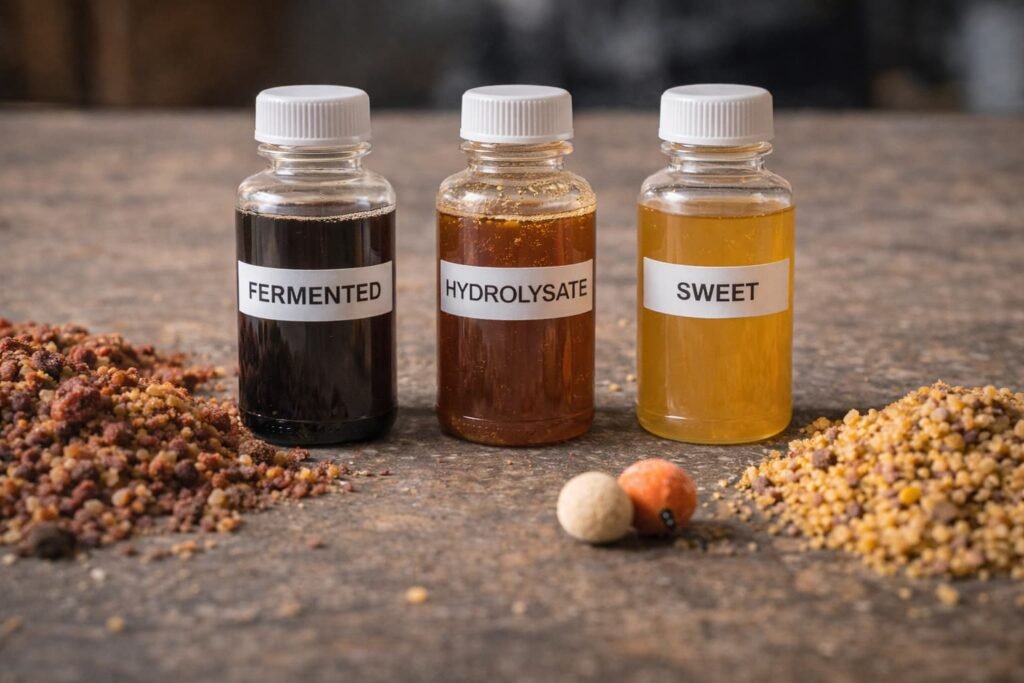
Fermented Liquids
These are usually the best choice when you want a bait to feel more alive without making it too heavy.
They often suit:
- hookbaits
- crumb and chopped boilies
- pellets
- short-session traps
- cooler water
- big natural waters where a cleaner signal makes more sense
They usually work because they add a sharper food-signal edge rather than just smell. A good fermented liquid can help a bait leak better, smell more natural, and feel more convincing without drowning it.
Good examples include CSL-style liquids, liquid yeast, and other savoury fermented food-style liquids.
Read more: What Fermented Bait Liquids Really Do
Hydrolysates
These are usually the best choice when you want more savoury soluble food depth.
They often suit:
- hookbait treatment
- chopped bait and crumb mixes
- pellet coatings
- warmer-water applications
- situations where fish are feeding more confidently
- baiting situations where a richer food cue makes sense
A hydrolysate usually adds more depth than a lighter fermented liquid, but that also means it can be easier to overdo. Used neatly, they can be excellent. Used heavily, they can make a bait feel too rich, especially in cold water or on pressured fish.
Sweet Liquids
These are usually the best choice when you want a lighter flavour-led edge rather than a strong savoury food signal.
They often suit:
- simple hookbait treatment
- warmer-water baiting
- particles
- lighter flavour-led bait profiles
- situations where the bait does not need much more than a clean top note
Sweet liquids still have a place, but they are often overused. They are usually better as a light support liquid than as the whole attraction story.
When to Use Fermented Liquids
Use fermented liquids when the bait needs a cleaner, livelier, more active signal.
They usually make most sense when:
- the water is still cool
- fish are cautious
- you are fishing short sessions
- you want hookbaits, crumb, or chopped bait to wake up quickly
- you want to improve decent bait without rebuilding it
- you are fishing larger natural Michigan waters where subtlety matters
They are often the safest all-round starting point.
When to Use Hydrolysates
Use hydrolysates when the bait needs richer savoury food depth rather than just a sharper edge.
They usually make most sense when:
- the water is warming or warm
- fish are feeding more confidently
- you want a stronger food-led cue
- you are building a better baited patch rather than just a tiny trap
- you want more depth on hookbaits, pellets, or chopped bait
They are usually not the first thing I would reach for in very cool water unless used carefully.
When to Use Sweet Liquids
Use sweet liquids when the bait needs a softer flavour-led edge rather than more savoury depth.
They usually make most sense when:
- the water is warmer
- fish are already feeding well
- you are using simpler hookbait approaches
- you want a lighter top note rather than a rich food cue
- you are using particles or lighter baiting approaches
They are usually not the best first answer when the bait feels too flat or too dead. In that situation, a fermented liquid or hydrolysate often makes more sense.
Cold Water vs Warm Water
Cold Water
In cold water, I would usually lean toward:
- fermented liquids
- yeast-style liquids
- CSL-style liquids
- lighter, cleaner application overall
In many cold-water situations, the cleaner signal is the better signal. This is especially true when fish are moving less and inspecting bait more carefully.
Read more: Best Liquids for Carp Fishing in Cold Water
Warm Water
In warmer water, I would usually be more comfortable with:
- hydrolysates
- richer savoury liquid use
- slightly stronger bait treatment
- sweet liquids as a support edge where they fit
That does not mean heavy-handed. It just means fish are usually more able to deal with richer bait signals once the water is warmer and feeding windows are stronger.
Hookbaits, Crumb, Pellets, and Feed
Hookbaits
For hookbaits, all three types can work, but:
- fermented liquids often give a cleaner, sharper edge
- hydrolysates often add richer depth
- sweet liquids often add a lighter top note
Crumb and Chopped Boilies
This is where fermented liquids and hydrolysates often do some of their best work. Both can help a small trap wake up more quickly and feel more convincing.
Pellets
Usually best with a neat coating rather than a heavy soak. Fermented liquids and lighter hydrolysate use often make most sense here.
Bigger Baiting Situations
This is where hydrolysates can often earn their place more clearly, especially if you want the baited area to carry more savoury food depth.
Michigan Notes
On Michigan waters, a lot depends on how natural and how pressured the water is.
Big natural lakes, cool spring conditions, natural food, zebra mussels, short feeding windows, and moving fish often push you toward cleaner, more believable baiting. That is one reason fermented liquids so often make sense here.
Hydrolysates still have a very good place, especially once the water warms and fish are feeding more confidently, but I would usually rather see them used neatly than over-applied.
Sweet liquids still work, but on many Michigan waters they are usually a support act rather than the main event.
Common Mistakes
- Using the richest liquid just because it smells strongest.
- Using sweet liquids where the bait really needs more food signal.
- Using hydrolysates too heavily in cold water.
- Treating fermented liquids as miracle rescue tools.
- Using multiple liquid types together without understanding what each one is doing.
- Forgetting that the bait form matters just as much as the bottle.
FAQ
Are fermented liquids better than hydrolysates?
Not across the board. Fermented liquids are often better when you want a sharper, cleaner, more active signal. Hydrolysates are often better when you want richer savoury food depth.
Are sweet liquids still worth using?
Yes, but usually in a supporting role rather than as the whole bait strategy.
Which is best in cold water?
Usually a lighter, cleaner option. Fermented liquids often fit very well here.
Which is best for hookbaits?
All three can work, but fermented liquids and hydrolysates usually offer more food-like signal than sweet liquids alone.
Should I mix them?
Sometimes, but it is usually better to understand one properly before layering multiple liquids together.
Next Steps
After this page, the best next reads depend on what you want to improve next.
- What Fermented Bait Liquids Really Do — the practical fermented-liquid starting point.
- Best Liquids for Carp Fishing in Cold Water — where lighter liquids fit when water is still cool.
- Cheap Carp Bait Liquids That Actually Work — practical no-carp-tax liquid options.
- The Bait Shed — practical workshop-style bait improvements.
- Bait Science — the deeper why behind liquids, food signals, and leakage.