

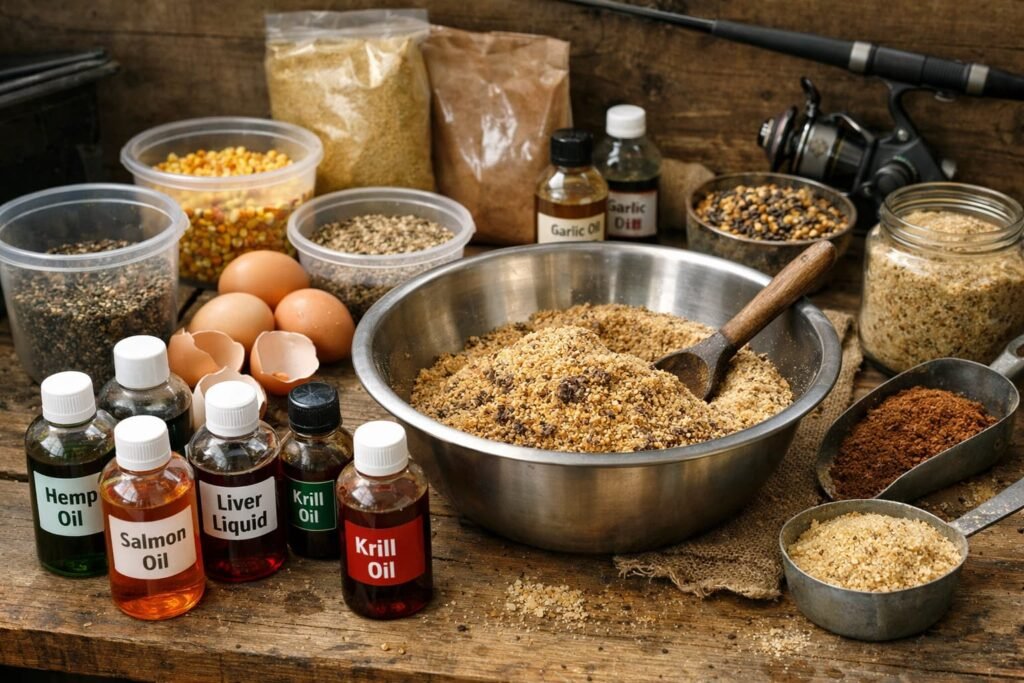
Oils and fats can improve a bait, but they can also slow it down if they are used badly.
This is one of the most misunderstood areas in bait making. Many anglers hear “oil” and think attraction. Others hear “high energy” and assume better food bait. Neither idea is automatically right on its own.
Oils and fats are mainly about energy, richness, texture, and food value. They can help make a bait more substantial and more useful as a long-term food source. But they can also reduce wake-up speed, dull leakage, and make a bait less suitable in cooler conditions if they are overdone.
That is why this subject matters. A bait can be nutritionally richer and still fish worse if the oil level is wrong for the season. A bait can feel better in the hand and still be slower in the water. A bait can look like a proper summer food bait and still be the wrong tool for April.
For Michigan carp anglers, this is especially important because the water changes so much through the year. A bait that makes perfect sense in warm summer conditions may feel too rich, too oily, or too slow in early spring or late autumn.
This page is about getting that balance right.
Quick Start
- Oils are an energy source, not a magic attractor.
- Fats help give bait richness and food value.
- In warm water, carp can usually handle richer bait more comfortably.
- In cold water, too much oil often works against the bait.
- Oils can affect rolling, texture, leakage, and how a bait behaves in the water.
- A bait can be well-fed and still be badly balanced.
- For most carp bait, oils should support the mix, not dominate it.
- In Michigan, oil levels should usually be lower in spring and winter, and more confident in summer if the rest of the bait supports it.
Practical Rule:
Oils and fats are best treated as support tools for food value and bait texture, not as a shortcut to instant attraction.
What Oils and Fats Actually Do in Bait
This is the first thing to get straight.
Oils and fats bring:
- concentrated energy
- richness
- mouthfeel
- rolling support in some mixes
- texture changes in the finished bait
- a more substantial long-term food-bait character
What they do not automatically bring is fast attraction.
That is one of the biggest myths in bait making. Oils can help a bait overall, but they are not usually the same as soluble attractors, free amino acids, acids, salts, or hydrolysates. In fact, if you overdo them, they can slow the bait down by making it less open and less chemically active.
This is why some oily baits look impressive but feel lazy in the water. They are rich, but not lively. They may make sense later in the feeding cycle, but they do not always do a great job of switching a baited area on quickly.
Oils vs Attraction
This is where anglers often get crossed up.
A bait can be:
- highly attractive
- poorly energetic
Or:
- highly energetic
- not especially quick to attract
These are not the same thing.
Attraction usually comes more from:
- free amino acids
- soluble proteins
- hydrolysates
- acids
- salts
- yeast extracts
- soluble food signals
Energy usually comes more from:
- oils
- fats
- richer food ingredients
- more calorie-dense bait structure
That is why a very oily bait is not automatically a better bait. It may be richer, but not quicker. It may be more substantial, but not more readable to the fish in the first few minutes or hours.
The best bait often balances both sides:
- enough food value to make sense
- enough solubility and leakage to come alive
The Difference Between Oils and Fats
In everyday bait making, anglers often lump them together, which is fine most of the time. But it helps to understand the difference in simple terms.
Oils
Oils are fats that are liquid at normal temperatures. In bait making, that usually means bottled oils such as:
- salmon oil
- fish oils
- hemp oil
- nut oils
- blended bait oils
Fats
Fats are usually solid or semi-solid at cooler temperatures and often come built into ingredients rather than poured in separately. That means:
- fishmeal fat content
- seed fat
- nut fat
- egg yolk fat
- milk and dairy fat fractions
- meat-based ingredient fat
In practical bait making, both matter because both add energy and richness. But bottled oils are easier to overdo because you can pour them in quickly without noticing how much they are changing the bait.
Why Energy Matters in Carp Bait
Energy matters because carp are not only responding to attraction. Over time, they also respond to what a bait does for them as food.
A more energetic bait can make sense when:
- fish are feeding hard
- the water is warmer
- you are building a real food bait
- you are baiting over time
- you want the bait to have some lasting food value
This is one reason richer boilies can perform so well in good conditions. They do not just attract fish. They can become part of a genuine feeding pattern.
But energy has to fit the season and the baiting situation. A high-energy bait in the wrong conditions can easily become too much bait rather than better bait.
Why Temperature Changes Everything
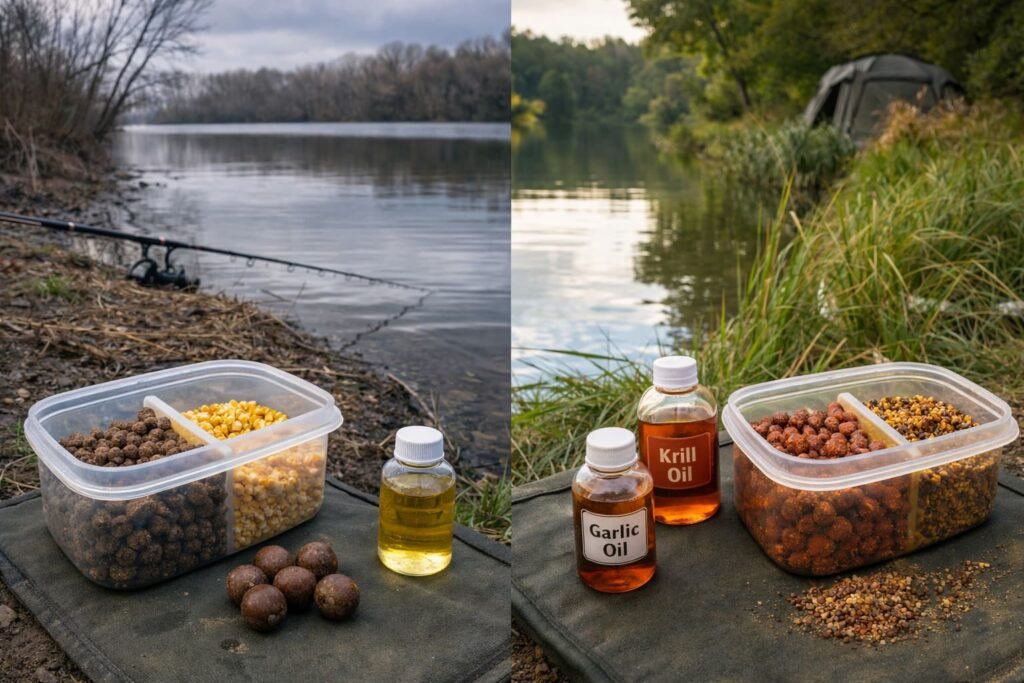
This is the most important section in the whole article.
Carp are ectothermic. Their metabolism and digestive efficiency change with the water temperature. That means the usefulness of a richer oily bait also changes with the season.
Cold Water
In cold water, carp usually feed less aggressively and process food more slowly.
That means:
- too much oil can slow the bait down
- a rich bait can feel heavy for the conditions
- solubility and leakage often matter more than calorie density
- lighter, easier, lower-oil bait often makes better practical sense
This is why spring and winter are rarely the time to fish as though every bait needs maximum richness.
Warm Water
In warm water, carp can usually process food more efficiently and feed more confidently.
That is where oils and fats make more sense:
- as part of richer boilies
- in food-bait campaigns
- in bigger baiting situations
- where the bait needs to function as real food over time
The Practical Takeaway
A bait that is right in July may be badly out of place in April.
This is one of the main reasons anglers struggle when they keep the same oil levels in every season.
Which Oil Sources Make Sense in Carp Bait
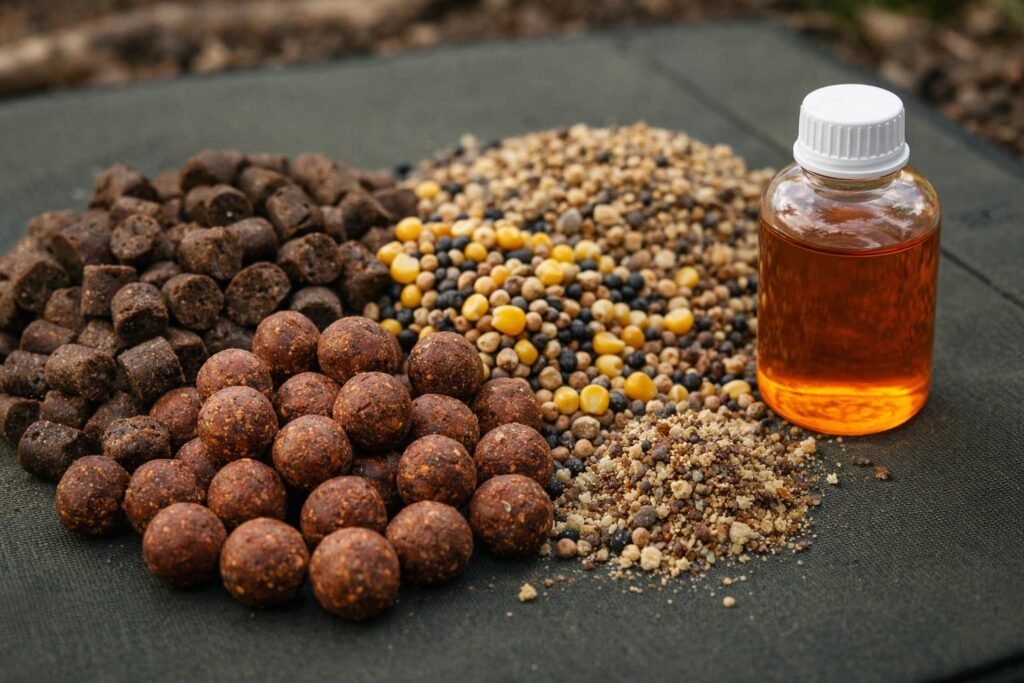
Not all oils are equal, and not all need to be used in the same way.
Fish Oils
Fish oils and salmon oil have been popular for years because they fit naturally with fishmeal and richer food baits.
Best use:
- warmer water
- richer food boilies
- stronger summer and early autumn baiting
Hemp Oil
Hemp oil makes sense because it fits well with seed-based and lighter bait ideas.
Best use:
- moderate inclusion
- seed mixes
- balanced bait, not overload
Nut Oils
Nut oils can be useful, but they need restraint. They are usually better as a subtle support than a headline ingredient.
Best use:
- warmer-water bait
- lighter support role
- hookbait coating only if used very carefully
Built-In Natural Fats from Ingredients
This is often the smartest route.
Many ingredients already bring some oil or fat naturally:
- egg
- fishmeal
- seeds
- nuts
- krill
- milk-derived ingredients
- pellets
That means you often do not need to add huge amounts of bottled oil on top.
Where Oils Fit Best
Food Boilies
This is where oils make the most sense. A proper food boilie can justify some oil because it is being built as a real long-term bait, not just a short-term attractor.
Summer Baiting
This is the best seasonal fit for richer oily bait. When carp are feeding hard, a more substantial bait makes sense.
Hookbaits
This is where oils are often overvalued. A hookbait usually benefits more from leakage, outer food signal, soluble treatment, and balance. A tiny oil role can be fine, but oils are rarely the main reason a hookbait works.
Particles
Particles already carry natural food value, and some also carry natural oil or fat. That means added oil should usually be modest. There is no need to drown particles in oil just because the bottle sounds good.
Pellets and Crumb
Pellets already contain oil in many cases. Additional oil should be used carefully. Too much can reduce the clean leak-off you actually want.
How Much Is Too Much?
This is where a lot of bait making goes wrong.
A little oil can support the bait.
Too much oil can:
- make the bait greasy
- reduce wake-up speed
- dull leakage
- make the mix harder to balance
- make the bait less suitable in cool conditions
That is why oils are one of those ingredients where “just a bit more” can quickly become a mistake.
In practical terms, once the bait starts feeling more oily than balanced, you have probably gone too far.
Signs a Bait May Be Too Oily
- it feels greasy in the hand
- it is slow to wake up in the water
- crumb and pellets feel sealed rather than active
- the bait seems rich but not lively
- you are relying on oil instead of proper attractor support
Oils and Leakage
This deserves its own short section because anglers often mix the two ideas up.
Oils are not usually what make a bait switch on quickly.
That quick wake-up normally comes more from:
- soluble liquids
- amino-rich components
- acids
- salts
- yeast extracts
- hydrolysates
- easy water penetration
If oil gets too dominant, it can reduce the very leakage you need.
That does not mean oils are bad. It means they belong in the food-value side of the bait more than the instant-activation side.
Best Practical Uses of Oils
If I were keeping this simple, I would use oils like this:
Spring
Very lightly, if at all.
Summer
Most confident use of oils.
Autumn
Moderate use, but begin reducing as water cools.
Winter
Minimal and restrained.
In Richer Boilies
Useful support.
In Quick Hookbait Traps
Usually not the first place I would look for an edge.
Michigan Notes
For Michigan carp anglers, the seasonal angle is everything.
Spring
In cold spring water, I would keep oils low. A bait that leaks well and stays easy to process makes much more sense than a heavy rich bait that still feels shut down.
Summer
This is where richer bait makes sense. If you are building a better boilie for a proper campaign, oils can have a role here as part of the food side of the mix.
Autumn
Autumn is a balancing season. Carp are still feeding well, but water temperatures are moving downward. This is where moderate richness often makes more sense than going full summer-heavy.
Winter
In very cold conditions, I would keep the bait simple:
- low oil
- high practical leakage
- easier hookbait response
- smaller baiting approach
On big Michigan natural waters, this often makes much more sense than trying to force rich baiting at the wrong time.
Common Mistakes
Thinking Oil Equals Attraction
It does not. Oil mainly supports food value and energy.
Using Summer Oil Levels in Spring
Very common mistake.
Overloading a Bait with Bottled Oils
A bait can quickly become greasy and sluggish.
Ignoring the Fat Already in Ingredients
Fishmeal, egg, seeds, and pellets may already be doing part of the job.
Letting Oil Replace Better Bait Thinking
Digestibility, structure, leakage, and confidence still matter more.
FAQ
Are oils useful in carp bait?
Yes, in sensible amounts and in the right conditions. They are most useful as a support for food value and energy rather than as a quick-fix attractor.
Do oils help in cold water?
Usually only in very modest amounts. In cold water, too much oil often works against the bait by making it feel slower and heavier.
Are fish oils better than plant oils?
Not automatically. Both can have a place. The bigger question is whether the oil level fits the bait and the season.
Is more oil better?
No. This is one of the clearest cases in bait making where more often becomes worse.
Should hookbaits be oily?
Usually not as a main idea. Hookbaits normally benefit more from leakage and soluble treatment than from oil richness.
Do oils belong more in boilies than in quick traps?
Yes, generally. Oils usually make more sense in richer food baits than in quick-response single hookbait approaches.
Next Steps
Read The Science of Carp Bait Digestibility
Read The Complete Science of Carp Feeding Attractants
Read Building a Better Boilie
Read Best Digestible Carp Baits for Cold Water