

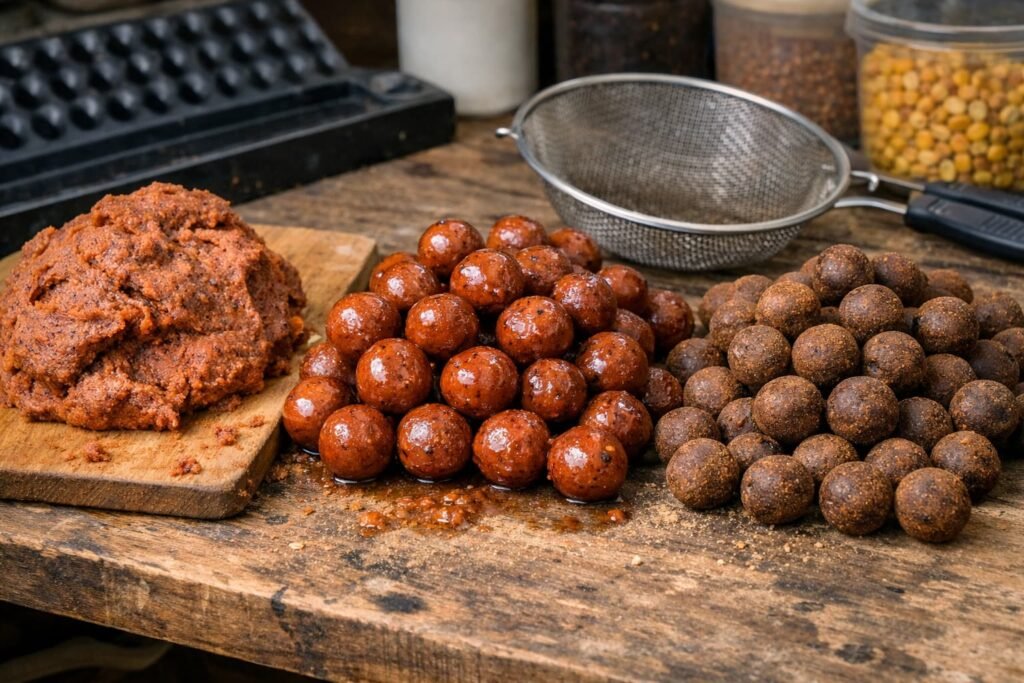
How Boiling Changes Carp Bait Digestibility
Boiling is not just a way to finish a boilie. It changes the bait.
It changes texture, hardness, moisture, leakage, and how easy the bait is for carp to process. That is why boiling time matters more than many anglers think. A boilie is not the same bait after boiling as it was when it was still soft paste. The structure tightens, the outer skin firms up, moisture shifts, and the whole bait starts behaving differently in the water.
This matters because carp bait is not judged only by how well it rolls or how firm it feels in your hand. It is judged by what it does in the water and by whether it still makes sense once a carp eats it. Boiling is one of the key stages where a good bait can stay good, or where a decent bait can become too hard, too sealed, and less useful than it should be.
For Michigan anglers, this is especially relevant because the same bait can behave very differently in April than it does in July. A boilie that is too heavily boiled may still be usable in warm summer water, but in spring it can easily become slow, tight, and less attractive than a more open bait.
Quick Start
- Boiling firms the bait and sets the structure.
- Too little boiling can leave a bait weak and unstable.
- Too much boiling can make it hard, sealed, and less useful.
- The aim is not maximum toughness. The aim is proper function.
- Overboiling often hurts leakage and digestibility.
- Colder water usually rewards a more open, more sensible bait.
What Boiling Actually Does
Boiling does a few important jobs all at once.
- It sets the outside of the bait.
- It helps the boilie hold its shape.
- It firms the structure so the bait can be dried and used practically.
- It changes how water gets into the bait later.
- It changes how quickly food signals come out.
That is why boiling is a balancing act. Without enough boiling, the bait may be soft, weak, and unreliable. With too much boiling, the bait may become tougher, tighter, and slower to wake up in the water.
In practical bait terms, the boil is not there to make the bait “as hard as possible.” It is there to set the bait enough to work properly while still leaving it useful as food.
Why Overboiling Is a Problem
A bait can become:
- too hard
- too dense
- too sealed
- slower to leak
- less comfortable as food
That may help nuisance resistance, but it does not automatically help carp fishing. In fact, many anglers accidentally make their bait less effective by chasing toughness instead of function.
A heavily boiled bait may still catch. Carp are adaptable fish. But there is a big difference between “a bait that still works sometimes” and “a bait that is working as well as it could.” If the boilie has been tightened too much, it may lose some of the very qualities that make it useful — especially in colder water or on cautious venues.
Why This Matters for Digestibility
This links directly back to the fact that carp have no true stomach.
Because carp do not rely on a strong acid stomach phase, bait still has to make sense once eaten. If the boilie is too hard, too heavily sealed, or too awkward in structure, it may still be eaten, but it becomes less sensible as food than a better-balanced bait.
Boiling does not automatically destroy digestibility, but overdoing it can certainly push the bait in the wrong direction. The practical lesson is simple: set the bait properly, but do not turn it into a stone.
Signs You May Be Boiling Too Long
A bait does not need to fall apart to be too heavily boiled.
Common signs include:
- the boilie dries very hard very quickly
- the outer skin feels sealed rather than open
- leakage seems slow
- the bait feels tougher than it needs to be
- the bait performs better after being crushed, soaked, or roughened up
This is one reason some anglers accidentally improve a bait after the fact with glugs, soaks, or corkscrew damage. They are often just reopening a bait that was made too tight in the first place.
The better answer is usually to get the boil right from the start.
The Right Mindset
Boil long enough to set the bait properly.
Do not boil so long that the bait becomes a hard little stone. That is the practical target. A bait should still feel like a bait, not a pebble.
Some anglers fall into the trap of thinking the hardest boilie is the best boilie. That usually comes from wanting a bait that survives casting, nuisance fish, and time in the water. Those things matter, but there is a point where durability starts hurting performance. The trick is getting enough firmness for practical use without sealing the bait so much that it stops behaving naturally.
What This Means for Different Bait Styles
Cold-water boilies
These usually benefit from a more open, less overdone boil. In cold water, leakage and sensible digestion matter more, so there is less reason to push the structure too far.
Warm-water food boilies
You can usually get away with a little more structure here, because the fish are feeding harder and processing food more effectively. Even so, there is still no reward for overcooking.
Hookbaits
Hookbaits often need to be practical and durable, but they still need to leak and behave properly. Too much firmness can still work against them.
Michigan Notes
In Michigan spring conditions, there is rarely much point making the bait harder than it needs to be. In cold water, a boilie that wakes up properly and still makes sense as food often gives you more than a hard, overbuilt bait.
On bigger Michigan waters, where confidence and bait suitability matter, a more sensible boil can help the bait feel more believable. In summer, you can get away with a little more structure, but even then there is no reward for overdoing it.
This is another area where Michigan anglers often do better by being practical rather than chasing the most extreme version of the bait.
Common Mistakes
Boiling for toughness rather than function
The bait needs to fish well, not just survive forever.
Treating longer boiling as automatically better
It often is not. Longer boiling can easily start working against leakage and usefulness.
Ignoring the ingredients
Different mixes respond differently. Some tighten quickly. Others stay more open. The boil should fit the mix, not follow some one-size-fits-all rule.
Using warm-water boil logic in spring
A bait that is fine in July can feel too much in April.
FAQ
Does boiling affect leakage?
Yes. Boiling changes how water gets into the bait and how quickly useful signals come out.
Can overboiling hurt a bait?
Yes. It can make the bait too hard, too sealed, and less useful in the water.
Should cold-water baits be softer?
Often yes, or at least less overdone. In cold water, a more open sensible bait usually makes more practical sense.
Does boiling destroy digestibility completely?
No. But too much boiling can certainly push the bait in the wrong direction.
Next Steps
Read The Science of Carp Bait Digestibility
Read Why Carp Have No Stomach and Why It Matters for Bait
Read Building a Better Boilie
Read Seasonal Baiting
.