
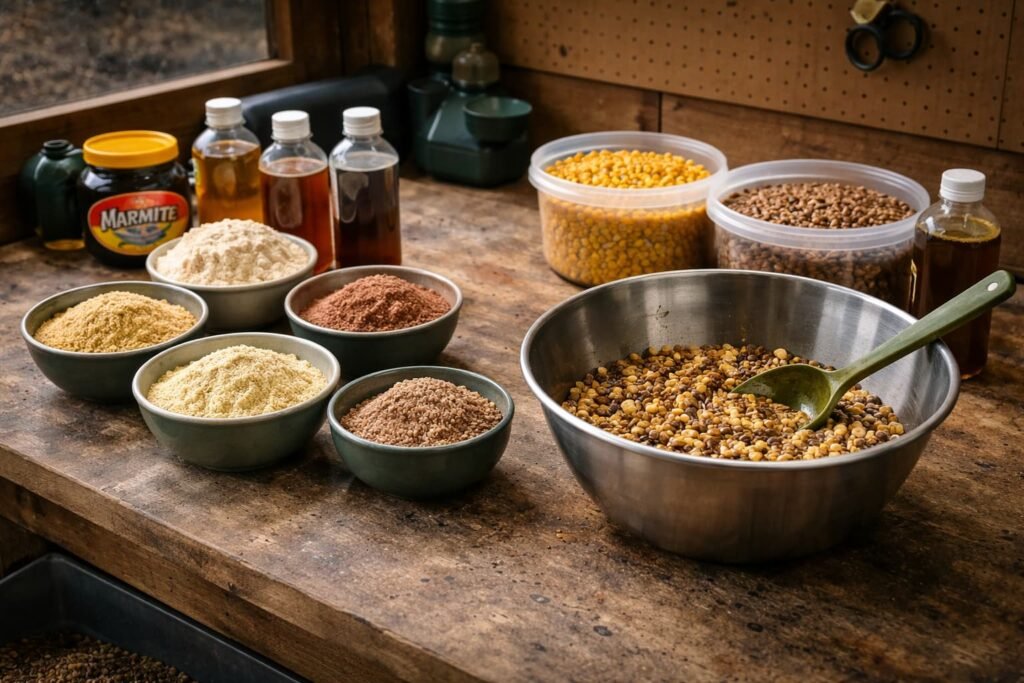
Carp Bait Guide

The Smart Angler’s Guide to Carp Bait

What the science really says, what the fish actually detect, and how to make better bait for less money. An in-depth feature for carp anglers who want to fish smarter, not just spend more.

Inside This Guide

• What carp actually detect
• Amino acids and feeding triggers
• How to read carp bait labels
• The real cost of carp bait additives
• DIY carp bait recipes
• Budget bait ingredient shopping list

common carp searching lakebed for food underwater

Introduction: The Bait Aisle Problem

Here is a moment every carp angler in America will eventually face. You walk into a tackle shop or open a bait company’s website, and you’re confronted with rows of bottles, tubs, and bags — each one promising to be the secret weapon that will transform your fishing. “Amino complex.” “Ultra attractant.” “Science-formulated feeding trigger.” The prices range from eyebrow-raising to genuinely startling. A small bottle of liquid might cost more per ounce than decent whiskey.

If you’re coming from European-style carp fishing, you already know this world. Over there, they call it the “carp tax” — a premium applied to any product the moment the word “carp” appears on the label. The same compound sold in a bodybuilding supplement store for fifteen dollars suddenly costs sixty when it’s packaged in a bait company’s branding.

Here’s the thing: American carp fishing is at an inflection point. The sport is growing fast, European techniques are crossing the Atlantic, and with them comes an entire ecosystem of specialist products. Some of those products are genuinely excellent and worth every penny. But some are, to put it diplomatically, the same basic compounds you can buy elsewhere for a fraction of the price. And a few are outright snake oil — products that sound scientific but have little or no basis in actual fish chemoreception research.

This article is not here to bash any specific company or product. There are bait companies doing excellent, science-informed work, and the convenience of a well-formulated, ready-to-use product absolutely has value. What this article IS here to do is arm you with the knowledge to make informed decisions. Once you understand what a carp actually detects in the water — the specific molecules, at what concentrations, through which sensory systems — you can evaluate any product on its merits. You can decide when the premium is justified, when a cheaper alternative delivers the same chemistry, and when something is just marketing dressed up as science.

I spent months reviewing peer-reviewed research papers, field studies, and aquaculture science to write this piece. Every claim in this article is traceable to published research. By the end, you’ll know more about carp bait chemistry than most of the people selling it to you.

Part 1: What A Carp Actually Detects

How Carp Detect Bait in Water

Carp detect specific dissolved chemicals in water rather than “flavors” as humans experience them. Their olfactory system senses amino acids and organic compounds leaking from bait at long range, while taste receptors on the mouth and barbels determine whether the bait is actually swallowed or rejected.

Before we can evaluate any bait product, we need to understand the hardware. A carp’s chemosensory system — its ability to detect chemicals in water — is one of the most sophisticated of any freshwater fish. It operates through two completely separate systems, and understanding the difference between them is the single most important concept in bait science.

The Nose: Long-Range Detection

A carp’s paired nostrils (nares) contain densely packed olfactory receptor neurons. These detect dissolved chemicals in the water column from a considerable distance — think of it as the equivalent of smelling dinner cooking from another room. The olfactory system is particularly sensitive to low-molecular-weight, water-soluble compounds. In practical terms, this means small, easily dissolved molecules that leak from your bait and disperse through the water. A 2009 review published in Environmental Chemistry by researchers at La Trobe University confirmed that carp olfaction operates primarily as a long-range food-detection system, with free amino acids being among the most potent stimuli.

For bait makers, this is your “drawing power” — the ability to pull fish toward your spot from a distance. Compounds that dissolve quickly and disperse widely are what drive this. Betaine, free amino acids, and certain organic acids are among the most effective.

The Mouth: The Decision Maker

Here’s where most anglers’ understanding breaks down, and where the science gets really interesting. A carp’s gustatory (taste) system is separate from its olfactory (smell) system. Carp have taste receptors not only in their mouth and pharynx but also on their barbels, lips, and parts of their body surface. When a carp picks up your bait, it’s not just feeling the texture — it’s running a rapid chemical analysis.

And here’s the critical finding: research by Kasumyan and Døving, published in Fish and Fisheries in 2003, demonstrated that although an attractive food odor increases a carp’s feeding motivation, it does NOT override taste preferences. In plain English: a bait can smell incredible and still get spat out if it tastes wrong to the fish. The olfactory system draws them in; the gustatory system decides whether they swallow or eject.

This means your bait needs to work on two levels. It needs water-soluble compounds that leak and disperse (for olfactory attraction), AND it needs to taste right once it’s in the carp’s mouth (for gustatory acceptance). Any product that only addresses one of these systems is only doing half the job.

Part 2: Amino Acids — What The Research Actually Found

Amino Acids for Carp Bait

Why are amino acids important in carp bait?

Amino acids are among the strongest chemical feeding triggers for carp. Research shows compounds such as L-cysteine, L-proline, L-alanine, and glutamic acid stimulate feeding behavior, while others may actually cause carp to reject food.

Amino acids are, by a wide margin, the most extensively studied chemical attractants for carp. If there’s one area of bait science that is genuinely well-established through rigorous peer-reviewed research, this is it. And the findings have profound implications for how you evaluate bait products.

The Landmark Study Every Carp Angler Should Know About

In 1996, researchers Kasumyan and Morsi at Moscow State University published a study in the Journal of Ichthyology that tested the taste sensitivity of common carp to 21 individual free amino acids and several classical taste substances. Using behavioral pellet-testing methods on carp yearlings, they categorized each compound as attractive, neutral, or deterrent. The results were striking:

  • L-Cysteine, L-Proline, L-Glutamic acid, L-Aspartic acid, L-Alanine, and L-Glutamine were all classified as highly attractive to common carp.
  • Citric acid and calcium chloride were also attractive classical taste substances.
  • Histidine, lysine, leucine, glycine, and several others were neutral — neither attracting nor repelling.
  • L-Tryptophan, L-Arginine, L-Threonine, L-Methionine, L-Phenylalanine, L-Serine, and L-Valine were all classified as DETERRENTS — they caused carp to reject food.

Read that last point again. Nearly a third of the amino acids tested actively repel common carp. This is not some minor finding buried in an obscure paper — it’s one of the most replicated results in fish chemoreception research, confirmed across multiple studies and species.

Why This Matters For Your Wallet

Now think about what this means when you look at a bait product label. When a company sells you an “amino acid complex” or “amino blend” without specifying which amino acids are in it, you have no way of knowing whether you’re paying for compounds that attract carp or compounds that repel them. A generic protein hydrolysate could easily contain more deterrent amino acids (tryptophan, methionine, phenylalanine) than attractive ones — especially if it’s derived from soy, wheat gluten, or casein, which are all high in those deterrent compounds.

The solution? Either buy products that list their specific amino acid composition, or — far more cost-effectively — buy the individual amino acids that the science identifies as attractive and add them yourself. This is exactly what we’ll show you how to do later in this article.

The “Big Six” Feeding Stimulants

In 1996, researchers Carr, Netherton, Gleeson, and Derby published a landmark cross-species analysis in Biological Bulletin. They analyzed tissue extracts from 30 species of marine organisms and correlated the chemistry with feeding stimulants known to work across 35 fish species. They identified six compounds that appeared as feeding stimulants in more than 20% of all species studied: glycine (80% of species), alanine (74%), proline (37%), arginine (37%), betaine (34%), and histidine (23%).

They also found that mollusc and crustacean tissue contains the highest natural concentrations of these compounds. This is not a coincidence — it’s why shellfish-based baits have worked for as long as people have been fishing. The chemistry explains the tradition.

Another critical finding: free amino acids are always more stimulating than peptides or proteins. Even a dipeptide made from two molecules of the same amino acid is less effective than the single free amino acid alone. This means that the most effective way to deliver amino acid attraction is through free, dissolved amino acid powders — not through intact proteins that need to be digested before the fish can detect them.

Part 3: How To Read A Bait Label And Spot The Markup

Armed with the science, let’s look at how to evaluate products critically. Here are the patterns to watch for.

Carp Bait Additives Explained

Are expensive carp bait additives worth it?

Some specialist carp bait additives are excellent products, but many contain the same basic compounds available from supplement or food sources at much lower prices. Carp respond to specific molecules like amino acids, betaine, and organic acids — not brand names. Understanding the chemistry behind bait helps anglers decide when a premium product is truly worth the cost.

Red flag #1: “Proprietary Blend” Or “Secret Formula”

If a product claims a “proprietary blend” without listing specific active compounds and their concentrations, you cannot evaluate it. The science on which compounds attract carp is not secret — it’s published in peer-reviewed journals. A company that knows its chemistry has no reason to hide it. Vague claims are often masking a simple (and cheap) formula behind marketing. This is not universal — some companies have genuinely novel formulations they protect. But it should make you ask questions.

Red flag #2: “Amino Acid Complex” Without Specifying Which Aminos

As we’ve established, some amino acids attract carp and some repel them. A generic “amino complex” is meaningless without knowing its composition. A blend heavy in L-Cysteine, L-Proline, and L-Alanine (attractive) is a completely different product from one heavy in L-Tryptophan, L-Methionine, and L-Phenylalanine (deterrent) — even though both can be truthfully labeled “amino acid complex.”

Red Flag #3: “Science-Backed” Without Citing Studies

The real peer-reviewed research on carp chemoreception comes from scientists like Kasumyan, Carr, Hara, Døving, and their colleagues. Their findings are publicly available. If a company claims “scientifically proven” but can’t point you to specific published studies, treat the claim with healthy skepticism. Real science is transparent.

Red flag #4: Flavors Marketed As Attractants

Here’s an important distinction: a carp doesn’t “smell” strawberry. It detects specific chemical compounds dissolved in water — esters, amino acids, sugars, organic acids. Some ester-based flavor compounds do have genuine attractant properties (butyric esters like scopex, for example, are chemically related to N-butyric acid, a proven fermentation signal). But many fruit flavors are primarily designed to smell good to humans. The fish responds to the amino acids, betaine, and organic acids underneath the flavor, not to the concept of “strawberry.”

This doesn’t mean flavors are useless. They can serve as a “signature” that helps carp associate a particular chemical signal with a safe, rewarding food source over time. And some contain genuinely active compounds. But the flavor is the icing, not the cake. Don’t pay premium prices for a fancy-smelling liquid that’s mostly solvent and food coloring with a tiny amount of actual attractant.

Red flag #5: Colored Liquids At Premium Prices

Adding red dye to a liquid doesn’t make it more attractive to carp. It makes it more attractive to anglers. There’s nothing inherently wrong with bait coloring, but don’t pay a premium for what is essentially food coloring added to a base liquid. The active chemistry underneath is what matters.

What Is Worth Paying For

Not everything is overpriced. Some specialist products are genuinely difficult to replicate at home and are worth the money. Genuine bloodworm-based products (like CC Moore’s Liquid Bloodworm Compound) contain actual whole bloodworm that you cannot easily source or process yourself. High-quality essential oils from reputable bait companies are properly sourced and tested for fish-safe concentrations. N-butyric acid in small, practical bottles is hazardous to handle in bulk. And genuine green-lipped mussel powder is expensive everywhere because the raw material is costly. The key is knowing WHICH products offer genuine, irreplaceable value versus which are repackaging cheap commodity compounds at a markup.

Part 4: The Real Cost Of Carp Bait Additives

Cheap Carp Bait Ingredients

This is where the numbers speak for themselves. The same pharmaceutical-grade compounds sold by specialist bait companies at premium prices are available from other industries — particularly the bodybuilding supplement industry, the aquaculture feed industry, and your local grocery store — at dramatically lower prices. The chemistry is identical. The molecules don’t know what label is on the bag.

4.1 Amino Acids And Supplements

The bodybuilding supplement company BulkSupplements.com (based in Henderson, Nevada) sells pharmaceutical-grade, cGMP-certified, third-party-tested amino acid powders in exactly the L-isomer forms the research identifies as effective for carp. They’re available on Amazon, Walmart, and their own website.

ProductBait supplier priceAlternative source & priceSavings
Betaine HCl powder$15–25 per 100g from specialist bait companies~$15 per 500g (1.1lb) from BulkSupplements on Amazon5–8x cheaper per gram
L-Cysteine HCl powder$8–12 per 50g from bait suppliers~$15–18 per 100g from BulkSupplements3–5x cheaper per gram
L-Proline powder$8–15 per 50g from bait suppliers~$18–22 per 500g from BulkSupplements5–10x cheaper per gram
L-Alanine powder$6–10 per 50g from bait suppliers~$12–15 per 500g from BulkSupplements5–8x cheaper per gram
L-Glutamic acid powder$8–12 per 50–100g from bait suppliers~$12–15 per 250g from BulkSupplements3–5x cheaper per gram
Taurine powder$6–10 per 50g from bait suppliers~$12–14 per 500g from BulkSupplements5–8x cheaper per gram

Important: One critical note: always buy the L-isomer form (L-Alanine, L-Proline, L-Cysteine HCl, etc.), not DL-forms or D-forms. Research by Barnard (2006) confirmed that L-amino acids are significantly more stimulatory to carp’s gustatory and olfactory systems than D-amino acids. BulkSupplements sells the correct L-forms — check the label to be sure.

4.2 Grocery Store Gold

Several of the most effective carp bait additives are sitting in your local grocery store at a tiny fraction of specialist prices.

ItemWhere to buyApprox. priceWhat it does in your bait
Citric acidWalmart baking aisle, Amazon~$5–8/lbConfirmed palatable taste for common carp in peer-reviewed research. Heat-stable. Preservative. The same compound bait companies sell at 5–10x markup.
Food-grade glycerinePharmacy, Amazon, Walmart~$8–12/qtGlug carrier. PVA-friendly. Holds amino acids in solution. Bait companies sell flavored glycerine at huge markup.
Blackstrap molassesGrocery baking aisle~$4–6/12ozNatural sugars, iron, minerals. Spod/method mix binder. Darkens bait. Trace amino acids.
MSG (Accent brand)Grocery spice aisle, Asian grocery~$3–5/lbPure monosodium glutamate — the sodium salt of glutamic acid. The dominant amino acid in sweet corn. One of the top carp attractants, available for pennies per session.
Condensed milkGrocery aisle~$2–3/tinMilk proteins + sugars. Creates milky cloud in water. Bait companies sell “milk protein liquid” at massive markup.
Vanilla extract (pure)Grocery baking aisle~$6–10/bottleContains vanillin. Widely successful in US carp angling on corn and dough baits.
Garlic powderGrocery spice aisle~$3–5/jarContains allicin — a proven feeding stimulant. Some bait companies sell “garlic extract” for $10+ per small bottle.
Turmeric powderGrocery spice aisle~$3–5/jarBright yellow dye + mild feeding stimulant. Natural bait coloring. Pennies per batch.

4.3 The Asian Grocery Store Secret

If there is one section of this article that could save you the most money per session, this is it. Asian grocery stores sell products that are chemically identical to premium bait additives, because the underlying food science is the same.

ItemWhere to buyApprox. priceWhat it does in your bait
Fish sauce (Red Boat, Squid brand)Asian grocery, Amazon~$4–6/bottleFish sauce IS hydrolysed fish protein. Made by fermenting whole fish with salt for 6–18 months. The resulting liquid is packed with free amino acids (especially glutamic acid), short-chain peptides, and organic acids. This is what bait companies sell as “enzyme-treated fish protein” at 5–10x the price. Buy brands with just “anchovy” and “salt” on the ingredient list.
Shrimp paste (belacan)Asian grocery~$3–5/blockFermented crustacean paste. Incredibly rich in free amino acids (glycine, alanine, proline, taurine) + betaine + organic acids. Dissolve a marble-sized piece in warm water for a glug base that rivals products costing 10x as much. The Big Six feeding stimulant chemistry in a $4 block.
Dried shrimp / krillAsian grocery~$5–8/bagGrind to powder in a food processor. Same chemistry as “krill meal” from bait suppliers. Rich in the Big Six feeding stimulants.
Oyster sauceAsian grocery~$3–4/bottleMade from oyster extracts. Oysters are molluscs — the group with the highest natural concentrations of betaine, glycine, alanine, proline, and taurine (Carr et al., 1996).
Miso pasteAsian grocery~$4–6/tubFermented soybean paste rich in free glutamic acid (umami) + organic acids. The fermentation converts bound proteins into free amino acids — exactly what the science says carp detect best.
Dried squid / cuttlefishAsian grocery~$6–10/bagGrind to powder. Rich in proline, taurine, glycine, betaine. Make your own squid extract by soaking ground squid in warm water overnight.

The fish sauce revelation: The fish sauce finding deserves special emphasis. High-quality fish sauce undergoes 6–18 months of natural enzymatic hydrolysis — the fermentation of whole anchovies. This is the same process used to create “enzyme-treated fish protein” or “hydrolysed fish protein liquid” in the bait industry. The end product contains the same free amino acids, the same short-chain peptides, and the same organic acids. A $4 bottle of Red Boat fish sauce from your Asian grocery delivers the same active chemistry as $15–25 of specialist bait liquid. Use it at 10–20ml per kg of base mix, or as a glug component.

4.4 Pet Food And Livestock Feed

ItemWhere to buyApprox. priceWhat it does in your bait
Koi pellets (Mazuri, Hikari, Tetra)Pet store, Chewy.com, Amazon~$25–30 per 20lb bagPre-formulated cyprinid (carp family) feed containing fish meal, betaine, spirulina (natural DMPT source), citric acid, and corn-derived amino acids. 30–40% protein. Grindable into boilie base mix. Dramatically cheaper than specialist carp pellets.
Chicken/Beef livers (raw, frozen)Grocery meat section~$2–3/lbLiver is one of the richest natural sources of glutamic acid, B vitamins, and iron. Blend raw livers to liquid, freeze in ice cube trays. Add 1–2 cubes to your egg mix when rolling boilies. Pennies per session vs $10+ for “liver extract.”
Spirulina powderHealth food store, Amazon~$10–15/lbNatural source of DMPT + protein + vitamins. Same product whether it’s labeled for smoothies or for bait.
Canned tuna (in water)Grocery aisle~$1–2/canDrain the water and use it as a fish protein liquid in glugs and method mixes. The tuna water is rich in free amino acids and costs almost nothing. The tuna itself can be mashed into method mixes.

The Koi Pellet Lesson

Here’s something worth thinking about with those koi pellets: notice that they contain no added flavoring whatsoever. No strawberry. No pineapple. No scopex. No tutti-frutti. Just fish meal, corn, soy, betaine, spirulina, citric acid, and vitamins. These pellets are the product of decades of R&D by Mazuri’s nutritionists, who work with zoos, universities, and aquaculture scientists to formulate feeds specifically for cyprinid fish — the family that includes carp and koi. They didn’t add a single flavor compound because the science told them they didn’t need to. The amino acids, betaine, and natural attractants in the base ingredients are what the fish respond to. That should tell you everything you need to know about the relative importance of “flavor” versus fundamental chemistry when it comes to what actually makes carp eat.

The bottom line: Decades of aquaculture R&D and millions of dollars in koi feed development have produced pellets that contain zero added flavor — just amino acids, betaine, fish meal, and natural attractants. The fish eat them eagerly. That tells you everything about where the real attraction lies. A flavor on top gives carp a unique chemical signature to follow through the water, and it can absolutely improve catch rates — but it’s a bonus layer on a foundation that already works, not a substitute for one that doesn’t. This is why getting your base mix right matters more than anything else in bait making. If the amino acid profile, the betaine content, and the protein sources are dialed in, you have a bait that will catch fish unflavored. Add a well-chosen flavor to that foundation and you’ll often catch more. But no amount of flavor will fix a base mix that’s built on the wrong chemistry.

4.5 Decoding GLM: What’s Actually In The “Magic” Ingredient ?

Why Green Lipped Mussel Works for Carp

What makes green-lipped mussel so effective

Green-lipped mussel powder is effective because it naturally contains high concentrations of free amino acids such as taurine, glycine, alanine, and proline. These compounds are among the strongest natural feeding stimulants for carp. Mussel tissue also contains betaine and omega-3 lipids that further enhance attraction.

If there is one ingredient in carp fishing that carries an almost mythical reputation, it’s green-lipped mussel powder (GLM). Originally from New Zealand, it commands premium prices from both bait companies and health supplement suppliers. Many bait makers consider it a cornerstone ingredient, and some anglers won’t fish without it. But what is it about GLM that makes it so effective — and can you get the same chemistry for less money?

To answer that, we need to look at what’s actually inside mussel tissue at the molecular level. Research on mussel biochemistry, including work published in Frontiers in Nutrition (2024) on blue mussel composition, and the Carr et al. (1996) cross-species analysis, tells us exactly what’s there.

The Chemical Profile Of Mussel Tissue

Green-lipped mussel powder is approximately 55% protein, 13.5% lipids (including omega-3 fatty acids), and 17% carbohydrates. But the raw numbers don’t tell the real story. What makes mussel tissue uniquely attractive to carp is its free amino acid profile — the dissolved, immediately detectable compounds that leak into water.

Research on mussel free amino acids consistently shows that taurine is the single most abundant free amino acid in mussel tissue, with glycine and alanine present in substantial quantities right behind it. Studies on mussel osmoregulation have demonstrated that betaine and alanine are present at extremely high concentrations, and that alanine, proline, and glycine account for most of the total amino acid pool. Carr et al. (1996) found that mollusc tissue contains four of the Big Six feeding stimulants — betaine, glycine, alanine, and proline — among its top six chemical components. This is exactly why the research ranks mollusc tissue as the highest-concentration natural source of fish feeding stimulants.

So the “magic” of GLM boils down to five key compounds:

  • Taurine — the most abundant free amino acid in mussel tissue. A potent olfactory stimulant for fish.
  • Betaine — present at extremely high concentrations. Mussels accumulate it for osmotic regulation. The #1 synergist for carp attraction.
  • Glycine — the most universal feeding stimulant across all fish species (80% of species in Carr’s study).
  • L-Alanine — the second most universal feeding stimulant (74% of species). Highly attractive to carp by both taste and smell.
  • L-Proline — a top-3 carp attractant. Abundant in shellfish tissue.

On top of these, GLM contains omega-3 fatty acids (EPA, DHA, and the unique ETA — eicosatetraenoic acid), glycosaminoglycans (GAGs), chondroitin sulfate, and a unique bioactive protein called pernin that is rich in histidine and aspartic acid.

What You Can Replicate — And What You Can’t

Here’s the honest breakdown. About 80–90% of GLM’s attractant effect for carp comes from the five compounds listed above: taurine, betaine, glycine, alanine, and proline. Every single one of these is available individually from BulkSupplements on Amazon at a fraction of GLM powder prices.

What you genuinely cannot replicate from other sources is the unique ETA omega-3 fatty acid (found almost exclusively in green-lipped mussels), the glycosaminoglycans, the pernin protein, and the specific way all these compounds coexist in the natural mussel matrix. There may be synergistic effects from the complete matrix that individual compounds don’t fully capture. That’s the honest argument for real GLM.

The GLM-Effect Blend: A Budget Alternative

This blend is designed to replicate the free amino acid and betaine profile of green-lipped mussel tissue using supplement-grade powders. It won’t contain the unique fatty acids or GAGs, but it delivers the core attractant chemistry that carp chemoreception actually responds to.

Makes approximately 100g of dry powder blend. Store sealed in a cool, dark place. Shelf life: 12+ months.

IngredientAmountPurpose / Notes
Taurine powder (BulkSupplements)30gThe most abundant free amino acid in mussel tissue. Potent olfactory stimulant. Use L-taurine form.
Betaine HCl powder (BulkSupplements)25gPresent at very high concentrations in mussel tissue (osmotic regulation). The #1 synergist for all other attractants.
Glycine powder (BulkSupplements)15gThe most universal fish feeding stimulant. 80% of all species respond to it.
L-Alanine HCl powder (BulkSupplements)12gThe second most universal stimulant. Highly attractive to carp.
L-Proline powder (BulkSupplements)10gTop 3 carp attractant. Abundant in natural shellfish tissue.
L-Aspartic acid powder (BulkSupplements)5gPresent in the unique GLM protein pernin. Highly attractive to carp (Kasumyan).
L-Glutamic acid powder (BulkSupplements)3gUmami signal. Present in mussel viscera and gonad tissue at high levels.

Method: Measure all powders and combine in a sealed container. Shake or stir thoroughly to distribute evenly. The blend is a fine, off-white powder.

Dosage: Use at 5–10g per 500g of boilie base mix (dissolve into your egg mix), or dissolve 5g per liter of glug/soak liquid. For particle soaks, use 8–10g per liter of soak water.

Cost comparison: The total cost of this 100g blend is approximately $8–10 using BulkSupplements powders. At the recommended dosage of 5–10g per 500g base mix, this gives you 10–20 batches of boilies. The equivalent amount of genuine GLM powder at typical bait supplier prices ($25–40+ per 500g bag, used at 50–100g per mix) would cost $50–80+ for the same number of batches.

The Smart Approach: Combine Both

The most cost-effective strategy isn’t to eliminate GLM entirely — it’s to use less of it. If you’re currently using 50–100g of GLM per 500g base mix, try cutting it to 15–20g (enough for the unique fatty acids, GAGs, and pernin protein you cannot get elsewhere) and making up the amino acid and betaine contribution with the GLM-Effect Blend at 5–10g. You get the irreplaceable mussel matrix compounds at a manageable cost, while the heavy lifting on amino acid attraction is done by supplement-grade powders at a fraction of the price. The fish gets the same chemical signal; your wallet takes a much smaller hit.

This same principle applies to any premium shellfish ingredient — krill meal, squid meal, shrimp powder. They’re all excellent because they naturally contain the Big Six feeding stimulants at high concentrations. But you don’t need to rely solely on expensive shellfish meals to deliver those compounds when the individual amino acids are available for pennies per gram from the supplement industry.

4.6 Decoding Robin Red: The Legendary “Secret” Ingredient

What Is Robin Red Carp Bait

What is Robin Red made from

Robin Red is a famous carp bait ingredient originally developed by Haith’s and widely used in boilie mixes. The modern formulation primarily contains capsicum (chili pepper), beet extract, sucrose, vegetable oil, and maltodextrin. The key active compound is capsaicin from chili peppers, which carp can detect quickly in water.

Robin Red is arguably the most famous single ingredient in the history of carp bait. Made by Haith’s of Grimsby, England, it has been responsible for catching untold thousands of carp since the 1970s. Its reputation is so entrenched that most bait companies include at least one Robin Red-based mix in their lineup. For decades, anglers speculated about its secret composition.

It turns out the secret is no longer a secret. The Haith’s trade site lists the composition of the current EU/UK natural version: capsicum, red beet extract, sucrose, vegetable oil, and maltodextrin. That’s it. The legendary Robin Red is a blend of chili pepper, beetroot powder for color, sugar, oil, and a starch carrier.

The active attractant? Capsaicin — the compound that makes chili peppers hot. Haith’s own blog confirms it: carp can detect capsaicin almost instantly, and they actively seek it out. The red beet extract adds color (carp do respond to visual cues, particularly red), the sucrose adds a sweetness signal, and the vegetable oil carries the capsaicin and aids dispersal. It’s a brilliantly simple formula, and Haith’s deserves credit for perfecting it. But the individual components are all grocery store items.

A budget approximation of Robin Red:

  • Hot paprika or cayenne pepper powder: provides the capsaicin. Paprika is milder and gives better color; cayenne is hotter with more capsaicin per gram. A blend of both works well.
  • Beetroot powder: available from health food stores or Amazon. Provides the deep red color. Use at about 10–15% of your Robin Red substitute.
  • Tomato powder: rich in lycopene (red pigment), natural glutamic acid (umami), and sugars. Adds color, body, and a genuine feeding-trigger amino acid. Available from grocery stores or Amazon.
  • Granulated sugar: simple sucrose. The sweet signal component.
  • Vegetable oil: any neutral oil. Carries the capsaicin and adds fat content.

DIY Robin Red: A blend of 35% hot paprika, 15% cayenne, 15% tomato powder, 10% beetroot powder, 10% sugar, and 15% vegetable oil (absorbed into the dry powders) creates a deep red, sweet, spicy powder that delivers the same active chemistry as Robin Red at a fraction of the price. The tomato powder pulls double duty — it adds color and body while also contributing natural glutamic acid, one of the top carp-attractive amino acids. Is it identical to Robin Red? No — Robin Red likely uses specific capsicum cultivars and precise ratios perfected over decades. But the core chemistry that carp respond to — capsaicin, color, sweetness, umami, oil — is the same. Use at 5–10% of your base mix, the same as Robin Red.

Fair credit: One important note: Robin Red is a genuinely good product and Haith’s is a company with deep expertise. The point here isn’t that Robin Red is a rip-off — it’s that understanding what’s in it empowers you to make informed decisions, experiment with your own blends, and recognize that the “secret” is accessible chemistry, not magic.

4.7 Freeze-Dried Beef Liver: The Pet Store Secret Weapon

This one comes from the clever lateral thinking of bait makers who’ve noticed that the pet food aisle contains some remarkable bait ingredients hiding in plain sight.

Freeze-dried beef liver treats for dogs are widely available at Walmart, pet stores, and Amazon. They’re typically single-ingredient products — 100% beef liver with no additives — processed by freeze-drying rather than heat-drying. This matters enormously for bait, because freeze-drying preserves the amino acid profile almost completely, while heat-drying (the method used for most commercial bait-grade liver powder) denatures proteins and reduces free amino acid availability.

The amino acid profile of beef liver is outstanding for carp bait. Per 100g of raw liver, it contains approximately 3,100mg glutamic acid, 2,290mg aspartic acid, 1,380mg alanine, 1,380mg glycine, and 1,140mg proline. Those are five of the six amino acids Kasumyan classified as highly attractive to common carp, and they’re the five most abundant amino acids in the ingredient. When freeze-dried, all the water is removed but the amino acids remain — so the powder is roughly 3–4x more concentrated than raw liver per gram. It’s also one of nature’s richest sources of B vitamins (especially B12), iron, and vitamin A.

How to use it: Buy a bag of freeze-dried beef liver dog treats ($8–15 for 4–14oz depending on brand), grind to a fine powder in a food processor, and you have a premium liver powder that is chemically identical — or superior, due to the gentler freeze-drying process — to “liver powder” sold by bait companies at a significant markup. Use at 30–60g per 500g base mix, or dissolve in warm water to create a liver extract liquid for glugs. I use one from Costco which is cheap and saves a lot of time messing around and having to cook it.

4.8 Krill Meal: Another Shellfish You Can Deconstruct

Krill meal follows exactly the same logic as GLM. Krill are tiny crustaceans, and crustacean tissue contains the same Big Six feeding stimulant chemistry as mollusc tissue — high concentrations of taurine, betaine, glycine, alanine, and proline. The Carr et al. (1996) analysis confirmed that crustacean extracts have four of the Big Six (glycine, betaine, arginine, and proline) among their top six components.

What krill meal adds beyond the amino acids is astaxanthin — the red-pink carotenoid pigment that gives krill (and shrimp, salmon, and flamingos) their color. Astaxanthin is a powerful antioxidant, and it does contribute to bait color, which has a minor but real visual attraction effect. However, astaxanthin is available as a standalone supplement powder from health food stores and Amazon.

The GLM-Effect Blend we formulated in section 4.5 already covers 80–90% of krill meal’s attractant chemistry, since it’s built on the same taurine-betaine-glycine-alanine-proline foundation that both mollusc and crustacean tissue share. If you want to replicate the color and antioxidant contribution of krill, add a pinch of astaxanthin powder (available as a supplement) or use the much cheaper paprika for a similar red-orange hue.

Similarly, dried shrimp from the Asian grocery store ($5–8 per bag) ground to a fine powder in a food processor delivers genuine crustacean-matrix amino acid chemistry at a fraction of specialist krill meal prices. It won’t be identical — krill and shrimp are different species with slightly different profiles — but the core Big Six chemistry is the same.

Can you make carp bait cheaper yourself?

Yes. Many of the most effective carp bait ingredients — including amino acids, betaine, and natural attractants — are available from supplement suppliers, grocery stores, or Asian food markets. By sourcing these ingredients directly, anglers can produce highly effective bait at a fraction of the cost of many specialist product

Part 5: DIY Carp Bait Recipes

Now let’s put the knowledge into practice. Here are three recipes built entirely on the science we’ve discussed, using the budget-friendly ingredients from the shopping list. Each one targets the specific amino acids and compounds that peer-reviewed research identifies as attractive to common carp.

5.1 The Master Glug: Your Universal Amino Acid Soak

This is the foundation of everything. One liquid that works across all your baits — boilies, particles, hookbaits, PVA bags. It delivers the amino acids the research identifies as most attractive, in their free, water-soluble form.

Makes approximately 1 liter. Store in the fridge. Shelf life: 3–4 months.

IngredientAmountPurpose / Notes
Warm water500mlBase solvent. Warm (not boiling) helps dissolve powders.
Glycerine, food grade (Pharmacy/Amazon)200mlCarrier liquid. PVA-friendly. Holds aminos in solution.
Molasses, blackstrap (grocery baking aisle)100mlNatural sugars + minerals. Adds viscosity for bait coating.
Betaine HCl (BulkSupplements, Amazon)15g (3 heaped tsp)The #1 synergist. Amplifies all amino acid signals.
L-Alanine (BulkSupplements, Amazon)10g (2 heaped tsp)Top 3 carp taste attractant. Olfactory + gustatory.
L-Proline (BulkSupplements, Amazon)10g (2 heaped tsp)Top 3 carp taste attractant. Abundant in natural prey.
L-Glutamic acid (BulkSupplements, Amazon)8g (1.5 heaped tsp)Umami signal. The dominant amino acid in sweet corn.
L-Cysteine HCl (BulkSupplements, Amazon)5g (1 tsp)THE most potent taste stimulant for carp. 100% acceptance in lab tests.
Fish sauce, high quality (Asian grocery)50mlPre-made hydrolysed fish protein. Packed with free amino acids.
Citric acid (grocery baking aisle/Amazon)3gPalatable classical taste substance for carp. Aids preservation.

Method: Dissolve all powders into the warm water first, stirring thoroughly. Add glycerine, molasses, and fish sauce. Shake well before each use.

Usage: Soak hookbaits for minimum 24 hours. For particles, add 50–100ml per kg. For boilie glugging, submerge for 12–24 hours then air-dry.

Cost: This liter of glug costs approximately $8–10 in ingredients and will last an entire season’s worth of hookbait preparation. The equivalent in commercial carp glug products would cost $60–100+.

5.2 Budget Particle Preparation: Sweet Corn

Sweet corn has the best natural amino acid profile for common carp of any readily available particle bait. Research from a 2024 field study on the Akhtuba River tested multiple boilie flavors on wild carp over 79 days, with sweet corn flavor dominating at 70–75% of the total boilie catch. Its effectiveness comes from its chemistry: it’s naturally rich in glutamic acid (the #1 amino acid in corn), alanine, and proline — three of the six amino acids Kasumyan classified as highly attractive.

Here’s how to make it even better:

  • Drain canned sweet corn. KEEP the liquid — it contains dissolved sugars and amino acids.
  • To the corn liquid, add per liter: L-Cysteine HCl (3g) + Betaine HCl (3g) + L-Proline (3g). These compensate for sweet corn’s main weakness: it’s naturally very low in cysteine, the single most potent taste attractant for carp.
  • Return the corn to this enhanced liquid. Refrigerate 12–24 hours.
  • For hookbaits: soak individual kernels in the Master Glug for 24+ hours.
  • For feed/spod: use the enhanced corn plus its liquid as-is.

Cost per session: Total added cost: approximately $0.50 per session. The science-backed amino acid correction turns a $1 can of grocery store corn into a hookbait that outperforms most commercial alternatives at any price.

5.3 Budget Particle Preparation: Tiger Nuts

Tiger nuts are the most popular hookbait particle in American carp fishing for good reason — they’re tough, durable, and carp love them. But their amino acid profile has a significant weakness: arginine is one of the most abundant amino acids in tiger nuts, and Kasumyan’s research classifies it as a deterrent for common carp. The good news is this weakness is easily corrected.

  • Soak raw tiger nuts in cold water for 24–48 hours. Boil 30–40 minutes until soft enough for a hook.
  • DO NOT discard the cooking water. Allow to cool, then add per liter: L-Cysteine HCl (5g) + L-Proline (8g) + L-Alanine (5g) + Betaine HCl (5g).
  • Leave the tiger nuts in this corrected liquor for 24–48 hours in the fridge.
  • OPTIONAL: Leave at room temperature for 3–5 days to deliberately ferment. The starch (25–40% of tiger nut content) ferments into organic acids including butyric acid derivatives. The sour, thick liquor that results is one of the most potent particle liquids you can produce.

The fermentation liquor: The fermented tiger nut liquor is not a waste product — it’s an asset. Use 50–100ml in your spod mix, method mix, or PVA bags. It delivers exactly the organic acid signals (butyric, lactic) that carp chemoreception is tuned to detect at parts-per-billion levels.

5.4 Budget Boilie: Koi Pellet Foundation Mix

Here’s a complete boilie recipe built around koi pellets as the base — delivering built-in betaine, citric acid, spirulina, and fish meal at a fraction of specialist ingredient costs. This makes approximately 60–80 boilies at 16–20mm.

Dry mix (500g total):

  • Ground koi pellets (Mazuri or similar): 150g — grind to fine flour in food processor
  • Semolina: 120g — primary binder
  • Soya flour: 70g — protein and binding
  • Dried ground shrimp (Asian grocery, ground to flour): 50g — Big Six amino acids
  • Egg albumin: 40g — hardener for casting durability
  • Maize flour: 40g — glutamic acid + alanine (sweet corn profile)
  • Garlic powder: 15g — allicin feeding stimulant
  • Turmeric: 15g — natural yellow color + mild attractant

Egg mix (per 500g dry):

  • 6 medium eggs, beaten
  • Betaine HCl: 5g — dissolve in eggs (heat-stable)
  • L-Cysteine HCl: 3g — dissolve in eggs (survives brief boiling)
  • Citric acid: 2g — dissolve in eggs (heat-stable)
  • Fish sauce: 10ml — free amino acid boost
  • Chosen flavor: 3–5ml — your preferred flavor top-note

Method: Combine egg mix into dry mix. Knead to smooth dough. Roll, boil for 60–90 seconds MAXIMUM, air-dry 18–24 hours. Then soak in the Master Glug for 24–48 hours to restore the free amino acids that boiling degrades.

Cost per batch: At these quantities, a batch of approximately 70 boilies costs roughly $3–5 in ingredients (excluding the one-time amino acid powder purchases that last all season). A comparable batch of premium commercial boilies would cost $15–30+. The chemistry is not just comparable — it’s specifically optimized using the science that most commercial formulas don’t account for.

Part 6: The Complete Budget Bait Shopping List

Everything you need to build a science-backed bait system for an entire season, with approximate prices as of early 2026. All items are available in the United States.

6.1 Amino Acids & Supplements — BulkSupplements.com

Available on Amazon, Walmart.com, or direct from BulkSupplements.com. Search the product name on your preferred retailer.

ItemWhere to buyApprox. priceWhat it does in your bait
Betaine HCl powder, 500gAmazon: search “BulkSupplements Betaine HCl 500g”~$15The single most important additive. Used in everything. Buy this first.
L-Cysteine HCl powder, 100gAmazon: search “BulkSupplements L-Cysteine HCl 100g”~$15The #1 taste attractant for carp. Small quantities needed per batch.
L-Proline powder, 500gAmazon: search “BulkSupplements L-Proline 500g”~$20Top 3 carp attractant. Can clump — dissolve in liquid first.
L-Alanine powder, 500gAmazon: search “BulkSupplements L-Alanine 500g”~$13Top 3 carp attractant. Olfactory + gustatory.
L-Glutamic acid powder, 250gAmazon: search “BulkSupplements L-Glutamic Acid 250g”~$13Umami signal. Dominant in sweet corn.
Taurine powder, 500gAmazon: search “BulkSupplements Taurine 500g”~$13The most abundant free amino acid in mussel/shellfish tissue. Key component of the GLM-Effect Blend. Potent olfactory stimulant.
Glycine powder, 500gAmazon: search “BulkSupplements Glycine 500g”~$12The most universal fish feeding stimulant (80% of species). Key component of the GLM-Effect Blend.

Total: approximately $101 for a full season’s supply of amino acids including the GLM-Effect Blend components. This quantity would cost $400–800+ from specialist carp bait suppliers — and that’s before you factor in the GLM powder savings.

6.2 Grocery Store Items

ItemWhere to buyApprox. priceWhat it does in your bait
Citric acid (food grade)Walmart baking aisle or Amazon~$6 per lbHeat-stable palatable taste signal.
Food-grade glycerineWalmart pharmacy or Amazon~$10 per qtGlug carrier. PVA-friendly.
Blackstrap molassesGrocery baking aisle~$5 per bottleSugars, minerals, binder.
MSG (Accent or Aji-no-moto)Grocery spice aisle or Asian grocery~$4 per lbPure glutamic acid salt. Cheap umami signal.
Condensed milkGrocery aisle~$2 per tinMilk proteins. Creamy clouding liquid.
Vanilla extract (pure)Grocery baking aisle~$7 per bottleSweet aromatic. Proven on US waters.
Garlic powderGrocery spice aisle~$4 per jarAllicin feeding stimulant.
Turmeric powderGrocery spice aisle~$4 per jarNatural yellow dye + mild stimulant.
Hot paprika + cayenneGrocery spice aisle~$4–6 eachCore capsaicin source for a DIY Robin Red substitute. See section 4.6.
Beetroot powderHealth food store or Amazon~$8–12 per lbDeep red color for DIY Robin Red. Also available as “beet root powder” supplement.
Tomato powderGrocery store, Amazon~$6–10 per lbRed color + natural glutamic acid (umami) + sugars. DIY Robin Red component.

6.3 Asian Grocery Store

ItemWhere to buyApprox. priceWhat it does in your bait
Fish sauce (Red Boat or Squid brand)Asian grocery or Amazon~$5 per bottleHydrolysed fish protein liquid. Look for 2-ingredient labels (anchovy + salt).
Shrimp paste (belacan)Asian grocery~$3–5 per blockFermented crustacean amino acid bomb.
Dried shrimpAsian grocery~$6 per bagGrind to powder for Big Six amino acids.
Oyster sauceAsian grocery~$3 per bottleMollusc-derived attractant chemistry.
Miso pasteAsian grocery~$5 per tubFermented umami. Free glutamic acid source.

6.4 Pet Food / Feed Store

ItemWhere to buyApprox. priceWhat it does in your bait
Mazuri Koi Pond Nuggets 20lbChewy.com, Amazon, pet stores~$28 per 20lb bagCyprinid feed with built-in betaine, citric acid, spirulina, fish meal. Grindable for base mixes.
Freeze-dried beef liver dog treatsWalmart, Amazon, pet stores~$8–15 per 4–14oz bagGrind to powder. 100% liver, freeze-dried = amino acids fully preserved. Richer in glutamic acid, aspartic acid, alanine, glycine, and proline than most bait-company liver powders. A hidden gem.
Frozen chicken/beef liversGrocery meat section~$2–3 per lbBlend to liquid. Rich in glutamic acid, B vitamins.
Spirulina powderHealth food store or Amazon~$12 per lbNatural DMPT source.

6.5 Total Cost Comparison

Let’s put this all together. Here’s what a full season’s bait-making supplies cost using the smart shopping approach versus buying everything from specialist carp bait companies:

CategorySpecialist bait suppliersSmart shopping
Amino acid powders incl. GLM-Effect Blend$400–800+~$101
Liquid additives & glugs$80–150+~$30–40
Pellet/base mix ingredients$100–200+~$50–70
Particle prep additives$40–80+~$15–25
SEASON TOTAL$620–1,230+~$196–236
SAVINGS $400–1,000+ per season

That’s not a typo. By sourcing the same compounds from supplement, grocery, and Asian grocery stores, you can save $400–1,000+ per season while using ingredients that are chemically identical to what the specialist companies sell. The fish cannot tell the difference between L-Proline from BulkSupplements and L-Proline from a bait company. They’re the same molecule.

Conclusion: Fish Smarter, Not Richer

The American carp fishing community is at a crossroads. As the sport continues its exciting growth, the inevitable influx of specialist products — both excellent and questionable — is accelerating. The decisions we make now about how we evaluate and purchase bait products will shape the culture of our sport for decades.

In Europe, the “carp tax” became so entrenched that many anglers simply accept paying premium prices as part of the hobby. But it doesn’t have to be that way here. We have advantages European anglers didn’t: the internet makes research accessible to everyone, the US supplement industry provides pharmaceutical-grade compounds at competitive prices, and our diverse grocery landscape — especially Asian grocery stores — puts world-class bait ingredients within reach of any angler willing to look beyond the tackle shop.

None of this means you should never buy a commercial bait product. There are companies doing genuinely innovative, science-informed work, and the convenience of a well-formulated, ready-to-use product has real value. What it means is that you should buy those products because you understand what’s in them and have decided the convenience or unique formulation is worth the price — not because marketing convinced you that there’s no alternative.

The science is clear. Carp detect specific molecules at specific concentrations through specific sensory systems. Those molecules have names, published research behind them, and prices that vary enormously depending on who’s selling them. Now you know the names, the science, and where to find them.

Here’s a thought worth sitting with: if you don’t know what’s in your bait, how do you know what’s working? When you catch well on a session, was it the base mix, the flavor, the amino acids, the presentation — or just the spot and the weather? And when you blank, what do you change? If you can’t answer those questions because the label on your bait just says “proprietary blend,” you’re fishing blind. Most of us know exactly what we feed our dogs. We read the label, we check the protein source, we compare brands. Yet those same anglers will tip a mystery liquid into their bait bucket without a second thought. That doesn’t add up. The best anglers in any discipline are the ones who understand their tools. A fly fisherman knows every fiber in his tie. A bass angler can tell you the exact action and rattle pattern of every crankbait in his box. Carp anglers deserve the same clarity about the single most important tool in our arsenal — the bait. We’re not asking companies to give away trade secrets. We’re asking for what every other food-producing industry already provides: an honest ingredient list. The anglers who know what’s in their bait are the ones who can adapt, experiment, improve, and ultimately catch more fish. The ones who don’t are just trusting a label. As the American carp scene matures, I believe transparency will become the standard — because the days of snake oil and secret formulas are coming to an end. Informed anglers make better customers, and better customers build a stronger industry for everyone.

Tight lines.

— Robert – MichiganCarp.com

Sources

Apart from my 50+ years of carp fishing and bait making in Europe and USA, which was used to investigate the science.

The science in this article draws from the following published studies. If you want to dig deeper into any of the claims we’ve made, these are the papers to look for:

Kasumyan & Morsi (1996) — Taste sensitivity of common carp to free amino acids and classical taste substances. Journal of Ichthyology, 36(5). The landmark study classifying which amino acids attract and which repel common carp.

Kasumyan & Døving (2003) — Taste preferences in fish. Fish and Fisheries, 4. The comprehensive review proving olfaction and gustation are independent systems in carp.

Kasumyan, Kuzishchin & Gruzdeva (2024) — Evaluation of the Effectiveness of Food Chemical Attractants for Wild Common Carp. Journal of Ichthyology. The 79-day Akhtuba River field study testing boilie flavors on wild carp.

Carr, Netherton, Gleeson & Derby (1996) — Stimulants of Feeding Behavior in Fish: Analyses of Tissues of Diverse Marine Organisms. Biological Bulletin, 190. The cross-species analysis identifying the “Big Six” feeding stimulants.

Elkins, Barrow & Rochfort (2009) — Carp chemical sensing and the potential of natural environmental attractants. Environmental Chemistry, 6(5). The Australian review of carp chemoreception mechanisms.

Murthy, Manai & Patil (2016) — Effect of Betaine Hydrochloride as Feed Attractant on Growth, Survival and Feed Utilization of Common Carp. J. Aquac. Mar. Biol., 4(3). The controlled trial proving betaine’s effectiveness specifically on common carp.

Barnard (2006) — Gustatory and olfactory responses in Japanese Koi carp. Doctoral research confirming L-amino acids are more stimulatory than D-amino acids for carp.

Hu et al. (2021) — The attractive effects of amino acids and some classical substances on grass carp. Fish Physiology and Biochemistry, 47. Behavioral and electro-olfactogram study of amino acid attractants in cyprinids.