

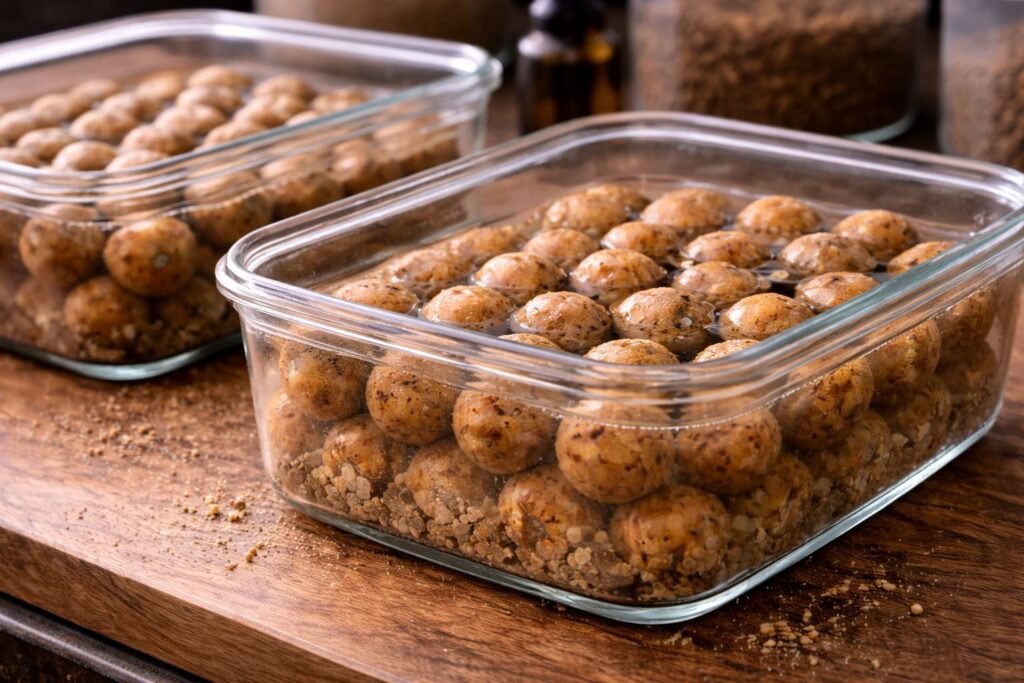
Osmosis, Water Movement, and Bait Breakdown
Every bait changes the moment it hits the water.
Some swell. Some soften. Some harden. Some leak hard for an hour, then go quiet. Some hold together far longer than you expected. Others collapse into mush.
Anglers usually describe all of that with loose words like “leakage” and “breakdown” without really explaining what is happening.
The main drivers are not mysterious. They are basic physical processes:
- water moving in
- dissolved signals moving out
- structure opening or tightening
- the bait slowly moving toward equilibrium with the lake
That means bait behaviour is not random.
Once you understand the basic mechanics, you stop guessing. You can start controlling how fast a bait swells, how hard it stays, how quickly it leaks, and how long it keeps working.
This page explains the science in plain English and shows what it means on the bank.
For the companion leakage article, read Why Some Carp Baits Leak Faster Than Others. For how heat changes bait structure before it even reaches the lake, read What Boiling and Heat Really Do to Carp Bait Ingredients.
Quick Start
- Water usually moves into the bait while soluble signals move out
- That is why a boilie can swell while also losing attraction at the same time
- Smaller, more soluble molecules leave the bait first
- Heavier, less soluble materials stay put much longer
- Boil time and drying change how tight the outer skin becomes
- Chopped bait, crumb, and porous bait forms leak much faster because they expose more surface area
- Salt, sugar, and other dissolved solutes can increase the pull of water into the bait
- Cold water slows everything down, which is why bait breakdown can look completely different in spring and autumn
Why Bait Changes Once It Hits the Water

A bait in water is not a fixed object.
It is a changing structure under pressure from the surrounding water.
The main processes are:
- osmosis — water moving into the bait
- diffusion — dissolved molecules moving out of the bait
- capillary action — water moving through pores and channels
- hydration — ingredients physically taking water on
All of these happen at the same time.
That is why a bait can seem to soften, swell, and leak all at once.
Osmosis in a Boilie: Why Your Bait Swells
Osmosis is the movement of water toward the area with more dissolved material.
In simple bait terms:
- lake water is usually a relatively dilute solution
- the inside of a fresh bait contains much higher concentrations of dissolved and partly dissolved material
- water moves inward toward that stronger internal concentration
That is one reason boilies swell over time.
The bait is not just “going soft.” It is actively taking water in.
This happens faster when the bait contains lots of dissolved or dissolvable content such as:
- amino acids
- salts
- sugars
- soluble milk proteins
- hydrolysates
- liquid foods
The stronger the internal concentration, the more strongly the bait tends to pull water in.
Diffusion: Why Your Bait Leaks
At the same time water is moving in, dissolved molecules are moving out.
That outward movement is what anglers usually mean when they talk about leakage.
Anything already dissolved inside the bait, or easily dissolved once wet, can move down its concentration gradient into the surrounding water.
That includes:
- free amino acids
- betaine
- sugars
- salts
- small peptides
- water-soluble vitamins
- some liquid-food fractions
- some flavours and acids
This is why leakage and swelling often happen together.
The bait is taking water in while also pushing soluble material out.
The Skin Effect: Why Boil Time Matters
The outer layer of a boilie matters enormously.
Boiling and drying create a firmer skin around the outside of the bait.
That skin acts like a barrier.
A thinner, looser outer layer:
- lets water in faster
- lets attractors out faster
- gives quicker early signal
- breaks down sooner
A thicker, tighter outer layer:
- slows water ingress
- slows diffusion
- keeps the bait tougher
- delays breakdown
- can make the bait go quiet too soon if overdone
This is why boil time matters so much.
You are not just “cooking the bait.” You are setting how open or tight the outer valve of the bait will be.
What Drives Breakdown Speed?
Breakdown speed is shaped by several things working together.
Molecular size
Small molecules leave the bait quickly.
Large molecules move much more slowly.
That is why:
- free amino acids and betaine leak fast
- small peptides leak fairly fast
- intact proteins leak very slowly unless they are already partly broken down
Solubility
Only the soluble fraction can really move.
A bait may be high in protein on paper, but if that protein sits in a slow, insoluble form, the bait can still be fairly quiet.
Temperature
Warm water speeds everything up.
Cold water slows everything down.
That means the same bait can behave like two different baits depending on season.
Surface area
A chopped boilie, crumb, or broken pellet exposes far more surface area than a whole boilie.
That is why broken bait nearly always talks faster.
Skin thickness and density
The tighter the skin and the denser the bait, the slower the exchange tends to be.
The Three Main Phases of a Bait in Water
Phase 1: Fast early signal
This is the strongest leakage phase.
The easiest-to-move solubles start leaving the bait quickly, and water starts moving in.
This is often the most important window in a short session.
Phase 2: Slowing but still active
The easy outer fraction has begun to wash out.
Water is further into the bait. The concentration difference is smaller. Leakage continues, but more slowly.
The bait often feels softer and larger in this phase.
Phase 3: Near equilibrium
Most of the easy signal has gone.
The bait has taken on more water, lost much of its most soluble content, and is now quieter.
What remains is the slower part of the bait.
This is the stage where a bait may still physically sit there but no longer say very much.
Why Some Baits Harden Instead of Softening
This catches a lot of anglers out.
A bait does not always get softer in a useful way.
Sometimes it gets:
- rubbery
- dense
- skin-heavy
- harder in the outer layers
- oddly gummy inside
This often happens when the bait has:
- too much egg protein
- too much starch
- too much drying
- too much casein or dense binder
- too long a boil
In other words, water may still be moving in, but the structure is not opening in a helpful way.
That can leave you with a bait that technically has absorbed water but still feels too hard and too quiet.
Capillary Action: The Hidden Part of Breakdown
Capillary action is one of the least discussed but most useful ways to understand bait texture.
A bait with pores, grain, texture, or tiny channels will often let water wick inward more quickly.
That means:
- birdfoods
- seed-rich baits
- coarse crumb
- chopped bait
- textured mixes
can often take water on faster and distribute it more deeply than a very smooth, dense bait.
That also helps explain why textured baits often feel more alive.
They are easier for water to move through.
Salt, Sugar, and Osmotic Pull
Salt and sugar do more than taste.
They also help shape water movement.
When dissolved salts or sugars sit inside a bait, they add to the internal pull for water.
That can:
- increase swelling
- support leakage
- sharpen the early phase of bait activity
- help move soluble material into the water
That does not mean more is always better.
It means these ingredients are part of the bait’s water-balance mechanics, not just part of its taste story.
Glugging and Soaking: Loading the Bait Back Up
When you soak a dried bait in liquid, you are reversing the direction of the concentration difference.
The soaking liquid is now the stronger phase, and the bait is the weaker one.
That lets the bait draw liquid inward.
This is why soaks work well on:
- dried hookbaits
- air-dried boilies
- shelf-life hookbaits
- wafters with open structure
It is also why deeply soaked baits often give a strong early burst once they hit the lake again.
They are now loaded with fresh soluble content that wants to move back out.
For the practical side of that, read How to Treat Boilies for Carp (Step-by-Step).
Michigan Notes
Michigan makes this topic especially practical.
Cold spring water slows breakdown a lot. A bait that works actively in July can stay much quieter in April.
That is why spring often favours:
- smaller baits
- chopped bait
- crumb
- short boil times
- lighter skins
- more soluble support
- glugged hookbaits or active outer layers
On big Michigan water, front-loading attraction often matters more than anglers think. A small amount of active bait can do more than a big pile of slow, quiet bait.
In warmer summer water, the breakdown clock speeds up. A bait that looks perfect in spring can become too soft or too washed out much faster once temperatures climb.
So on Michigan waters, the smart move is not just choosing a bait.
It is understanding how that bait will change over the session.
Common Mistakes
- boiling too long and sealing the bait up
- drying the bait too hard
- assuming swelling automatically means good leakage
- using very soluble ingredients without enough structure
- ignoring temperature
- forgetting how much faster chopped bait works than whole bait
- treating glugs as flavour only instead of as concentration loading
FAQ
Why do my boilies swell in water?
Because water is moving in while dissolved materials are moving out. That is normal.
Why do some baits go soft while others go hard?
Because ingredient structure, skin thickness, starch, protein, and drying all change how the bait absorbs water and releases solubles.
Does chopping bait really make that much difference?
Yes. Chopping exposes the interior and increases surface area, which speeds up both water ingress and signal release.
Why does the same bait work differently in spring and summer?
Because temperature changes diffusion, water movement, leakage speed, and the bait’s physical breakdown.
Is there an ideal breakdown rate?
Only relative to the session. A day session wants a very different breakdown profile from a two-night campaign.
Next Steps
Read these next: