


Many anglers ask what time carp feed, as though every lake follows the same clock.
It does not.
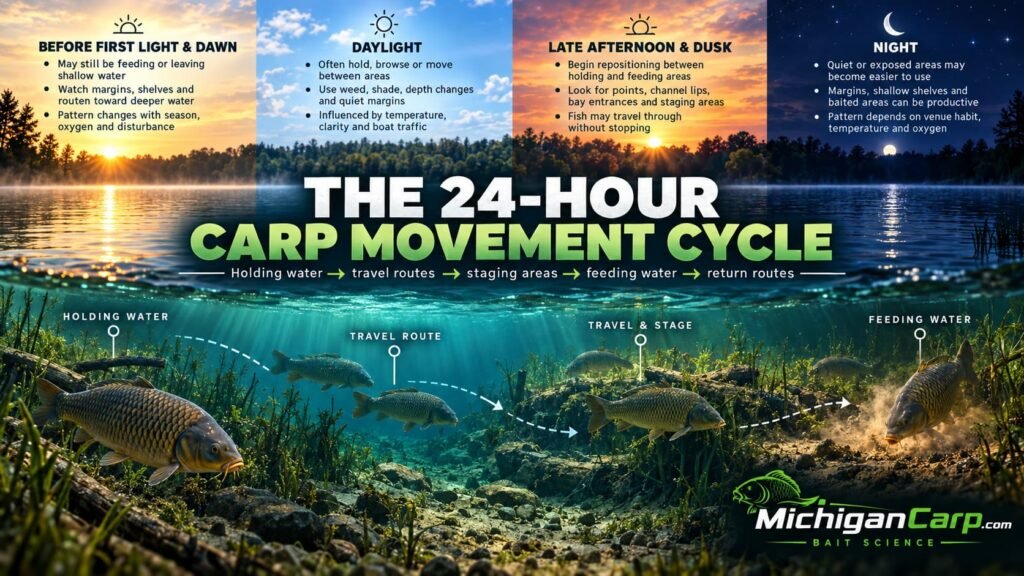
Carp can, however, develop surprisingly repeatable daily routines. They may spend several hours in secure holding water, follow a weed edge or depth change, pause beside a point or channel lip, move onto a feeding area and later return by the same route.
That is why understanding how carp move around a lake is more useful than simply knowing that somebody caught one at 7:30 p.m.
The important questions are:
Where were the carp before the bite?
How did they reach the feeding area?
Were they travelling or actually feeding?
Where were they likely to go next?
Once you begin thinking in those terms, dawn, daylight, dusk and darkness become parts of a movement cycle rather than fixed “best times.”
This guide looks at that 24-hour cycle and shows how I use it on Michigan lakes, bays, dam ponds, channels and harbors.
For the separate question of why several favorable conditions can combine to produce a short feeding spell, see Carp Bite Windows in Michigan. For the places carp use when they are not actively travelling, see Where Carp Hold During the Day.
Table of Contents
Quick Start: The 24-Hour Carp Movement Cycle
There is no universal carp timetable, but this is a useful starting model.
| Part of the day | What may be happening | Good water to watch | What can change the pattern |
|---|---|---|---|
| Before first light and dawn | Carp may still be feeding from the night or beginning to leave shallow water | Margins, shallow shelves, bay mouths, weed edges and routes toward deeper or safer water | Cold nights, oxygen, disturbance or an earlier feeding spell |
| Morning and full daylight | Fish may hold, browse, warm up, use cover or move between areas | Weed, shade, reeds, depth changes, quiet margins and wind-affected water | Season, clarity, water temperature, boat traffic and natural food |
| Late afternoon and dusk | Carp often begin repositioning between holding and feeding water | Points, channel lips, weed-line ends, bay entrances and staging areas | The fish may travel through without stopping |
| Night | Quiet or exposed feeding areas may become easier for carp to use | Margins, shallow shelves, soft silt, baited areas and established patrol routes | Venue habit, temperature, oxygen, weather and human disturbance |
The basic movement sequence I am looking for is:
holding water → travel route → staging area → feeding water → return route
Not every carp completes that exact circuit. A fish may feed close to its daytime holding area, remain in one productive zone for hours or make several movements during a single day.
The value of the model is not that every carp must follow it.
The value is that it makes you look for connections between areas rather than treating every productive spot as an isolated location.
What Daily Carp Activity Really Means
Biologists often use the word diel to describe behavior occurring over a 24-hour day-and-night cycle.
For anglers, the important part is the relationship between time, location and behavior.
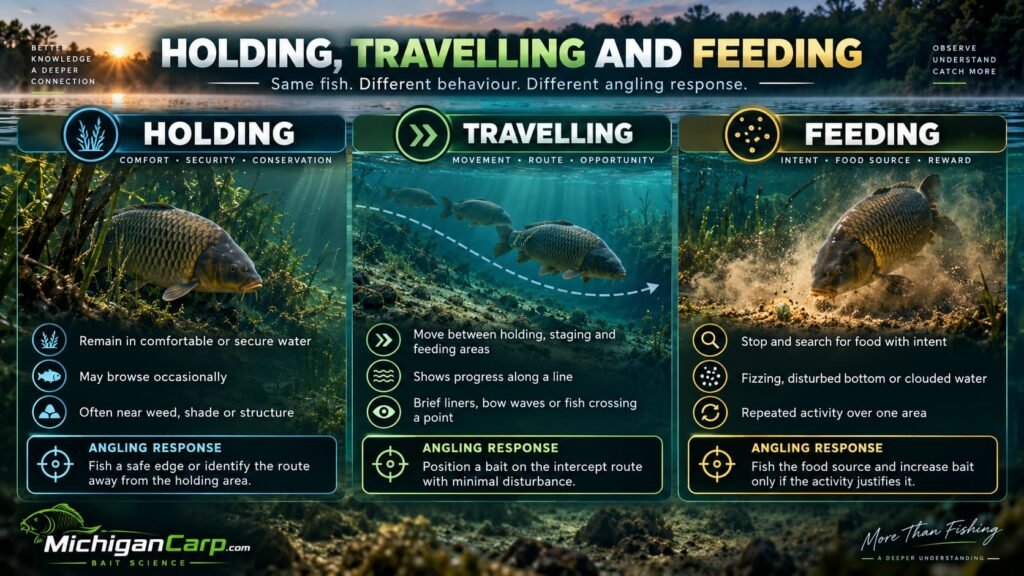
A carp can be active without feeding.
It may travel several hundred yards, roll on the surface, pass through your swim and continue without picking up a bait. Another carp may barely move while feeding heavily on a concentrated natural-food bed.
That distinction is extremely important.
| Carp behavior | What is happening | What you might see | Best angling response |
|---|---|---|---|
| Holding | Fish remain in comfortable or secure water and may browse occasionally | Repeated shows in one area, slow cruising, fish close to cover | Fish a safe edge or identify the route away from the holding area |
| Travelling | Fish move between holding, staging and feeding areas | Shows progressing along a contour, brief liners, bow waves or fish crossing a point | Position a bait on the intercept route with minimal disturbance |
| Feeding | Carp stop and search for food with intent | Fizzing, disturbed bottom, tails, clouded water or repeated activity over one area | Fish the food source and increase bait only if the activity justifies it |
One of the biggest mistakes in carp fishing is assuming that a showing carp must be a feeding carp.
It may simply be travelling.
That is why a sequence of observations is usually more valuable than one spectacular jump.
If you want to identify genuine feeding activity, see Signs Carp Are Feeding.
Carp Do Not Follow One Universal Daily Clock
Research supports the idea that carp can develop clear daily movement patterns, but it also shows why those patterns should never be turned into universal rules.
In a 19-month ultrasonic-telemetry study of carp in a regulated reservoir, Benito and colleagues recorded a clear warm-season day-and-night pattern. Tracked carp tended to occupy shallower water during the day and deeper positions with lower activity at night.
The pattern became much weaker during colder periods, and individual fish did not all behave identically.
Another acoustic-telemetry study produced a very different local result. Zhang and colleagues recorded common carp more frequently at night in the Pearl River, with fish using shallower water nearer the riverbank. Temperature, discharge and water level also affected their habitat use.
For an angler, the important lesson is not which study is “right.”
Both are useful.
They show that statements such as “carp always go shallow at night” or “carp always feed at dawn” are too simple.
Water type, temperature, flow, season, oxygen, natural food, cover, disturbance and individual fish behavior can all change the daily pattern.
The job is therefore to learn the clock of the water you are fishing rather than carrying a fixed clock from one lake to another.
How Carp Move Around a Lake Over 24 Hours
A full daily cycle is easier to understand if we follow the fish from one period to the next.
Before First Light and Dawn
Dawn is often treated as the beginning of carp activity.
Sometimes it is actually the end of it.
Carp that have spent the night feeding in quiet margins, shallow bays or exposed food areas may still be there when the sky begins to brighten. Other fish may already be leaving and heading toward weed, depth, shade or some other form of security.
That explains why two apparently identical dawn sessions can produce completely different results.
On one morning you arrive while carp are still feeding.
On another, you arrive while they are travelling away.
On a third, the useful movement may already be over.
Instead of simply thinking “dawn is good,” look at the direction of activity.
A series of shows moving away from a shallow bay tells you far more than the fact that those shows occurred at sunrise.
Also remember that oxygen does not automatically peak at first light. In heavily vegetated or algae-rich water, overnight respiration can reduce dissolved oxygen before dawn.
When hot weather, heavy weed or stagnant conditions are involved, Dissolved Oxygen and Carp Fishing becomes part of the location decision.
The Morning Transition
After sunrise, some carp may remain on productive feeding water while others begin to leave.
This is often when a travel route becomes more valuable than yesterday’s feeding spot.
Watch features that connect one type of water to another:
bay mouths, points, channel lips, weed-line ends, inside corners and depth changes.
If rolls or surface signs gradually progress along the same line, you may be watching a route.
The same applies to liners.
If activity disappears from one rod and begins appearing on the next rod along a contour, the fish may not have stopped feeding because of some mysterious change in appetite.
They may simply have moved.
Late Morning and Midday
Midday is often dismissed as dead time.
That is a mistake.
Whether the middle of the day is productive depends heavily on season, water type, weather and human activity.
During spring, sunshine can steadily warm a protected dark-bottomed bay. That bay may actually become more attractive several hours after sunrise.
During summer, the opposite can happen. A shallow, clear margin may become uncomfortable as light levels increase and swimmers, boats or bank traffic arrive.
Colored water, wind ripple, shade, healthy weed and deeper margins can keep carp active well into bright daylight.
Some of the best daytime feeding can also be difficult to see from the bank. Carp feeding around weed, docks, shaded margins or deeper edges may give away very little.
Use Carp Water Temperature Guide for Michigan Lakes when deciding whether sunshine is making an area more attractive or pushing carp toward cooler and more stable water.
Late Afternoon and the Approach to Dusk
Evening movement can begin long before it looks like evening to us.
Carp may leave secure daytime water and begin working toward a feeding area while the sun is still well above the horizon.
This is where staging areas become important.
A staging area is somewhere carp pause or gather before moving onto another area. It may be an outside weed edge, a point, the entrance to a bay, a shelf, channel edge or harbor mouth.
The fish do not necessarily feed there.
You may see several carp roll or pass through and get no bites whatsoever.
That does not make the observation useless.
It may tell you exactly where the carp will approach from later.
This is also one of the worst times to create unnecessary disturbance.
If I believe an evening route is about to become active, I would rather have the rods positioned, hook points checked and landing equipment ready before the fish arrive than repeatedly cast into the route while they are approaching.
Dusk
Dusk can bring several changes together.
Light levels fall.
Boat and bank activity may decrease.
Exposed margins become less intimidating.
Shallow feeding areas may become accessible.
What matters, however, is not darkness itself.
It is what the changing conditions allow the carp to do.
Fish may move onto shallow shelves, soft silt, weed holes, margins, marina edges or established baited spots.
But they may also travel straight through a visually attractive area because somewhere farther along the route offers better food or greater security.
That is why a bait positioned on the approach can sometimes outperform one placed in the middle of an obvious feeding area.
If you receive a liner, hear a roll or see reeds begin to move, treat it first as information.
Do not automatically answer every sign with another cast and another handful of bait.
Night and After Midnight
Night can open water that carp are reluctant to use during a busy summer day.
Margins, shallow flats, harbor edges and exposed feeding areas can all become more useful when disturbance falls.
There is also evidence that local night-feeding routines can be learned.
Research in Minnesota found that carp conditioned to feeding sites repeatedly returned from other parts of the water. Later work recorded baited feeding aggregations occurring mainly at night. See Hundt and colleagues.
That is useful evidence for the ability of carp to develop a repeatable local routine.
It does not mean every lake should be fished at night.
Some waters produce soon after dusk.
Others develop an after-midnight period.
Another may come alive shortly before dawn.
Some produce very little at night.
The difference between a pattern and coincidence is repetition.
One carp caught at 2:00 a.m. tells you what happened once.
Several comparable sessions showing carp entering the same area around the same phase of the night begins to tell you something useful.
Before fishing after dark, know your casting lines, snags, landing area and access route before you need them.
Also check both the current Michigan fishing regulations and the rules governing the particular access site. Michigan DNR notes that most state-sponsored boating access sites are posted closed from 11 p.m. until 4 a.m. unless otherwise posted.
Being allowed to fish a water does not automatically mean every piece of shoreline provides legal overnight access.
Movement Windows and Feeding Windows Are Not the Same
This is one of the most useful distinctions in the whole article.
A movement window is a period when carp are repositioning.
A feeding window is a period when they stop and feed with enough confidence to create a good angling opportunity.
The two can overlap, but they do not have to.
Imagine an evening pattern where carp leave daytime cover, follow an outside weed line, pass a point, pause near a bay entrance and finally move onto a shallow feeding shelf.
A bait beside the weed line may produce an interception bite.
A bait on the point may produce another.
The feeding shelf may remain completely quiet until the fish finally reach it.
All three rods are fishing the same daily movement, but they are fishing different stages of it.
This also explains why a feeding spot can appear dead immediately before it becomes productive.
The carp have not arrived yet.
Conversely, a previously productive area can remain baited perfectly and still become useless once the fish have left.
For a deeper look at the conditions that can create a short feeding opportunity, see Carp Bite Windows in Michigan.
How Water Type Changes the Daily Pattern
Carp movement cannot be separated from the shape and character of the water.
Shallow, Weedy Inland Lakes
Distances may be relatively short, yet the daily changes can be strong.
Carp may spend part of the day in weed, lily pads, reeds or shaded water before moving onto clean holes, margins and softer food-rich bottom.
During spring, warming water can create excellent afternoon movement.
During high summer, weed condition, oxygen and boat traffic may make quieter periods much more important.
Large Natural Lakes and Great Lakes Bays
On larger water, holding areas and feeding grounds may be separated by considerable distances.
A group of carp appearing in an inner bay at dawn may have travelled a long way overnight.
A wind change may then alter that route completely.
Rather than trying to understand the entire lake at once, divide the movement into zones:
outer route → bay entrance → staging area → feeding area
On big water, the direction the carp are travelling can be more useful than the exact time they passed you.
Dam Ponds, Channels and River-Connected Water
Flow and water-level changes introduce another variable.
Carp may use channel edges, slacks, flooded margins, points and low-current refuges differently as discharge changes.
On this type of water, a movement that appears to be caused by daylight may actually have been triggered by changing current or water level.
A rain event or change in dam operation can sometimes matter more than the clock.
Harbors, Marinas and Built Structure
Human activity can create an extremely obvious daily timetable.
Carp may spend busy periods around shade, dredged depth, riprap, pilings or other secure structure and then move through harbor entrances or outer edges as activity decreases.
The safest interception point is often outside the heaviest structure rather than directly inside it.
For a dedicated approach to these areas, see Man-Made Structures for Carp Fishing.
How Season Resets the 24-Hour Cycle
A useful daily pattern in May may tell you very little about the same lake in August.
Season changes the temperature, daylight, weed growth, natural food, oxygen, recreational pressure and available cover.
The carp respond accordingly.
Spring
A cold spring night can make dawn one of the least attractive periods.
Protected shallow water may improve steadily through late morning and afternoon as sunshine raises the temperature.
The daily route can therefore run from deeper, more stable water toward warming shallows before reversing as those shallows cool again.
Summer
Low-light periods can become increasingly useful, particularly on clear or busy waters.
But “summer means night fishing” is still too simple.
Wind, cloud, healthy weed, shade, natural food and comfortable oxygen levels can all support good daytime feeding.
Fall
Cooling water, shorter days, declining boat traffic and dying weed can alter routes that were reliable throughout summer.
Carp may remain on productive food for longer under stable conditions, while other groups abandon shallow summer routes as cover disappears.
Cold Water
Movement often becomes more limited and useful feeding periods may become shorter.
Location and stability become increasingly important.
Instead of forcing a dawn, dusk or night rule onto the water, find where the fish are comfortable and look for the shorter periods when they begin moving or feeding.
For the larger seasonal picture, see Seasonal Carp Movement in Michigan.
How to Map a Lake’s Daily Carp Pattern
You do not need telemetry equipment to learn a carp lake.
You need repeated observation and enough discipline to record what actually happened rather than what you expected to happen.
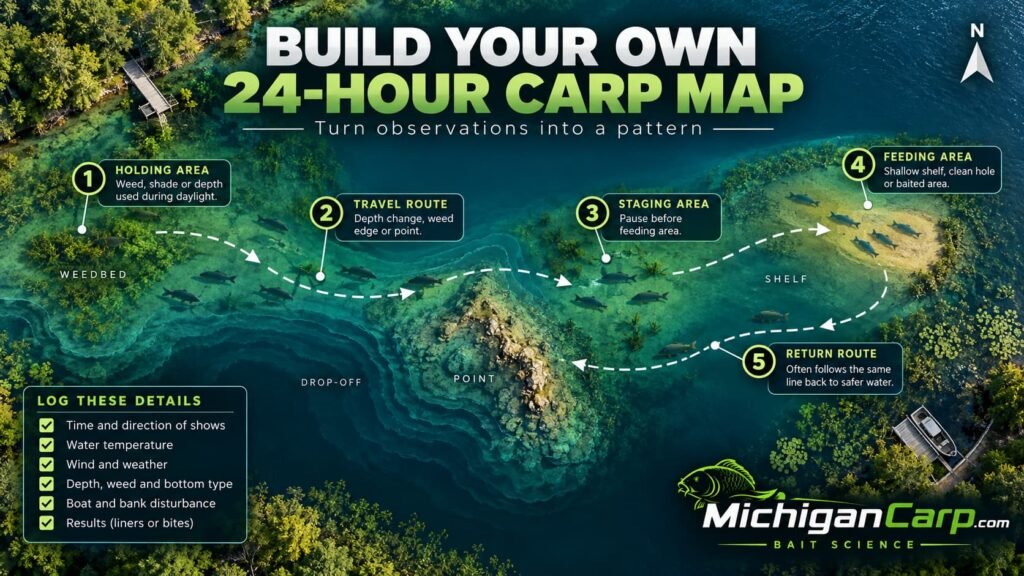
During comparable sessions, record:
- first and last light; exact times of shows, liners and bites; location and direction of moving fish; whether the behavior appeared to be holding, travelling or feeding; water temperature and recent temperature trend; wind direction and strength; cloud, clarity and surface conditions; boat and bank disturbance; depth, weed, cover and bottom type; and when and how much bait was introduced.
A simple log might look like this:
| Time | Location | Observation | Conditions | Result |
|---|---|---|---|---|
| 5:45 a.m. | Inner weed edge, 6 ft | Two rolls travelling toward point | Calm after cool night | One liner |
| 7:10 a.m. | Point and outside edge, 9 ft | Several shows following same line | Light south wind beginning | One bite |
| 2:30 p.m. | Protected bay, 4 ft | Clouded water and tails | Spring sunshine; warmer than morning | Two bites after light baiting |
One result gives you a clue.
Repeated results under comparable conditions begin to give you a pattern.
Track Direction, Not Just Location
If you see a fish roll, remember where it appeared.
Then look for the next sign.
If another fish appears farther along the same weed line, channel edge or shoreline, you may be seeing a route rather than two unrelated shows.
Liners can reveal the same thing.
So can moving bubbles, disturbed reeds, pad movement or activity beginning at the mouth of a bay before appearing farther inside it.
The direction matters because eventually it allows you to get ahead of the carp.
That is far more useful than repeatedly casting at the place where you last saw one.
Test the Pattern Carefully
Once you think you have identified a route, avoid destroying it while trying to prove yourself right.
One carefully positioned rig may tell you more than repeated marker casts and heavy baiting.
If the same line produces during a similar phase on several sessions, begin testing the edges of the window.
Arrive earlier.
Place a bait on the route before the feeding ground becomes active.
Record when the movement begins and when it stops.
Eventually you may be able to predict not merely when bites occur, but where the carp should appear before the first bite happens.
Building a Three-Rod Session Around Carp Movement
Rather than putting three rods at three arbitrary distances, I prefer to give each rod a job.
| Rod | Job | Typical position |
|---|---|---|
| Rod 1 | Cover the safe edge of the fish’s current holding area | Outside weed, edge of shade, depth beside cover |
| Rod 2 | Intercept travelling carp | Point, channel lip, weed-line end or bay mouth |
| Rod 3 | Cover the likely feeding destination | Shallow food shelf, clean weed hole, soft silt or established baited area |
That gives me information even when I am not catching.
If the holding-edge rod produces early but later liners begin appearing on the route rod, the fish may be moving.
If the destination rod then becomes active, I have learned far more than I would from three rods scattered randomly across the lake.
Safety always overrides the theory.
I will not put a “holding-water rod” into severe snags simply because carp are present there. The useful position is often the safe edge of the holding area, where a hooked carp can still be controlled.
Baiting should also match the job.
A route normally needs enough attraction to make a passing fish investigate, not a huge carpet of bait across the entire travel line.
A feeding destination can justify more bait once repeated activity proves that carp are stopping there.
When a known window is short, the most important thing may simply be having everything prepared before the fish arrive.
If bites normally occur around dusk, I want to understand what happens during the hour or two before dusk, not arrive at the historical bite time and start casting.
My Practical MichiganCarp View
After more than 50 years of carp fishing, I do not believe there is one best time of day that can be carried from lake to lake.
I have caught carp at first light, through bright daytime conditions, at dusk and during the night.
I have also watched the productive time on a water change with season, wind, water temperature, boat traffic and the routes the fish were using.
Some waters can eventually seem almost clockwork.
But that clock has to be learned.
It cannot be imposed on a lake because somebody once said that carp feed at dawn or move shallow after dark.
For me, the less useful question is:
What time do carp feed?
The better question is:
Where will these carp move next, and what will make them stop when they get there?
That change in thinking turns a bite time into a watercraft pattern you can actually test.
Common Mistakes When Reading Daily Carp Movement
| Mistake | Why it causes problems |
|---|---|
| Treating dawn or dusk as a guarantee | Good light conditions cannot compensate for being where there are no carp |
| Assuming carp always go shallow at night | Local telemetry studies show that depth patterns can differ greatly between waters |
| Confusing showing fish with feeding fish | Travelling carp may roll, line you up and continue without stopping |
| Staying on yesterday’s feeding spot | A productive night area may be empty several hours later |
| Creating disturbance during a transition | Recasting and leading around can interfere with the route you are trying to intercept |
| Using one pattern throughout the year | Temperature, weed, food and disturbance change the daily cycle |
| Recording bite times without conditions | “8:15 p.m.” means very little without location, direction, weather and fish behavior |
The common theme is simple.
Time becomes useful only when it is connected to place and behavior.
FAQ
What Is the Best Time of Day to Catch Carp?
There is no universal best time.
Dawn, dusk and darkness can all be productive, but spring afternoons, windy daytime periods or quiet midday conditions may be better on another water.
The best time is the repeatable period when carp reach catchable feeding water under the conditions you are actually fishing.
Do Carp Feed All Night?
They can, but they do not necessarily feed continuously from dusk until dawn.
Many waters produce shorter feeding periods soon after dark, later in the night or shortly before first light.
The important distinction is whether carp are actually feeding or simply travelling through the area.
Do Carp Always Move into Shallow Water at Night?
No.
Some carp populations use shallow margins more heavily after dark, while telemetry research on other waters has recorded shallower daytime use.
Season, food, water type, flow, cover, oxygen and security can all change the pattern.
Can Midday Be Good for Carp Fishing?
Absolutely.
Spring sunshine can warm shallow water into a productive temperature range. Wind and cloud can increase daytime confidence. Colored water, weed, shade and natural food can also keep carp feeding through bright conditions.
Midday can be much more difficult on hot, clear and heavily disturbed water.
What Is the Difference Between a Movement Window and a Feeding Window?
A movement window is when carp reposition between areas.
A feeding window begins when they stop and feed with enough confidence to create a genuine angling opportunity.
An interception bite may therefore occur on a travel route before the main feeding area becomes active.
How Long Does It Take to Learn a Lake’s Daily Pattern?
One session can reveal a clue.
A dependable pattern requires repetition.
Compare several sessions from similar seasons and conditions, record the direction and type of activity and gradually test the beginning and end of the apparent movement window.
Should I Move Swims as the Day Changes?
Move when repeated evidence shows that the carp have shifted beyond effective range and another swim can be fished safely.
Do not move simply because the clock has reached midday.
Equally, do not remain on a feeding area for hours after the carp have clearly left if you can safely intercept their next position.
Next Steps
Once you understand the daily movement cycle, the following guides build the rest of the picture.
Carp Bite Windows in Michigan explains why favorable conditions can combine to produce short periods of feeding.
Where Carp Hold During the Day looks specifically at security, depth, weed, shade and daytime holding water.
Signs Carp Are Feeding helps distinguish travelling fish from carp that are actually feeding.
How to Find Carp in Lakes expands the location process across an unfamiliar water.
Carp Water Temperature Guide for Michigan Lakes explains how temperature influences usable water.
Dissolved Oxygen and Carp Fishing becomes particularly important during warm, still or heavily vegetated conditions.
Seasonal Carp Movement in Michigan takes the same movement idea and expands it across spring, summer, fall and cold water.
A clock can tell you when the last bite happened.
Good watercraft tells you why the carp were there—and where to look for them on the next circuit.