
Carp are not just boilie eaters waiting for anglers to turn up. In natural lakes they spend most of their lives feeding on what the water already gives them.
That matters because the more you understand natural food, the better your baiting makes sense. You stop guessing and start matching what carp are used to finding.
On many Michigan waters, that means thinking less like a tackle catalogue and more like the lake itself.
Quick Start
- Carp in natural lakes feed heavily on bottom food.
- Snails, insect larvae, mussels, tiny crustaceans, seeds, and soft plant matter all play a part.
- Different lakes hold different food strengths.
- Bait works best when it fits the lake’s natural menu.
- In Michigan, snails, bloodworm-rich silt, mussels, and shallow natural feeding areas are well worth attention.
Snails, Mussels, and Hard Food
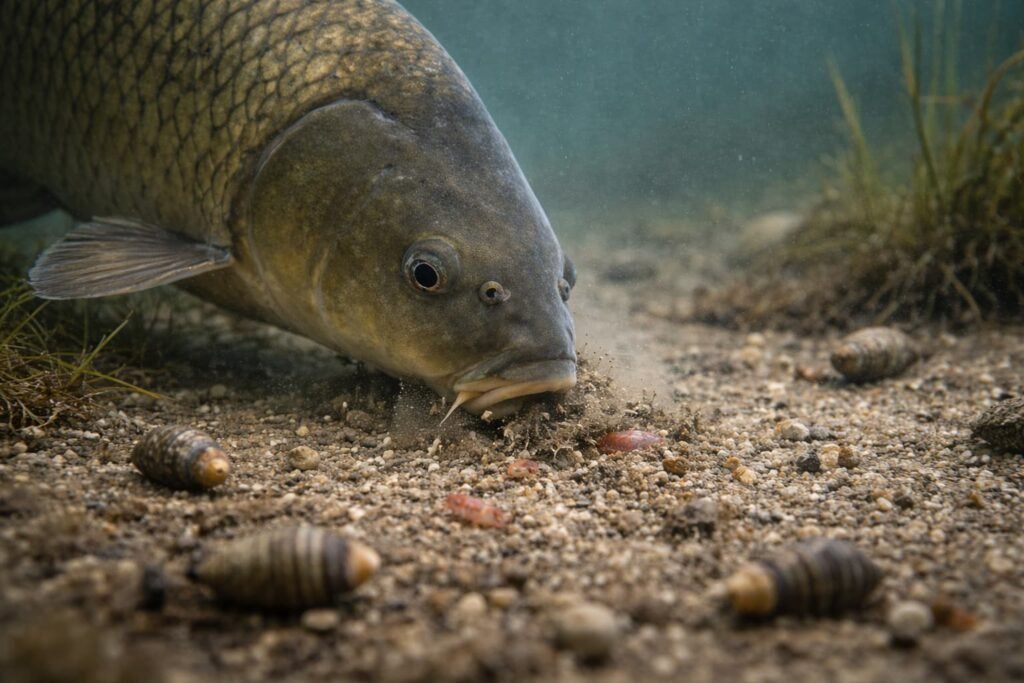
Carp are very capable of dealing with hard natural food. Snails and mussels are classic examples. Where those foods are abundant, carp spend a lot of time grubbing for them.
That is one reason rich, savoury, mineral, and shellfish-style baits can make sense on some waters. Even when you are not trying to copy the natural food exactly, you are at least working in the same direction.
If a lake is full of snails, you should not ignore that.
Insect Larvae and Soft Bottom Feeding
Soft bottoms can be full of life. Bloodworm, midge larvae, caddis, and other insect food make silt-rich areas very attractive at certain times.
Carp root through this sort of ground patiently. They do not need a giant clear spot to feed well. Sometimes the best area looks dull to the eye but is rich underneath.
This is one reason bubbling soft spots can be so important.
Seeds, Grains, and Bits Washed In
Carp are opportunists. They will eat seeds, grains, bits of vegetation, and food items washed in by wind or inflow. That does not mean a field of sweetcorn grows on the lakebed, but it does explain why grains and particles can be so effective.
They are familiar-shaped, easy to eat, and easy to browse over. On many lakes, simple food catches because it fits the carp’s natural way of feeding.
It does not need to be fashionable. It needs to be believable.
Plant Matter, Detritus, and General Browsing
Carp also spend time sifting through softer organic material. They are not always hunting one specific item. Often they are browsing, sorting, and taking in a mixture of edible bits.
That is why carp can spend long periods in an area without it looking dramatic. They are just steadily working through the lakebed.
For the angler, that means one thing: do not always wait for crashing shows and fireworks.
Michigan Notes
In many Michigan lakes, shallow natural bays, reed edges, soft silty corners, mussel-influenced areas, and spots with visible snail life can all be worth a serious look. Big natural waters often feed fish well without any angler input at all.
If you know a lake has a heavy snail population, that should affect how you think about location and bait. If you know the soft silt is alive with larvae, that matters too.
The lake’s natural pantry always comes first.
Common Mistakes
- Assuming carp live mainly on anglers’ bait.
- Ignoring the lake’s main natural food source.
- Baiting heavily in areas with poor natural feeding value.
- Thinking only in terms of boilies and pellets.
- Overlooking soft, rich, natural-looking zones.
FAQ
Do carp mainly eat on the bottom?
Most of the time, yes. Much of their natural food is found on or in the lakebed.
Do carp eat snails?
Yes. On some waters they are a major natural food item.
Do carp eat bloodworm and insect larvae?
Yes. Soft lakebeds can hold a lot of this food.
Does natural food make carp harder to catch?
Sometimes, yes. It can reduce urgency and make location more important.
Should bait match natural food exactly?
Not exactly, but it should make sense for the water and the fish.
Next Steps
Read Cheap Carp Baits That Catch Big Fish, Bait Shed, and Boilie School.