

Particles catch carp because they create lots of small feeding signals and keep fish grubbing instead of eating a couple of big mouthfuls and drifting off.
But particles only work long-term if you prep them safely and bait them with a plan—especially in Northern Michigan spring, where feeding often happens in short windows and water temperature can swing quickly.
This is my simple spring system: safe prep, easy storage, April (~45°F) vs May (55°F+) baiting amounts for three rods, plus hookbaits including corn, tiger nuts, and shelled raw peanuts.
Quick Start
- Never feed dry or undercooked particles. Soak properly, boil properly, cool properly.
- Keep it simple: maize + wheat + hemp catches carp everywhere.
- In spring, start small and only build when you get signs (liners/fizzing/takes).
- Store it right: fresh > fridge short-term > freeze long-term.
Particle Safety
- Do not feed dry particles. They expand and can harm fish.
- Do not use bait that smells rotten, looks mouldy, or has questionable storage. When in doubt, bin it.
- If you ferment, it should smell sweet/sour (a mild tang), not foul/putrid.
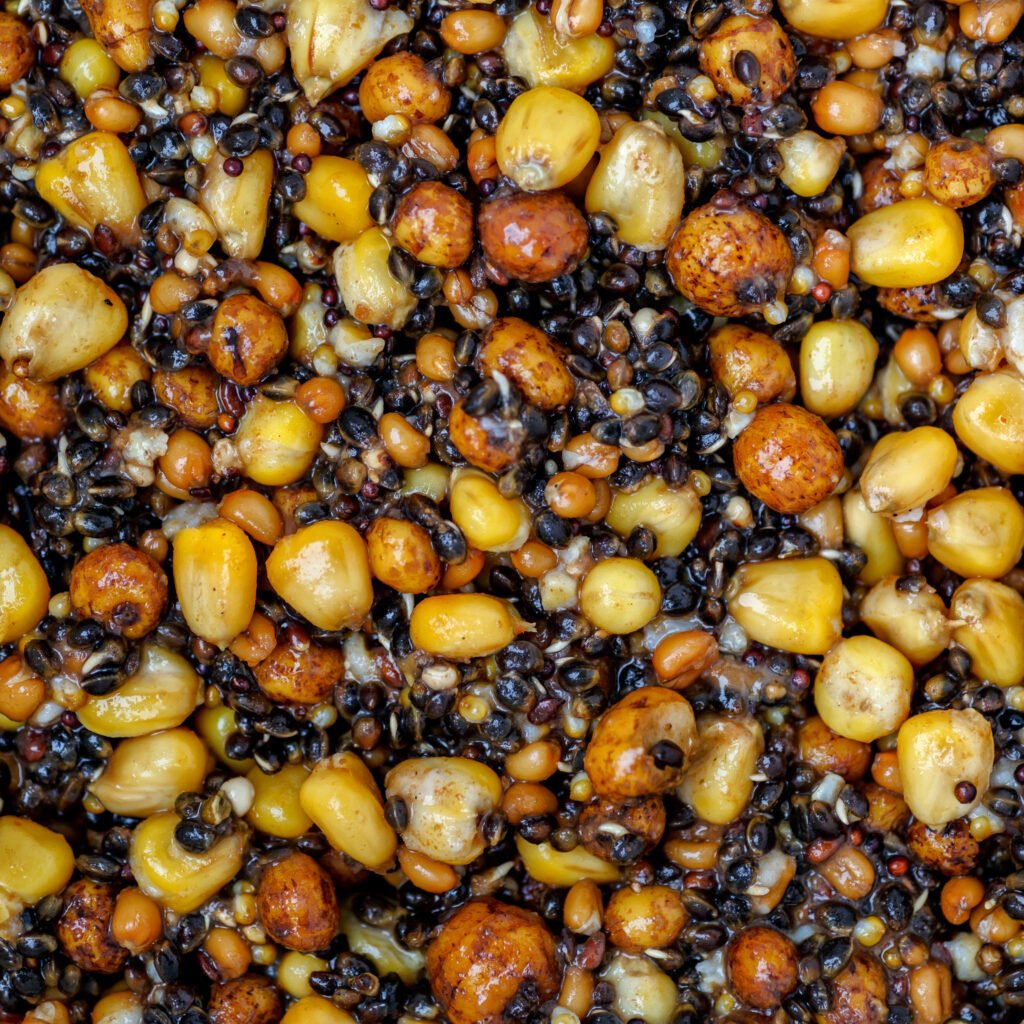
The Core Particles I Use
- Maize (corn): the backbone (cheap, visible, holds fish)
- Wheat: small-feed particle that keeps fish competing
- Hemp: oil/scent trail + keeps fish grubbing
Optional extras (nice but not required):
- Barley, maple peas, cracked corn (cook thoroughly)
Note: I keep tiger nuts and peanuts mainly as hookbaits. Tigers can be used as freebies if prepared properly; peanuts I keep hookbait-first and minimal.
My “One Bucket” Particle Mix (Simple + Repeatable)
Easy ratio (by volume)
- 2 parts maize
- 1 part wheat
- ½ part hemp
Example:
- 4 cups maize
- 2 cups wheat
- 1 cup hemp
Scale up as needed — the ratio is the point.
Prep Method (Easy, Reliable)
Day 1 — Rinse + soak
- Rinse everything.
- Cover with at least 2x water (more is safer).
- Soak times:
- Maize: 24 hours
- Wheat: 12–24 hours
- Hemp: 12–24 hours
Optional: add a bit of molasses/brown sugar to the soak water. Not required, but it helps the liquor.
Day 2 — Boil (fully cook)
- Maize: 45–60 min (plump/soft)
- Wheat: 20–30 min (soft but intact)
- Hemp: 20–30 min (many seeds split with white showing)
Practical one-pot method: boil maize ~30 min, add wheat, then hemp near the end.
Cool in the cooking liquor
Turn off heat and cool in the cooking water (don’t pour it off). That liquor is attraction.
Optional: Controlled Fermentation (Advanced)
Let cooled particles sit 24–72 hours in the liquor.
- Lid loosely on (don’t pressure seal warm bait)
- Stir daily
- Smell should be sweet/sour — not foul
Storage (So It Doesn’t Turn)
- Fridge: best used within ~3–5 days
- Freezer: portion into session-sized bags/tubs and freeze (weeks/months)
- On the bank: keep shaded/cool; don’t let it bake in the sun
Spring Particle Amounts (April ~45°F vs May 55°F+)
Spring is about short feeding windows. The aim isn’t to “feed them up” — it’s to nick bites, then build only when the fish show.
April (~45°F): Cold-water window hunting
Keep bait minimal and let location + timing do the work.
- Rod 1 (Margin/Shallow): 0 to ½ handful (or none)
- Rod 2 (Mid-depth): 1–2 handfuls tight
- Rod 3 (Deep edge): 0 to 1 handful
Session starting total: roughly 1–2 quarts max (often less)
Top-ups: only after liners/fizzing/take → add ½–1 handful to the active rod.
May (55°F+): Warming spells
You can build carefully once fish confirm they’re feeding.
- Rod 1 (Margin/Shallow): ½–1 handful
- Rod 2 (Mid-depth): 2–4 handfuls tight
- Rod 3 (Deep edge): 1–2 handfuls
Session starting total: roughly 2–4 quarts
Top-ups: after activity → add 1–2 handfuls to the productive rod.
Spring rule (always)
If you’re not seeing liners, fizzing/mud puffs, or bites, don’t increase bait — change angle/depth or move.
Cold front adjustment
If a front hits after a warm spell: drop back to the April amounts immediately.
Hookbaits: Corn, Tiger Nuts & Shelled Raw Peanuts
Corn (default)
- Real + plastic corn over maize-heavy spots is hard to beat for reliability and visibility.
- Great when you’re unsure and want a confident starting point.
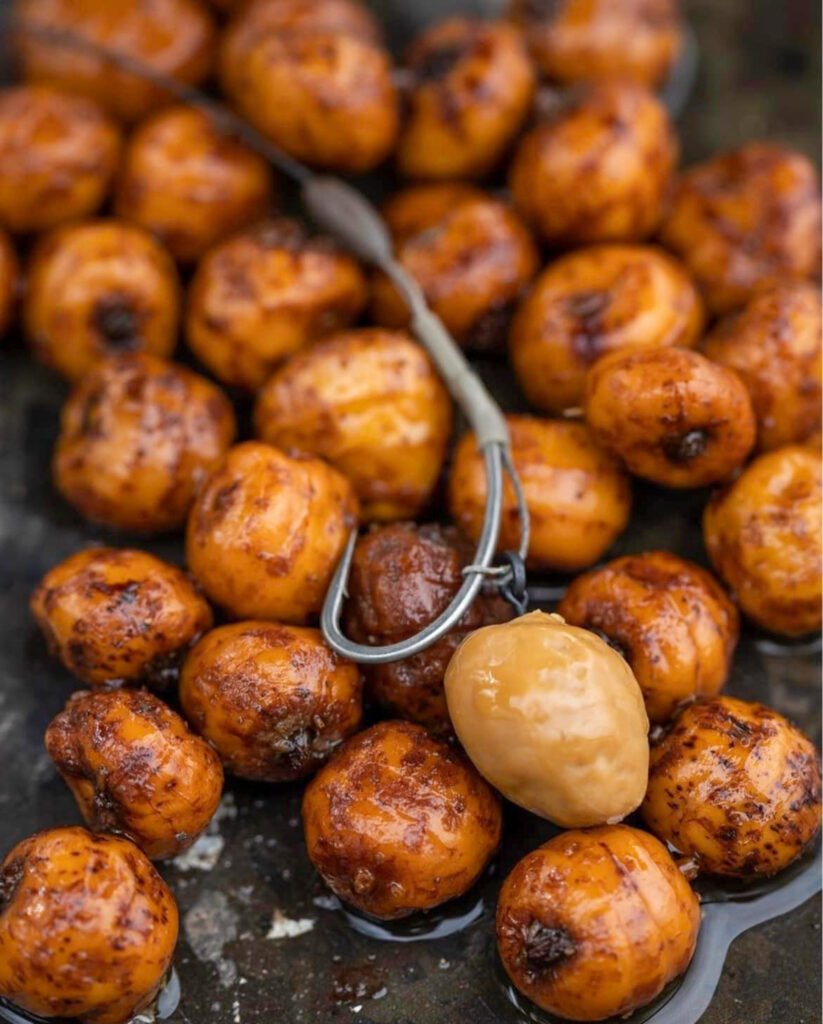
Tiger nuts (tough + selective)
Tiger nuts are one of my best natural hookbaits — tough, selective, and ideal when you want the hookbait to stay on.
Safe tiger nut prep
- Rinse well.
- Soak 24–36 hours in plenty of water (they expand a lot).
- Boil/simmer 45–60 minutes (big nuts often need the longer end) until cooked through and expanded.
- Cool and leave soaking in the cooking liquor (don’t drain it).
- Optional (advanced): ferment 2–5 days in the liquor (container closed, but don’t seal while warm). Stir daily.
Hookbait tips
- Pick the largest nuts for hookbaits.
- Hair-rig with a stop; for extra security, use bait floss.
- Great combo: Tiger nut + plastic corn (visual + food signal).
- Cocktail of mixed nuts tigers and peanuts etc
Shelled raw peanuts (subtle/oily, hookbait-first)
Peanuts can be very effective, but they’re controversial because dry/undercooked nuts swell.There has been problems in the past with anglers using undercooked peanuts which are bad for carp . So i f you do use them, do it properly and and follow the safe prep guidelines below . I treat peanuts as hookbait-first and keep freebies minimal.
What to buy
- Raw, shelled, unsalted, unroasted peanuts (avoid roasted/salted/flavoured)
Safe prep (shelled raw)
- Rinse.
- Soak 24 hours in plenty of water (optional: change water once).
- Boil 30–45 minutes (gentle rolling boil) until soft enough to squeeze.
- Cool in the liquor.
- Storage: fridge 2–3 days max or freeze in portions.
Hookbait tips
- Use 1–2 peanuts on the hair.
- If they’re a bit soft, secure with bait floss.
- If nuisance is bad, peanuts get smashed—tigers last longer.
Quick decision rule
- If I want tough + selective (or I’m getting picked at): tiger nuts
- If I want subtle/oily and nuisance is low: peanuts
- If I want reliable + visible anywhere: corn
Turtles in the Margins (What I Change)
If turtles are bothering the margin/shallow rod, I don’t fight them with more bait—I make the shallow rod harder to mess with.
- I reduce/avoid loose corn in the margins and switch to a tiger nut hookbait (or a tougher wafter).
- I fish the margin rod with little to no freebies until I see carp signs.
- I use bigger hookbaits (big tiger or double tiger) and bait floss / bait screws so the hookbait stays on.
- If turtles are persistently active shallow, I keep the margin rod as a sign-only rod and let the mid-depth rod do the work.
Troubleshooting (Spring)
“Liners but no bites”
- Reduce bait
- Recast one rod clean
- Check hook sharpness
- Slightly adjust hookbait balance
“One bite then silence”
- Don’t dump more bait
- Top up lightly only if you get fresh signs
“Turtles wrecking the margin”
- Switch to tiger nut/double tiger + floss
- Minimise freebies shallow
- Lean harder on mid-depth until turtles back off
Next Step (Advanced lane)
If you want the deeper side—leakage, liquids, testing notes—see Bait Science. That’s where I document what I changed and what it did.
Quick Recipe Card / Gear Used / Next Post Links
Quick Recipe Card
Goal: Spring particle mix for short feeding windows
Mix ratio: 2 maize : 1 wheat : ½ hemp
Soak: maize 24h, wheat 12–24h, hemp 12–24h
Boil: maize 45–60m, wheat 20–30m, hemp 20–30m
Cool/soak: in cooking liquor
Optional: ferment 24–72h
Spring baiting (starter amounts):
- April (~45°F): keep it tiny; top up only on signs
- May (55°F+): build carefully once fish confirm
Hookbait picks:
- Default: corn (real + plastic)
- Tough/selective: tiger nut
- Subtle/oily: shelled raw peanut (hookbait-first)