

Good on-the-water carp fishing adjustments should begin when the lake gives you evidence that the original plan is incomplete—not merely when the angler becomes bored.
A plan is still essential. It gives the session a starting location, expected feeding window, presentation and baiting level. But a Michigan lake does not remain fixed because the rods have been cast. Wind turns. Light strengthens. Boat traffic builds. A shallow bay loses warmth. Fish begin showing on a different line. A rig that landed cleanly on the first cast comes back fouled after the weed shifts.
The mistake is to defend the first plan after the water has contradicted it. The opposite mistake is just as damaging: changing rigs, hookbaits, spots and baiting every hour until there is no stable test left. Good adjustment sits between those extremes. It means reading new evidence, identifying the first assumption that may have failed, making the smallest useful change, and watching what happens next.
This article owns that during-the-session decision process. For preparation before leaving home, use Carp Session Planning in Michigan. For the larger condition-reading system, use Watercraft and Conditions for Michigan Carp Fishing. Once the rods are out, return here and work through the session in a controlled order.
Do not change something because the session is quiet. Change it because the evidence points to a specific weak assumption.
Table of Contents
Quick Start: Diagnose Before You Change
When a session slows or never starts, do not begin with the tackle box. Begin with the water. Decide what the latest evidence says about carp location and timing before assuming the hookbait, rig or quantity of feed is wrong.
| Evidence | Most Useful First Question | Smallest Useful Test | Avoid |
|---|---|---|---|
| Repeated carp signs close to the rigs | Are they feeding, traveling or holding? | Adjust one rod to the clean edge or likely feeding line | Moving the whole setup immediately |
| No signs, no liners and lifeless water | Does this zone still fit the conditions? | Watch adjacent water, recce, or move one search rod | Adding bait to make dead water work |
| Activity begins at a different time | Has the feeding window shifted? | Protect the area and wait through the developing window | Recasting as fish begin to arrive |
| Rig returns weeded, buried or moved | Is the presentation fishing cleanly? | Change the exact spot, lead arrangement or rig height on one rod | Changing flavor before fixing presentation |
| One rod receives all the liners or bites | What is different about its route, depth or line angle? | Move one other rod toward that pattern without crowding it | Recasting every rod onto the same small patch |
| Fish feed confidently and return | Is the existing feed level being cleared? | Add a measured top-up only when the response justifies it | Feeding automatically after every bite |
The sequence is simple: observe, diagnose, change one thing, then reassess. If the result improves, keep it. If it makes no difference, restore the control or move to the next logical test. If the evidence shows that the entire swim has lost its value, stop making tiny corrections and perform a deliberate reset.
Use the Right Adjustment Order
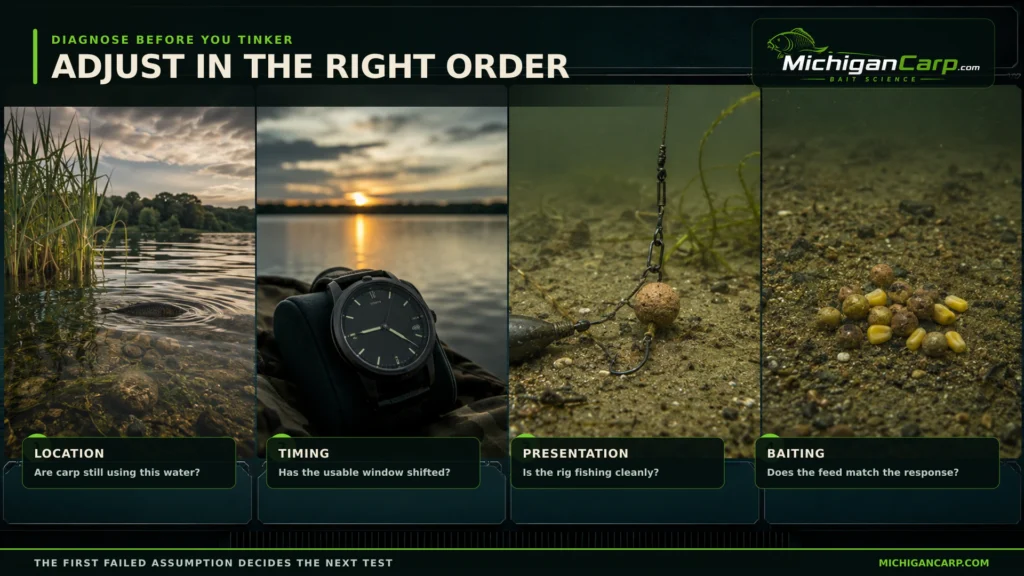
The most reliable order is location → timing → presentation → baiting. It prevents easy-to-change details from distracting you from bigger errors. Anglers often begin with a hookbait swap because it takes only a minute. But a different flavor cannot rescue a rod placed in water the carp have abandoned.
1. Re-check Location
Ask whether carp still have a reason to use the zone. Look for food, comfort, safety, cover and a travel route, then compare those reasons with the current wind, light, temperature, oxygen and disturbance. Use How to Find Carp in Lakes when the whole location picture needs rebuilding, and Where Carp Hold During the Day when the fish appear to have moved into safer resting water.
2. Re-check Timing
A quiet swim can still be the right swim at the wrong hour. A shallow spring bay may improve after several hours of sun. A pressured margin may not become useful until boat traffic stops. A route may produce for twenty minutes at dusk and look empty for the rest of the day. Compare the evidence with Carp Bite Windows in Michigan before abandoning an area that has not yet reached its best period.
3. Re-check Presentation
If carp are present, confirm that the rig is actually fishable. The hookbait may be buried in soft debris, suspended badly in weed, moved by undertow, masked by a pile of loose feed, or connected to the bank by a poor line angle. Presentation includes the exact landing spot, lead behavior, hookbait balance, leader path and safe route for landing a fish—not merely the named rig.
4. Re-check Baiting
Only after the first three questions make sense should baiting become the main suspect. Decide whether the feed is too heavy, too light, too spread out, too concentrated, being moved by water, or simply unnecessary around fish that are traveling rather than feeding. More bait is not a universal response to silence.
Build a Baseline Before Touching the Rods
A useful adjustment requires a control. Before changing anything, record what the lake and each rod are doing. This does not require a complicated logbook. A few clear observations create enough baseline to stop memory and impatience from rewriting the session.
| Baseline Item | What to Record | Why It Matters |
|---|---|---|
| Conditions | Wind direction and strength, light, air trend, surface change and recent weather | Shows whether the lake is improving, deteriorating or merely changing appearance |
| Water and feature | Depth, bottom feel, weed, silt, cover, line angle and nearby escape water | Separates a location problem from a presentation problem |
| Carp evidence | Rolls, bubbles, clouding, liners, reed movement and their exact time and position | Distinguishes repeated patterns from one random sign |
| Rod response | Which rod, spot, distance, hookbait and feed level produced attention | Reveals the one variable already outperforming the others |
| Disturbance | Casts, boats, bank traffic, dogs, other anglers and your own activity | Prevents pressure effects from being mistaken for bait failure |
Give a freshly placed rig enough time to become a meaningful test. The correct period depends on the water and situation; there is no universal two-hour rule. On a short movement window, ten quiet minutes may matter. On a large low-stock lake, a well-chosen rod may need several hours. Judge time against expected carp movement, not against the angler’s need to stay busy.
When you do make a change, note the time and the exact reason. “Moved left because three liners crossed that route after the wind turned” is useful. “Tried something different” is not. A clear reason lets you learn even if the rod remains quiet.
Know When to Wait and When to Move
Patience is valuable only while the underlying idea remains credible. Staying on fish because the window is still developing is discipline. Staying in lifeless water because setting up again is inconvenient is attachment. The practical task is to separate weak evidence from a genuinely broken swim.
| Hold the Swim | Test One Rod | Prepare to Move |
|---|---|---|
| Repeated signs remain in or close to the area | One route or depth has stronger evidence than the others | Carp repeatedly show elsewhere and your water remains empty |
| The expected bite window has not arrived | The swim still works but one presentation looks doubtful | A wind, temperature or oxygen change removes the area’s advantage |
| Rigs are known to be clean and the area needs quiet | One rod receives liners while the others receive none | Traffic, exposure or disturbance destroys fish confidence |
| Conditions are stable or improving | A nearby edge offers a low-disturbance comparison | The rigs cannot be fished or fish landed safely |
On pressured clear waters, doing nothing can be the most active decision available. Recasting a correctly placed rod as carp begin to edge into the swim can undo hours of quiet. On the other hand, a scout walk that reveals repeated rolling fish in a newly winded bay is stronger evidence than the sunk cost of bait already placed in the old swim.
When access and fish care allow it, one search rod is often the best bridge between waiting and moving. It can test a nearby depth, route or cleaner edge while two established rods preserve the original opportunity. This turns relocation into a measured comparison rather than a blind leap.
When Carp Are Nearby but Not Biting
Showing carp do not always prove feeding carp. Fish can roll while traveling, sit high in the water, hold beside cover, visit a baited area cautiously or feed a short distance from the visible activity. The first job is to interpret the sign. Signs Carp Are Feeding explains the difference between isolated clues and a repeatable feeding pattern.
Traveling Fish
Fish showing in a straight line or producing repeat liners may be using a route rather than stopping to feed. Put one trap on the clean interception point: the bay mouth, weed edge, depth transition, reed end or quiet line beside the movement. A small parcel of food or a single attractive hookbait can be more appropriate than building a large feeding area across the route.
Holding Fish
Carp may be comfortable near snags, shade, weed, depth or quiet water without wanting to feed. Do not cast directly into cover or create an unsafe extraction angle simply because fish are visible. Test the nearest clean, safe exit line or wait for the conditions that encourage them to leave the holding area.
Feeding Fish With No Bite
Repeated fizzing, clouding, tails, settled movement and liners around the bait justify a closer presentation check. The rig may be in the heaviest weed instead of the clean edge, the line may cross the feeding zone, or the hookbait may sit unnaturally above the surrounding feed. Adjust one rod to the outside of the activity before disturbing the center.
If fish visit but will not settle, reduce disturbance before increasing attraction. Let the lines settle, avoid unnecessary recasts, move rods off the most exposed part of the feature and consider whether the better opportunity is the next low-light or low-traffic window.
Choose a Small Adjustment or a Full Reset
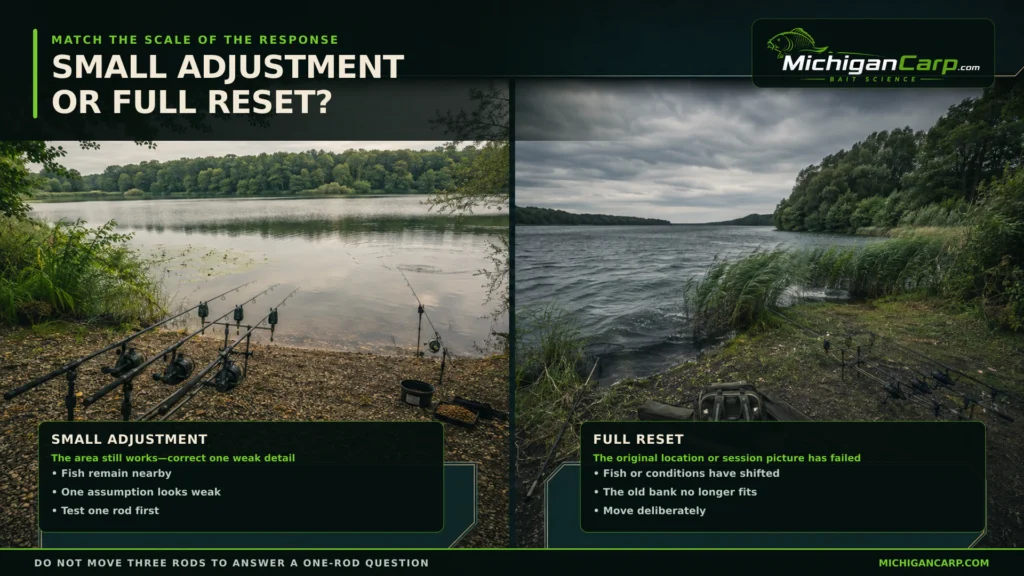
The scale of the response should match the scale of the problem. If carp remain nearby and the swim still provides food, comfort, safety and a fishable spot, correct the weakest detail. If the reasons for choosing the area have disappeared, a collection of tiny tweaks only delays the necessary move.
| Small Adjustment | Full Reset |
|---|---|
| Move one rod to the clean edge of the same feature | Move to the bank or zone now supported by fish and conditions |
| Change hookbait balance after proving the lakebed is the issue | Leave a shallow area that has lost warmth, oxygen or fish activity |
| Reduce line disturbance or improve the landing angle | Abandon a swim made unworkable by traffic, waves, debris or access |
| Tighten, reduce or pause baiting around nearby carp | Rebuild the rod spread around a newly confirmed route or feeding area |
| Wait for the window while preserving the area | Accept that the original timing and location picture has failed |
Do not move three rods to answer a one-rod question. If one presentation is doubtful, test one rod. Do not use one quiet rod to defend a broken swim either. If the full bank has become wrong and fresh evidence points elsewhere, move deliberately, place the minimum bait needed, and establish a new baseline.
Respond to Environmental Change
Conditions matter because they change the value of the water, not because every weather event creates an automatic rule. A wind turn can move surface water, food, color and confidence. Strong sun can make a clear margin feel exposed. Heat and dying weed can make oxygen more important than depth alone. Pressure and boat traffic can delay an otherwise good window.
Wind, Waves and Current
Ask what the moving water has changed. A steady warm wind into a productive spring bay can add value. A cold wind into the same shallow area can remove it. Summer ripple may improve cover and oxygen along a weed edge, while heavy wave action can make the rig, line and landing route unsafe. Use Wind, Waves and Current for Michigan Carp Fishing to interpret the effect rather than following “fish the wind” blindly.
Light, Temperature and Oxygen
A brightening sky can shorten a shallow-water opportunity on a clear lake and push carp toward shade, weed, depth or safer cover. In spring, several hours of sun can do the opposite and make a sheltered dark-bottomed area more attractive. In summer heat, a winded weed edge or inflow may be more comfortable than the warmest still water. Compare the change with the protected Carp Water Temperature Guide, Dissolved Oxygen and Carp Fishing and Water Clarity and Light Penetration.
Pressure and Disturbance
Public-water pressure often develops during the session. Boats, paddleboards, swimmers, bank walkers, lure anglers and repeated casting can turn an exposed area into movement water rather than feeding water. Carp may not leave the region completely; they may tighten to weed, use a quieter edge, move deeper or wait until activity falls. Fishing Pressure: How Carp Learn and How to Beat It helps separate a temporary confidence problem from a true location failure.
Safety Overrides the Fishing Plan
A storm, dangerous wave action, lightning, unstable bank, lost landing route or rapidly rising flow is not a tactical puzzle. It is a reason to stop or relocate. Check current forecasts and alerts through the National Weather Service, and use its weather-safety guidance. No possible bite window justifies unsafe bank work, boating, casting or fish handling.
Adjust Presentation and Baiting Without Creating Chaos
Prove the Presentation Problem First
Use the lead, retrieved rig and line behavior as evidence. Weed on the hook, a hookbait pushed into silt, a lead moved by undertow, a twisted hooklink or debris collecting on the line provides a reason to adjust. A clean rig that has sat quietly in a credible feeding zone provides a reason to leave it alone.
When a presentation change is justified, correct the physical problem. Move to a clean hole, fish the edge of the weed, alter the hookbait height, choose a lead arrangement suited to the bottom, or improve the line angle. Use The Complete Carp Rigs Guide for the wider rig system, but avoid “rig roulette.” Changing from one fashionable rig to another without proving why the first failed creates no useful information.
Let One Rod Carry the Test
With three rods, one can test while two preserve the control. Change only the test rod’s spot, depth, presentation or baiting level. If it begins producing liners or bites, repeat the useful part carefully. If it fails, you still have two stable references and can reverse the change without rebuilding the session.
Make Baiting Respond to Fish
Top up because fish have fed, not because time has passed. When carp are present but unsettled, a tighter or smaller trap may help. When they are clearly feeding and returning, a measured top-up can extend the opportunity. When the swim is empty, extra bait usually increases commitment to the wrong water.
Also consider where the feed finishes. Wind, waves, current, slope and weed can spread or move particles after they land. A hookbait placed where bait was introduced is not necessarily sitting where the loose feed settled. Repositioning the rig to the downstream or downhill edge may be more useful than adding another bucket.
Adapt to Big Water, Long Sessions and Public Pressure
Big Lakes Need Larger-Scale Diagnosis
On a large Michigan lake, changing a rig by six inches may be irrelevant if the carp have shifted half a mile with the wind, temperature or pressure. Big-water decisions begin with the zone: the correct bank, bay, point, channel, weed system or route. Only after that larger location remains credible do fine presentation changes deserve attention.
Do not confuse “no visible signs” with proof of no carp on huge water; stock may be low and signs subtle. Compare multiple clues: wind history, natural food, depth access, route shape, previous timing, liners and whether neighboring water looks more alive. Best Depth for Carp Fishing is most useful when depth is read as part of a route rather than as a magic number.
Long Sessions Need Checkpoints, Not Constant Change
A three- or four-day session naturally contains dead periods. Judge each phase against the expected window. Dawn, midday warmth, evening quiet, overnight movement and changing recreational traffic may each make different water useful. Review the plan at meaningful transitions rather than resetting the rods simply because another hour passed.
Protect the baited area if carp are likely to return, but keep enough uncommitted bait and organized tackle to move when the evidence becomes strong. Heavy early baiting can turn a tactical choice into a psychological trap: the angler stays because of what has been invested rather than because the swim remains good.
Public Water Often Rewards the Second Window
Many public Michigan waters change character through the day. A campsite bank can be quiet at dawn, busy through the afternoon and productive again after boats and visitors leave. A marina edge, reed line or shaded corner may become a temporary refuge during pressure, then release carp back onto feeding routes later.
This is why timing and pressure must be separated from location. The area may still be fundamentally right but temporarily unfishable. If safe access allows, reduce disturbance, protect the likely later window and use one rod to test nearby quiet water rather than abandoning the complete area on the first burst of traffic.
Use a Repeatable Mid-Session Review
Good on the water adjustments are easier to judge when every change has a clear reason and a defined review point.A repeatable review turns adjustment into a skill. Run it after a meaningful event: a wind shift, a new light period, a bite, repeated liners, a fouled rig, rising traffic, a temperature change or the end of an expected window. Do not run it every few minutes.
| Review Step | Question | Decision |
|---|---|---|
| Observe | What has objectively changed in the water, fish signs or rod response? | Name the evidence without explaining it away |
| Locate the failure | Is the weak assumption location, timing, presentation or baiting? | Stop at the first level that no longer fits |
| Choose scale | Does the session need one controlled test or a full reset? | Match the size of the response to the size of the problem |
| Change one variable | What is the smallest action that can answer the question? | Use one rod when possible and preserve a control |
| Set a review point | What result or time window will make this test meaningful? | Avoid changing again before the test can speak |
| Record the result | Did liners, signs, clean presentation or bites improve? | Keep, reverse, refine or escalate |
Five Reactions to Avoid
Recasting to feel active can disturb arriving carp. Changing several variables together destroys the comparison. Adding feed to dead water increases commitment without improving location. Copying another angler’s change without matching the evidence imports a solution to a different problem. Refusing a justified move turns patience into stubbornness.
The aim is not to create a perfect decision every time. It is to make decisions that can be explained, tested and learned from. Over a season, that record becomes more valuable than any single lucky move.
FAQ
What should I adjust first during a quiet carp session?
Re-check location and timing first. If carp are no longer using the water, rig and hookbait changes are unlikely to solve the problem. If the area still makes sense and the expected window is developing, confirm presentation before changing baiting.
How long should I wait before changing a carp rig?
There is no fixed time. Wait long enough for the specific spot and expected feeding window to provide a fair test. Change sooner when the rig is known to be fouled or the water has clearly changed; wait longer when fish signs remain nearby and disturbance would damage the opportunity.
Should I move if carp are showing elsewhere?
Repeated signs in another usable area are important, especially when your swim has no supporting evidence. A single roll is not always enough. Compare repetition, feature, timing, safe access and whether one search rod can test the new line before committing to a full move.
What if carp are showing over my bait but not taking?
Decide whether they are feeding, traveling or holding. If feeding signs are genuine, check lakebed presentation, line angle and whether the hookbait sits naturally with the feed. Test the clean edge with one rod and reduce disturbance before changing everything.
Should I add more bait when a swim goes quiet?
Not automatically. Add bait when feeding response shows that the existing feed is being used. Silence caused by wrong location, poor timing, pressure or a fouled rig is not corrected by feeding more.
Is moving one rod better than moving the whole setup?
When the main area remains credible, yes. One rod can test a nearby route, depth or clean patch while the others preserve the control. Move the whole setup when the broader location picture has failed or safety and access demand it.
Next Steps
Use Carp Session Planning in Michigan to build the plan before fishing, then keep The Complete Michigan Carp Session Checklist available for the practical setup and review points.
For the first two levels of the adjustment order, continue with How to Find Carp in Lakes, Signs Carp Are Feeding and Carp Bite Windows in Michigan. For condition changes, use Wind, Waves and Current, Water Clarity and Light Penetration and Barometric Pressure and Weather Fronts.
The principle tying those pages together is straightforward: build a reasoned plan, let the water test it, and change only what the new evidence has earned.