

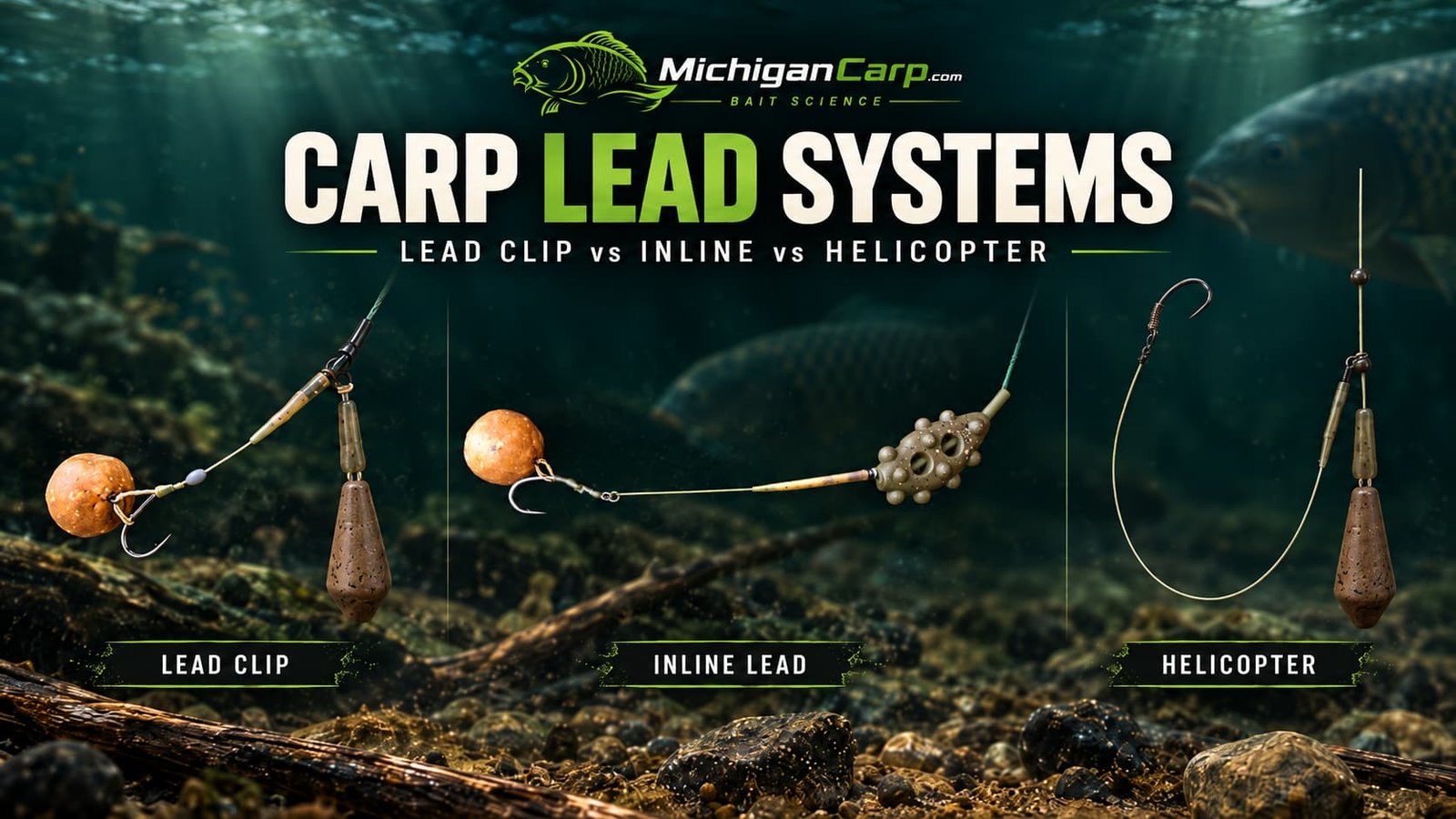
Carp lead systems are often discussed as though the only decision is which lead shape or weight to attach to the end of the line. In reality, the lead arrangement determines far more than that. It affects how the rig casts, how the hooklink settles, how directly the weight of the lead is transferred during a pickup, how the presentation behaves in weed or silt, and what may happen if the mainline or leader breaks.
The three main systems most carp anglers will encounter are the lead clip, inline lead and helicopter system. All three can be effective, and all three can be configured safely, but they solve different problems and should not be treated as interchangeable pieces of terminal tackle.
The most important principle is also the one that is easiest to oversimplify:
A safe lead system is not defined simply by whether the lead always falls off.
What matters is what happens when something goes wrong. Depending on the system, the lead may need to release, the hooklink may need to separate from the leader or mainline, or components may need to slide over a leader knot and off a broken line. The complete assembly has to work together.
For choosing the whole rig rather than the lead arrangement alone, use Complete Carp Rig Guide for Michigan. For mainline, leaders and abrasion hazards, use Carp Fishing Line and Leaders for Michigan.
Table of Contents
Quick Start: Lead Clip vs Inline vs Helicopter
| Lead System | Best Starting Situations | Main Strength | Main Limitation |
|---|---|---|---|
| Lead clip | Clean to mixed bottom, moderate weed, conventional hooklinks | Versatile and easy to change leads | Can be configured badly if components are mismatched or jammed |
| Inline lead | Clean hard bottom, solid PVA bags, compact presentations | Direct, compact connection between lead and hooklink | Less forgiving when a heavy lead plugs into deep silt or debris |
| Helicopter system | Soft silt, light debris, long-range fishing, Chod-style presentations | Hooklink can settle more independently of the lead | Safety depends heavily on the upper stop/bead and leader arrangement |
| Running system | Clean water where indication and low resistance are priorities | Lead can move independently after pickup | Different mechanics from the semi-fixed systems covered here |
There is no universal percentage such as “lead clips are right for 80% of carp fishing.” The better decision comes from the lakebed, weed, casting requirement, hooklink, leader system and failure mode.
What a Carp Lead System Actually Does
The lead is not simply there to make casting possible.
It also affects the mechanics of the complete presentation. When a carp picks up the hookbait and moves, the weight and position of the lead influence how quickly resistance is transferred through the hooklink. On the cast, the arrangement influences tangles and stability. On impact with the lakebed, the shape and attachment determine how deeply the lead can penetrate soft material and where the hooklink finishes relative to it.
A lead system therefore performs several jobs at once:
- provides casting mass;
- helps create resistance during a pickup;
- positions the hooklink;
- influences how the rig settles;
- affects the risk of tangles;
- determines how easily the lead can be changed;
- and contributes to what happens if the mainline fails.
That is why I prefer to choose the lead system with the rig and lakebed, rather than selecting the hook rig first and adding whatever lead arrangement happens to be in the tackle box.
Your Complete Carp Rig Guide for Michigan uses the same principle: the lead system is part of the presentation rather than an unrelated weight.
What “Safe” Really Means in a Carp Lead System
Rig safety is often reduced to the phrase “the lead must come off.”
That is incomplete.
Dropping the lead can be extremely useful, particularly in weed or where a heavy lead might snag during the fight, but the more fundamental question is whether a carp can become tethered to a lead, leader or length of broken mainline.
Different lead systems solve that problem in different ways.
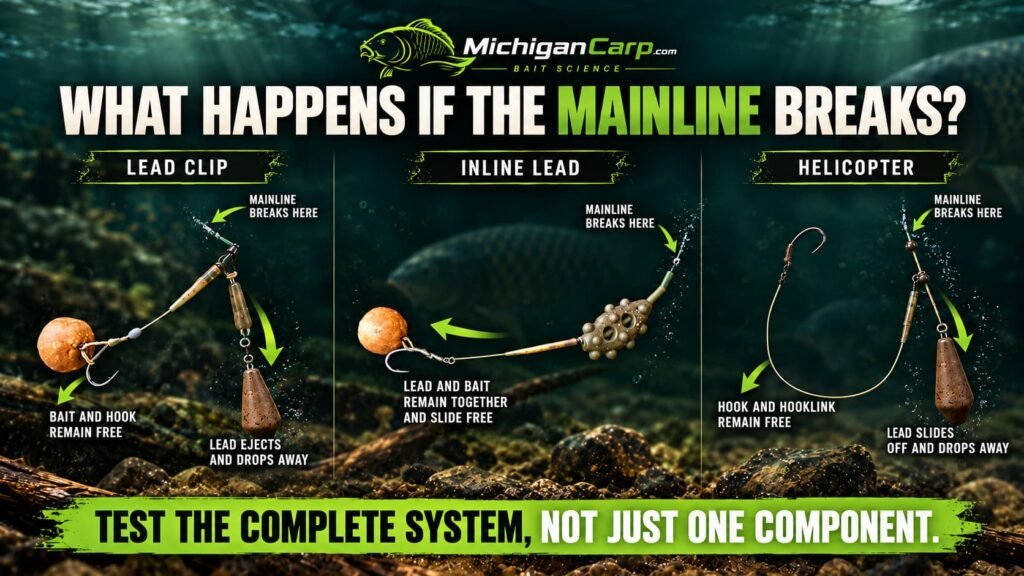
With a lead clip, safety may involve the lead releasing from the clip when necessary and the remaining terminal components being able to separate appropriately.
With an inline system, the lead or insert may need to pull free or allow the broken line and leader arrangement to separate from it.
With a helicopter system, the lead may remain attached while the hooklink swivel must be able to pass the upper stop, any leader knot and eventually the broken end of the line.
This is why the complete assembly must be tested.
A component can be marketed as “safe” and still become unsafe when combined with the wrong swivel, an oversized leader knot, a jammed bead or a tail rubber pushed on harder than the design intended.
Manufacturer guidance from Korda on choosing carp lead systems makes the same broad point: leaders and knots can complicate the failure path, so components must still be able to release or pass over those obstructions when required.
Lead Release and Fish Safety Are Not Exactly the Same Thing
There are good reasons to lose a lead during a fight.
A lead buried in heavy weed can act like an anchor. A lead caught behind timber or rock can create a second snag point. Removing that weight may allow the angler to maintain more direct control of the fish.
But losing the lead every time a carp takes is neither automatically necessary nor automatically more responsible.
On clean open water, keeping the lead attached can be perfectly workable when the system remains capable of separating safely if the line breaks.
It also avoids repeatedly leaving lead or other weights on the lakebed.
The decision should therefore be:
Does this swim benefit from deliberate lead release?
rather than:
Can I make the lead fall off as easily as possible?
Lead Clip Systems
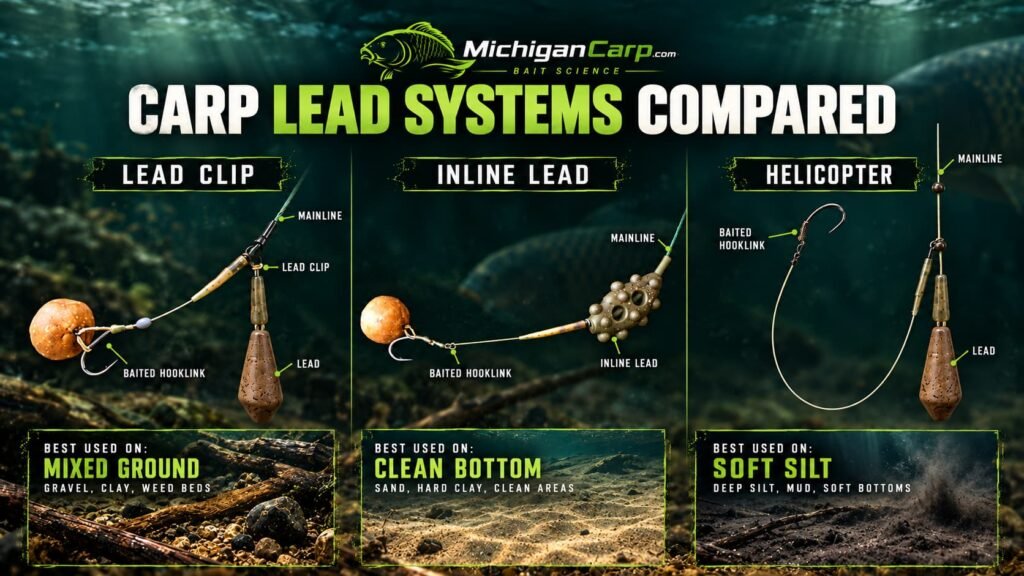
The lead clip is probably the most familiar modern carp lead arrangement because it combines conventional rig mechanics with easy lead changes and the option to configure lead release according to the swim.
A standard system normally places a suitably matched swivel into the body of the clip, with the lead attached to the external arm and a tail rubber controlling how securely the lead is retained.
That description sounds simple, but the details matter.
The swivel must be compatible with the clip. The tail rubber should be fitted according to the design of the system rather than forced as far forward as possible. Any leader or tubing needs to work with the clip rather than preventing the system from separating if the line fails.
A correctly configured lead clip is therefore very versatile, but it is not automatically safe just because a lead clip is present.
Where Lead Clips Make Sense
Lead clips are particularly useful on clean to mixed bottoms where a conventional hooklink can lie naturally and where the angler wants the option of changing lead shape or weight quickly.
They can also be useful around weed because the system can be configured to release the lead when retaining it would make landing the carp more difficult.
Typical applications include:
- gravel;
- sand;
- clay;
- firmer silt;
- mixed lakebeds;
- clear spots near weed;
- conventional bottom-bait rigs;
- wafters;
- many pop-up rigs;
- and general lake fishing.
That broad versatility is why lead clips are so commonly used.
It is not because they are automatically better than every other system.
Tail-Rubber Tension Should Match the Situation
One of the older pieces of advice on this page was effectively to keep loosening the tail rubber until the lead would fall off under a simple pull test.
That is too crude.
The correct retention depends on the actual clip design, the lead, the casting requirement and the fishing situation.
If the lead is released too easily, it can be lost unnecessarily during the cast, on impact or during ordinary fishing.
If the tail rubber is jammed excessively tightly, the clip may no longer behave as intended when the lead becomes trapped.
The safest approach is to use matched components and follow the design of the system, then test the complete assembly rather than guessing from how tight the rubber feels.
Weed and Lead Clips
Weed is one of the situations where deliberate lead release can be particularly helpful.
Once a carp is hooked, a heavy lead can collect weed and create additional drag. If the lead becomes buried, the fish may effectively be attached to both the angler and a weed-filled weight.
Configuring the lead clip to release appropriately can remove that problem.
But this does not mean a lead clip makes any weed swim safe.
Line angle, hooklink strength, mainline abrasion resistance and the ability to control the carp still matter more.
The safest rig is the one placed on a fishable weed edge or clear area where the carp can realistically be landed.
For the complete watercraft approach, use Weed Beds and Carp Fishing.
Lead Clips Around Snags
Snag fishing deserves even more caution.
Dropping the lead can help once the carp is hooked, but it does nothing to compensate for poor mainline, a dangerous line angle or fishing so close to an obstruction that the fish cannot realistically be controlled.
In serious snag situations I want the entire system assessed from the rod tip to the hook.
That includes:
- line strength;
- abrasion resistance;
- leader choice;
- lead release;
- hooklink strength;
- hook pattern;
- clutch or drag setting;
- rod position;
- and immediate access to the rod.
A lead clip is only one part of that system.
Inline Lead Systems
An inline lead places the line through the body or central insert of the lead, producing a compact relationship between the lead and hooklink.
That compactness is one of its main strengths.
When the bait is picked up on clean ground, resistance can be transferred very directly through the lead. The system also packages neatly inside a solid PVA bag, which is why inline leads are widely used for that presentation.
Your modern Complete Carp Rig Guide for Michigan already identifies clean hard ground and solid bags as two of the strongest inline applications.
Korda’s current inline lead guide similarly treats inline leads as particularly strong for hard spots and solid-PVA-bag fishing while noting that specialist safety or drop-off arrangements may be preferable in weed or snags.
Where Inline Leads Work Best
I particularly like the logic of an inline lead when the bottom is clean enough that the complete package can land and remain fishing predictably.
Useful situations include:
- sand;
- gravel;
- clay;
- polished hard spots;
- compact bottom-bait presentations;
- short hooklinks;
- solid PVA bags;
- Method-style fishing;
- and accurate close-to-medium-range work.
The system is especially attractive when you want the lead and hooklink to behave as one compact unit.
Inline Leads and Soft Silt
The weakness appears when a heavy inline lead penetrates soft silt.
Because the hooklink exits close to the lead, the entire presentation can be dragged toward the point where the lead has buried.
That does not mean an inline lead can never be used on silt. Lead shape, weight, hooklink length and the character of the silt all matter.
But once the bottom becomes very soft or uncertain, a helicopter-style arrangement often gives the hooklink more freedom to settle separately from the lead.
This is presentation logic rather than a rigid rule.
Inline Leads in Solid PVA Bags
Solid bags are one of the clearest specialist uses for an inline lead.
The lead, hooklink, hook and hookbait are all enclosed inside the bag, creating a compact package for casting and descent.
That compact arrangement lets the hookbait and loose feed arrive together while the inline lead remains at the center of the parcel.
For the complete method, use PVA Bag Fishing for Carp: Solid Bags, Mixes and Presentation.
As we established when rebuilding that article, the rig in a solid bag is inside the bag, not hanging outside it.
Inline Safety Depends on the Complete Insert System
An inline lead should not simply be threaded onto line and assumed safe.
Modern inline systems use inserts, sleeves or drop-off arrangements designed for specific line and leader combinations.
If the setup includes a thick leader knot, for example, an insert that would pull easily over bare mainline may no longer be able to pass the obstruction.
That is why it is important to test the same configuration you actually intend to fish.
Do not test one bare component on the kitchen table and then add tubing, knots and leaders on the bank without reconsidering the failure path.
Helicopter Lead Systems
A helicopter system is mechanically different because the hooklink swivel rotates around the mainline or leader above the lead rather than being attached directly behind it.
This gives the hooklink greater independence from the lead.
On the cast, the arrangement is inherently good at reducing tangles because the hooklink rotates around the central leader or mainline.
On soft bottom, the lead can penetrate while the hooklink settles higher up the system instead of necessarily being dragged into exactly the same point.
These characteristics make helicopter systems particularly useful for:
- softer silt;
- uncertain bottoms;
- light debris;
- long-range fishing;
- Chod-style rigs;
- and some pop-up presentations.
Helicopter Systems Are Not Only Chod Rigs
The terms are often confused.
A Chod Rig normally uses a helicopter-style lead arrangement, but a helicopter system can carry other hooklinks as well.
The defining feature is the way the hooklink swivel rotates around the central line or leader.
That distinction is useful because anglers sometimes avoid helicopter systems simply because they do not want to fish a high pop-up.
The lead system and the hook rig are related, but they are not the same thing.
The Upper Bead Is Critical
If there is one part of a helicopter system that deserves particular attention, it is the upper stop or bead.
In normal fishing, that bead controls how far the hooklink can travel up the leader or mainline.
If the mainline breaks, however, the hooklink must not remain trapped permanently below an immovable bead.
A properly configured safety system allows the bead to release, move or otherwise permit the hooklink swivel to pass beyond it and eventually separate from the broken line.
This is especially important when a leader knot is present.
The swivel has to be capable of passing whatever lies between it and freedom.
Manufacturer-specific systems such as Korda’s No-Trace/Helicopter safety approach are designed around exactly this failure scenario.
You do not have to use that particular brand.
You do need to understand the same mechanical problem.
Does a Helicopter Rig Need to Drop the Lead?
Not necessarily.
This is another place where the old “safe means drop the lead” rule becomes misleading.
If the mainline breaks and the hooklink can safely pass the upper bead, leader knot and broken line, the fish can separate from the remaining lead system even if the lead itself never ejects.
There are still situations where dropping the lead provides a major advantage.
Heavy weed and snags are obvious examples because removing a trailing weight can improve direct contact during the fight.
Systems such as Korda Heli-Safe are designed to add lead-release capability to helicopter arrangements.
Again, the useful lesson is the mechanics rather than the product name.
Setting the Hooklink Height on a Helicopter System
The position of the hooklink above the lead influences both presentation and hooking mechanics.
On relatively firm ground, the hooklink may only need limited travel.
On deeper silt, the upper stop can be positioned farther from the lead so the lead is able to penetrate while the hooklink remains closer to the surface of the soft material.
But moving the hooklink farther from the lead also changes how directly the carp encounters the lead’s resistance during the pickup.
There is therefore no universal distance.
The position should solve the lakebed problem without creating unnecessary separation.
For awkward-bottom rig choice, use Silt, Weed & Chod-Style Carp Rigs.
[IMAGE 3 — LEAD SYSTEM FAILURE / SAFETY PATH HERE]
Leaders Change the Safety Calculation
Adding a leader can solve one problem while creating another.
Heavy mono, fluorocarbon, braided snag leaders, lead-free leaders and other materials can provide useful abrasion or casting protection.
But every leader also introduces different diameters, joints and knots.
A component that slides freely along the mainline may stop completely at the leader knot.
That is why the lead system must be compatible with the leader arrangement.
For the full subject, read Carp Fishing Line and Leaders for Michigan.
The key rule is:
If the safety mechanism requires something to slide off the broken line, prove that it can pass every component and knot in its path.
Tubing Also Needs to Be Considered
Rig tubing can help protect the fish from the mainline and can also help keep the final section of line close to the bottom.
But it changes the diameter and stiffness of the terminal system.
If a lead clip, inline insert or helicopter swivel needs to move along or over the tubing following a breakage, that behavior should be checked rather than assumed.
Matched components are usually easier to assess than a collection of unrelated parts assembled from several systems.
That does not mean different brands cannot work together.
It means compatibility has to be demonstrated rather than guessed.
Lead Weight Should Follow the Job
The old article gave 2.5–3 oz as though it were the standard Michigan answer.
I would no longer write it that way.
Lead weight should be chosen according to:
- casting distance;
- rod and line system;
- current;
- lakebed;
- weed;
- rig mechanics;
- bite indication;
- and how much weight you can cast accurately and safely.
A lighter lead may settle better over soft ground.
A heavier lead may be useful for range, current or stronger self-hooking resistance.
There is no single correct Michigan lead weight.
I would rather cast a slightly lighter lead accurately onto the right spot than use a heavier lead because a chart says I should.
Lead Shape Matters as Well as Weight
Different shapes behave differently in flight and on the bottom.
A compact pear or distance-style lead may cast efficiently.
A flat or gripper-style lead may hold better in current or on a slope.
A broad lead may penetrate soft silt less deeply than a narrow dense shape of similar weight.
Lead shape should therefore follow the same logic as the rest of the system.
Choose it because it solves a problem.
Running Leads Are Another Valid System
Although this article focuses on lead clips, inline leads and helicopter arrangements, it is worth remembering that fully or semi-running lead systems also exist.
A running arrangement allows the line to move through or past the lead with less fixed resistance after the carp picks up the bait.
That can provide sensitive indication and can be useful in some situations, but its mechanics are different from the common semi-fixed carp systems covered here.
The fact that running rigs work perfectly well is another reason not to reduce carp lead mechanics to “the heaviest bolt effect possible.”
Lead Systems and Bottom-Bait Rigs
Most conventional bottom-bait rigs work naturally with a lead clip or inline system on sufficiently clean ground.
The better choice depends on how compact you want the presentation, how you want the lead to release and what the lakebed is doing.
For a wider comparison of those rigs, use Bottom-Bait Rigs for Carp.
The principle remains the same:
Choose the lead arrangement and hook rig together.
Lead Systems and Pop-Ups
Pop-up rigs are often associated with helicopter setups, but that does not mean every pop-up requires one.
Ronnie/Spinner rigs, Multi Rigs and other pop-up presentations can all work effectively from a conventional lead clip on suitable ground.
A helicopter arrangement becomes particularly useful when the lakebed itself requires the extra independence between lead and hooklink.
That is why bottom type, not fashion, should make the decision.
Lead Systems and Zebra Mussels
Zebra mussels are primarily a line and abrasion problem, not a lead-system problem.
A lead clip cannot make a weak mainline resistant to a sharp shell bed.
An inline lead cannot protect a leader dragged over mussel-covered rock.
A helicopter system cannot compensate for placing the line across a dangerous edge.
On those waters, the lead system must sit inside a broader abrasion-control plan.
Use Carp Fishing Line and Leaders for Michigan for that decision.
Carp Lead Systems in Current
Moving water creates another set of priorities.
The lead must be heavy and stable enough to maintain the presentation where you intend to fish, but increasing weight indefinitely is not always the answer.
Lead shape, current direction, line angle and rod position can matter just as much.
A gripper or flatter lead may hold better than a streamlined casting lead of similar weight.
If the lead repeatedly moves, the rig is not fishing the spot you think it is.
For interpreting moving water, use Wind, Waves and Current for Michigan Carp Fishing.
Testing a Lead System Before Fishing
I would test every new combination at home or in the margin before trusting it with a fish.
The test should ask what happens in several scenarios.
Does the System Cast as Intended?
Make sure components remain seated under normal casting pressure and do not release accidentally.
Can the Lead Release When You Intend It To?
If you have configured a lead clip specifically to dump the lead in weed, confirm that it can actually do so.
What Happens if the Mainline Breaks?
Trace the path from hooklink to broken line.
Can the fish separate from the lead and leader arrangement?
Can Components Pass the Leader Knot?
If the system depends on sliding components, physically pull them over the actual knot you use.
Does Anything Jam?
Check swivels, inserts, beads and sleeves under realistic tension.
The correct test is not:
Does this single component move in my hand?
It is:
Does the finished system behave properly when I reproduce the type of failure I am trying to protect against?
Mixed Components Need Extra Caution
Many carp components use familiar sizes such as “size 8” swivels, but that does not guarantee every manufacturer’s part has exactly the same dimensions, fit or release characteristics.
A swivel can look correct and still sit too tightly or too loosely in another brand’s lead clip.
A bead can look suitable while refusing to pass a leader knot.
A tail rubber can fit while dramatically altering lead retention.
There is nothing inherently wrong with mixing components.
Just do not assume compatibility because the packaging uses similar terminology.
Michigan Notes
Michigan carp fishing exposes lead systems to a wide range of conditions.
We have clean sand and gravel, deep soft silt, heavy weed, submerged timber, riprap, zebra mussels, channels, river current and large open-water casting.
That is exactly why I do not want one “Michigan lead system.”
On a clean hard spot with a compact solid bag, I may want an inline lead.
On mixed ground or a conventional boilie presentation, a lead clip may be the simplest answer.
On deep soft silt or an awkward Chod-style situation, a helicopter system may be mechanically better.
Around heavy weed, deliberate lead release may become much more important.
Around mussels and rock, the line and leader system may matter more than the lead arrangement itself.
The water should choose the system.
Common Lead-System Mistakes
Believing the Lead Must Always Fall Off
Lead release is useful in some situations, but it is not the only measure of fish safety.
Jamming the Tail Rubber
A lead clip should be configured according to the system design and fishing situation, not forced together as tightly as possible.
Assuming Every “Size 8” Swivel Fits Every Clip
Component dimensions vary. Test the actual parts.
Ignoring the Leader Knot
Any component that must escape up the line needs to be able to pass that knot.
Using an Inline Lead Because It Looks Neat
Compactness is useful only when the bottom allows the system to fish properly.
Using a Helicopter Rig on Every Soft Bottom
Light silt does not automatically require a helicopter setup. The depth and character of the silt matter.
Setting a Helicopter Top Bead Permanently
If the hooklink cannot escape following a line break, the system may leave the fish tethered to the remaining terminal tackle.
Choosing Lead Weight From a Fixed Chart
Use enough weight for the actual range, current, bottom and rig mechanics.
Treating Zebra Mussels as a Lead-System Problem
They are mainly an abrasion and line-angle problem.
Testing Individual Components Instead of the Finished Rig
The complete assembly is what the carp experiences.
My Practical MichiganCarp View
I have become much less interested in describing one carp lead system as “the best.”
All three main systems are tools.
The lead clip is versatile and easy to understand, which makes it an excellent general option when the bottom and hooklink suit it.
The inline lead is a very clean, compact system and particularly useful for solid PVA bags and clean-bottom work.
The helicopter arrangement becomes valuable when I want the hooklink to settle more independently of the lead, especially over softer or more uncertain ground.
The safety question sits above all three.
I want to know what happens after the failure I hope never occurs.
If the mainline parts, can the fish separate from the dangerous components?
If the lead enters heavy weed, can I remove that weight where doing so genuinely improves fish control?
If I add a leader, can every necessary part still pass the knot?
If the answer is uncertain, I do not cast simply because the individual products are sold as carp-safe.
The final rule is:
BUILD THE LEAD SYSTEM AROUND THE LAKEBED, THEN TEST IT AROUND THE FAILURE MODE.
That is far more useful than automatically choosing a lead clip, inline lead or helicopter system because somebody has described one of them as the default.
FAQ
Which carp lead system is best?
There is no universal best system. Lead clips are versatile, inline leads are excellent for compact clean-bottom and solid-bag work, and helicopter systems are particularly useful over soft or uncertain bottoms.
Is a lead clip the safest carp lead system?
Not automatically. A correctly configured lead clip can be very safe, but safety depends on component compatibility and what happens if the mainline or leader fails.
Should a carp always lose the lead after a take?
No. Lead release can be useful in weed and snags, but a safe system does not necessarily have to discard the lead on every fish.
When should I use an inline lead?
Inline leads are particularly useful on clean bottoms, in solid PVA bags and when you want a compact relationship between lead and hooklink.
When should I use a helicopter system?
Helicopter systems are useful over soft silt, light debris, for some long-range presentations and with Chod-style rigs where the hooklink benefits from settling independently of the lead.
Does a helicopter rig have to drop the lead?
No. The essential safety requirement is that the hooklink can separate from the broken line or leader system. Dropping the lead can still be advantageous in weed or snaggy situations.
How far should the helicopter top bead be from the lead?
There is no universal distance. Set it according to how deeply the lead is likely to penetrate and how much independence the hooklink needs from the lead.
What lead weight should I use for carp?
Use enough weight to cast accurately, maintain the presentation and achieve the mechanics you require. Range, current, lakebed, rod and rig all influence the decision.
Are lead clips good in weed?
They can be very useful because the lead can be configured to release where a trailing weight would make landing the carp more difficult.
Are inline leads safe?
They can be when configured with a system that allows the fish to separate from dangerous terminal tackle if the mainline fails. Test the actual lead, insert, leader and knot combination.
Are helicopter systems safe with leaders?
They can be, provided the upper safety component releases appropriately and the hooklink swivel can pass the leader knot and leave the broken line.
Should I mix lead-system components from different brands?
You can, but check fit and release behavior carefully. Similar labels do not guarantee identical dimensions.
Next Steps
For selecting the complete rig and lead arrangement together, read Complete Carp Rig Guide for Michigan.
For mainline, shock leaders, snag leaders and abrasion hazards, use Carp Fishing Line and Leaders for Michigan.
For awkward lakebeds, continue with Silt, Weed & Chod-Style Carp Rigs.
For weed location, presentation and safe fish control, use Weed Beds and Carp Fishing.
For solid inline-bag presentations, read PVA Bag Fishing for Carp: Solid Bags, Mixes and Presentation.
For current and lead-holding decisions, continue with Wind, Waves and Current for Michigan Carp Fishing.
For an external manufacturer’s explanation of how different lead systems address line-break safety, see Korda: Which Carp Fishing Lead System Should I Use?.