

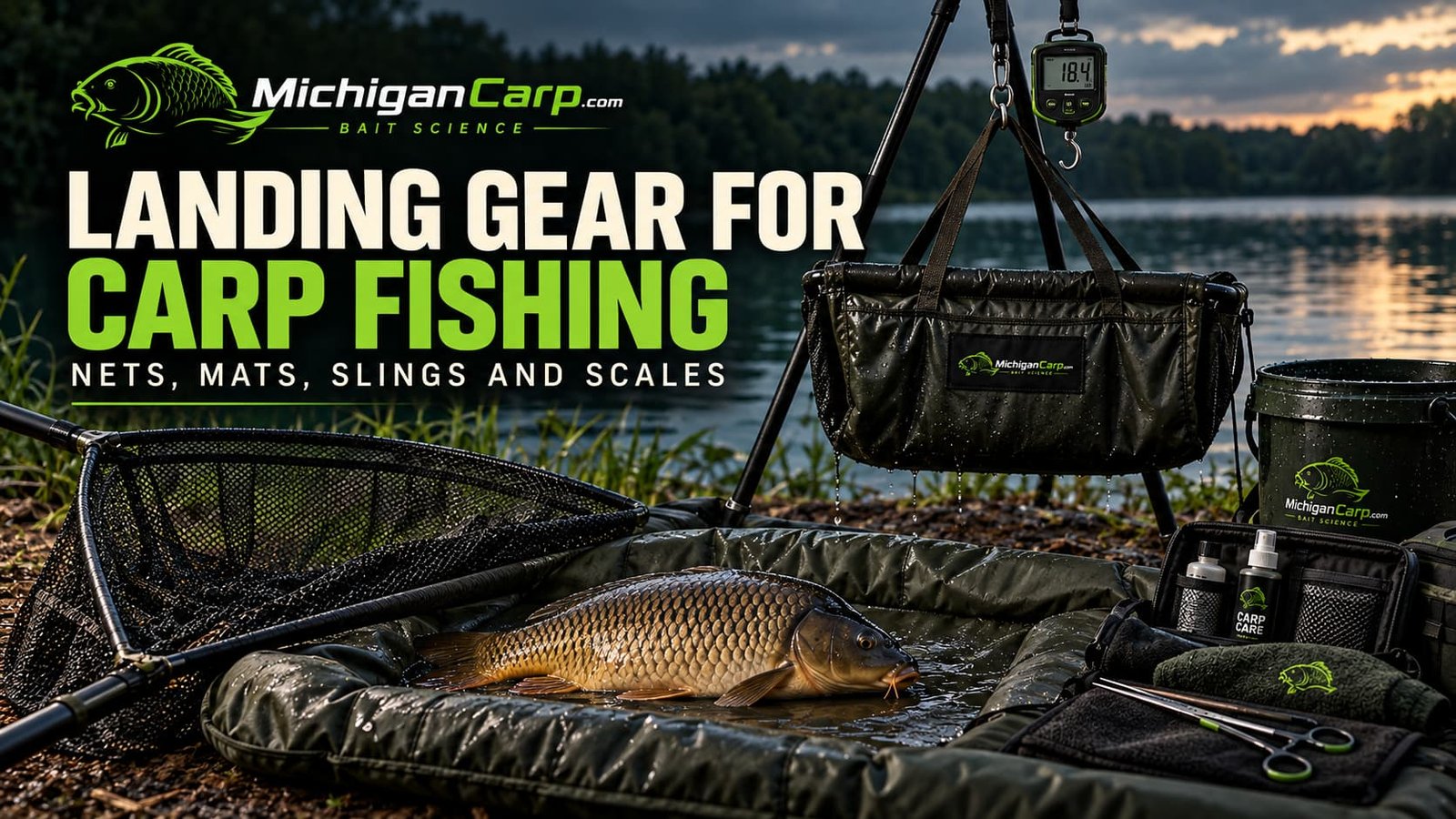
Landing gear for carp fishing should be treated as part of the fishing system rather than equipment you think about only after a carp is already in the net.
A rod, reel and rig help you hook a fish, but a landing net, padded mat or cradle, weigh sling and properly organized weighing setup determine what happens once that fish reaches the bank. On Michigan public waters, where banks may include rocks, campground shorelines, riprap, weed, steep drops and boat traffic, that planning matters just as much as it does on a purpose-built carp lake.
The aim is not to buy every carp accessory available. It is to have enough equipment to land, unhook, weigh and return the fish without improvising once the carp is already under your control.
That means choosing the equipment for the water you actually fish, preparing it before the rods go out and keeping the whole setup close enough that a fish is never left waiting while you search for forceps, scales or a sling.
For the complete handling and release standard, use Carp Fish Care and Safety. For the broader tackle system, use Carp Fishing Gear for Michigan.
Table of Contents
Quick Start: Essential Landing Gear for Carp Fishing
| Equipment | Priority | Main Job |
|---|---|---|
| Proper carp landing net | Essential | Land and temporarily secure the fish |
| Padded unhooking mat or cradle | Essential | Protect the carp on the bank |
| Water bucket/container | Essential | Keep mat, sling and fish wet |
| Forceps or pliers | Essential | Safe hook removal |
| Weigh sling | Strongly recommended | Support fish during weighing |
| Reliable scales | Recommended if recording weights | Accurate, repeatable weighing |
| Weighing tripod/support | Useful for large carp | Stable weighing with less lifting strain |
| Camera/phone ready | Optional | Quick photographs without unnecessary delay |
| Headlamp | Important at night | Safe hands-free handling |
| Carp-care treatment | Optional | Minor hookhold/abrasion care where appropriate |
| Retention sling | Specialist/optional | Short supervised retention only when genuinely necessary |
For most anglers, the minimum practical system is straightforward:
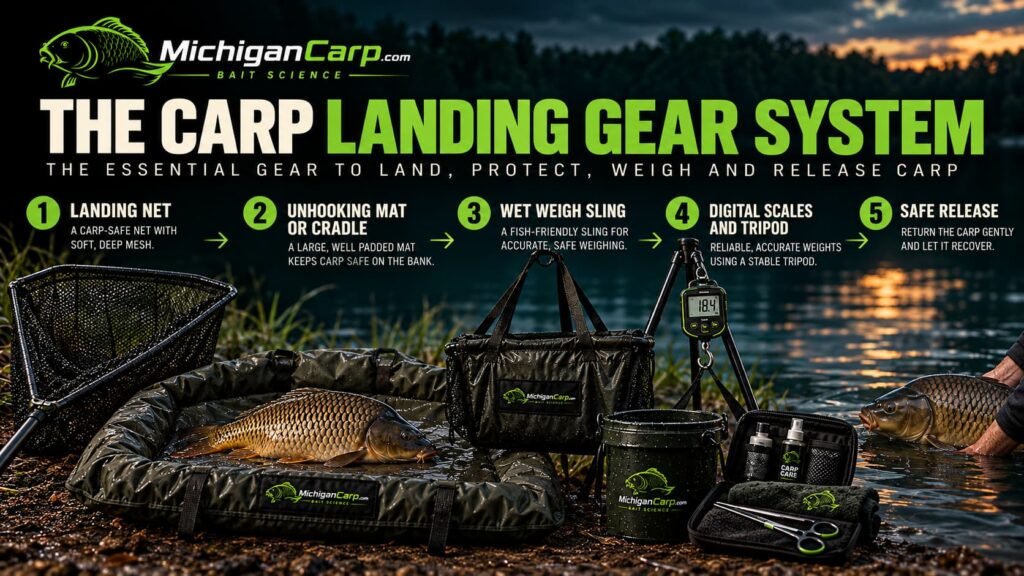
NET → MAT OR CRADLE → WATER → FORCEPS → SLING → SCALES
Everything else is secondary.
The Landing Net Is the First Part of the System
A proper carp landing net gives you enough opening and mesh depth to guide a large fish into the net without folding it awkwardly or chasing it around the margin with a small hoop.
For general Michigan carp fishing, the familiar 42-inch carp net is a very useful all-round starting point. The quoted size normally refers to the length of the net arms rather than the width across the front, and the resulting triangular head gives enough room for most common carp an angler is likely to encounter.
That does not make 42 inches a mandatory biological requirement. Smaller nets can work for smaller fish and very mobile fishing, while larger nets may make sense for anglers routinely dealing with exceptional fish or particularly awkward banks.
The useful question is whether the net is comfortably large enough for the fish you are targeting and manageable on the bank you are fishing.
What Makes a Good Carp Landing Net?
The important qualities are less complicated than the marketing often suggests.
The mesh should be fish-friendly and sufficiently deep to contain a carp safely. The arms and spreader block need enough strength for repeated use, while the handle should be long and rigid enough to give control at the margin without becoming unnecessarily heavy.
I also pay attention to how easily the net can be broken down once the fish is inside.
A good carp net allows the angler to remove the handle or release the arms and then support the mesh containing the fish, rather than attempting to carry a heavy carp around suspended from the end of the net handle.
The handle is designed to position and net the fish. It is not a crane.
Landing-Net Handle Length Matters
The ideal handle depends heavily on the shoreline.
A conventional two-piece carp handle works well on many gently sloping banks, campground shorelines and ordinary lake margins. Extra reach becomes valuable when fishing reeds, shallow shelves, riprap, marinas or banks where the water cannot easily be approached.
A longer handle is not automatically better. Extra length adds leverage, weight and bulk, and on a tight bank or under trees it can become awkward.
Choose enough reach to land the carp safely from the bank you actually use.
If a swim has such a severe drop that the fish cannot be safely netted or transferred to the mat even with a suitable handle, the answer is not simply a longer pole. It may be a poor fish-care swim.
Keep the Landing Net Ready Before the Bite
One of the easiest mistakes to eliminate is leaving the net folded behind the bivvy or packed into the vehicle while the rods are fishing.
Once a carp is close to the bank, the angler should be concentrating on fish control rather than assembling equipment.
I prefer the net already connected, positioned near the expected landing area and clear of loose line, bank sticks and other tackle.
The same principle applies to the mat and sling.
The landing system should be ready before the carp arrives.
Unhooking Mat or Carp Cradle?
Both perform the same basic job: providing a padded, clean and wet surface between the carp and the ground.
The difference is mainly containment, padding, weight and bulk.
A conventional padded mat is lighter, folds more easily and suits anglers who move frequently or carry equipment some distance. A well-sized mat can provide perfectly good protection when used on level ground and when the angler keeps the fish controlled.
A cradle generally provides deeper padding and raised or enclosed sides, which can help contain a lively carp and keep it away from uneven or dirty ground. The trade-off is considerably more bulk.
For long Michigan sessions where the vehicle, campsite or boat allows me to carry more equipment, I would normally choose the more protective option rather than save a small amount of space.
For very mobile fishing, a good full-sized padded mat may make more practical sense.
Size the Mat for the Carp, Not the Catalog Photograph
A mat should comfortably contain the whole fish.
The head and tail should not be hanging off opposite ends while the angler tries to keep the carp balanced in the middle.
This matters increasingly as fish size rises. A mat that looks generous beneath a 12 lb carp can feel very small beneath a 35 or 40 lb fish.
If you routinely target larger wild carp, choose landing gear with that realistic upper fish size in mind rather than buying for the average fish you expect to catch.
The cost and bulk difference between an adequate mat and a genuinely useful one is usually easier to live with than discovering the problem after a large carp is already on the bank.
The Mat Should Be Wet Before the Fish Arrives
A dry mat or cradle is not ready.
Keep a dedicated water container nearby and wet the surface before the carp is transferred from the net. During warm weather, it may need additional water during handling.
This is another reason I treat a water bucket as part of the landing kit rather than a camping accessory.
It should be filled before you need it.
Do not rely on finding a bottle after the fish is already on the mat.
For the detailed net-to-release procedure, use Carp Weighing, Photos and Release.
Forceps and Hook-Removal Tools
A pair of reliable forceps or long-nose pliers should always be within reach of the mat.
Most straightforward carp hookholds can be dealt with quickly, but the tool still needs to be accessible and strong enough to grip the hook cleanly.
This is especially important when using larger, stronger carp hooks.
I prefer one known pair of forceps in the fish-care kit rather than relying on whichever multitool happens to be somewhere in a tackle bag.
A small pair of line cutters is also sensible because there are situations where cutting a hooklink or damaged line is quicker and safer than trying to manipulate the whole rig around the fish.
Why a Weigh Sling Is Worth Having
If you intend to weigh carp regularly, a proper weigh sling makes the job much easier and more repeatable.
The sling supports the fish across a broad surface while allowing water to drain, and most modern versions provide secure handles or weighing loops that position the fish consistently beneath the scales.
A landing net can physically hold a fish, but it is not the ideal weighing tool. Nets trap variable amounts of water, their weight can change, and the fish can sit awkwardly inside the mesh.
A dedicated sling gives you a known piece of equipment that can be wetted and tared before use.
That makes both fish support and recorded weight more consistent.
Standard Weigh Sling or Retention Sling?
A standard weigh sling has one main purpose: transferring and supporting a carp during weighing.
A retention sling adds features designed to hold a carp temporarily in the water, usually with more secure closures, flotation and tether points.
That does not mean every carp angler needs a retention sling.
My preference is to organize the weighing and photography so the carp can be returned without unnecessary delay. Retention should remain an occasional tool rather than the default routine.
If a fish does need to be retained briefly, conditions, water depth, temperature, wave action and supervision all matter.
A retention sling should never become somewhere a carp is put simply because the angler is not ready.
Scales: Digital or Dial?
Both digital and dial scales can work well.
Digital scales are convenient, easy to read and normally make taring straightforward. Their obvious weakness is dependence on batteries and electronics, which means spare batteries are sensible on longer trips.
Good dial scales are simple and require no battery. They also make it easy to see a stable reading, although the angler must remember to check the zero and read the scale correctly.
The important issue is not whether the display is digital.
The important issues are:
- sufficient capacity;
- repeatability;
- the ability to tare the sling;
- a clear display;
- and reasonable accuracy.
If you fish waters capable of producing 40 lb carp, scales that max out at 40 lb are obviously a poor choice.
Give yourself sensible capacity above the largest fish you realistically expect.
Check Your Scales at Home
You do not need laboratory calibration equipment to notice a major problem.
Occasionally check the scales using one or more known weights at home. You are looking for obvious drift or inconsistency rather than attempting to certify them as commercial scales.
The same scales should also be used consistently if accurate personal records matter to you.
Changing between several inexpensive scales and several different wet slings introduces more uncertainty than most anglers realize.
For a personal best, consistency matters.
Why a Weighing Tripod Can Be Useful
A tripod is not essential for every carp angler, but it becomes increasingly useful with large fish.
Holding a heavy carp at arm’s length on a hand-held scale while trying to read the display can be awkward. A tripod places the scales at a stable height and lets the sling hang freely while the reading settles.
This is particularly useful for older anglers, very heavy carp and situations where another person is not available to help.
A tripod also removes the temptation to lift the fish higher than necessary merely to see the scales.
The limitation is obvious: another bulky item has to be carried.
For mobile sessions with modest fish, it may not justify the space. For long sessions targeting large carp, it can be an excellent piece of equipment.
A Strong Weigh Bar Is the Compact Alternative
A weigh bar gives two-handed control without the bulk of a tripod.
For moderate fish this can make weighing much easier than holding the scale body directly.
The same rule still applies: lift only as high and for as long as necessary, with the padded mat or cradle underneath the fish.
The purpose of a weigh bar is control, not height.
The Weighing Area Should Be Built Around the Mat
Whether using a tripod, bar or hand-held scales, position the weighing equipment so the fish remains above the protected area.
Do not carry a carp across the campsite simply because the tripod looks better beside the bivvy.
If the weigh station cannot be positioned near the mat, rethink the setup.
The sequence should be compact.
NET → MAT → SLING → WEIGH → MAT → RELEASE
Reducing distance reduces opportunities for mistakes.
Mobile Carp Fishing vs Long Sessions
Landing gear should suit the way you actually fish.
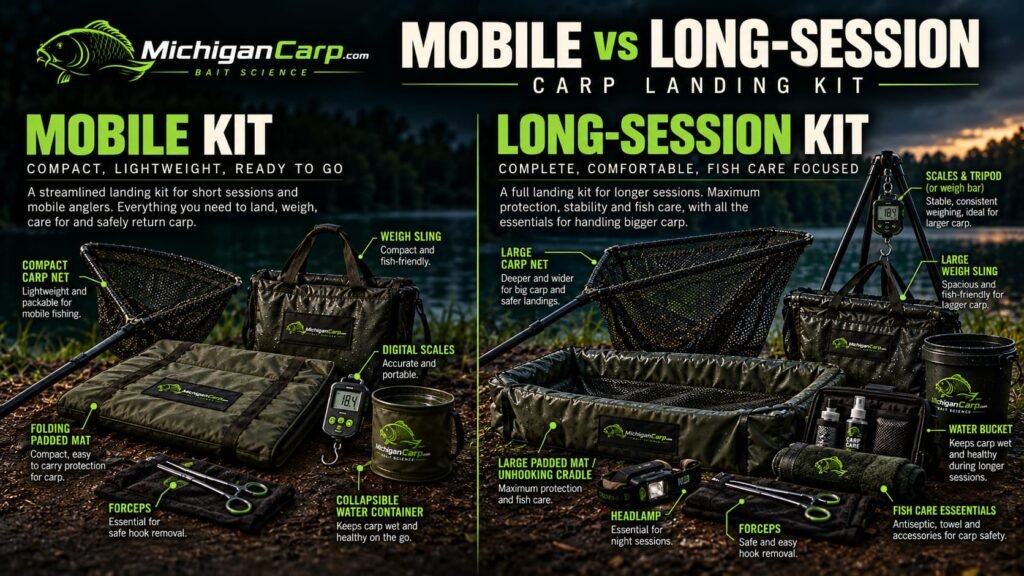
A mobile angler may accept slightly lighter equipment because every item has to be carried repeatedly. A compact net handle, folding padded mat, standard weigh sling and digital scales may create a sensible mobile system.
A long-session angler with vehicle or boat access can choose larger and more protective equipment without the same penalty.
For my own style of multi-day Michigan fishing, I would prioritize a spacious mat or cradle, a proper 42-inch-style net, a large sling and scales with enough capacity for the biggest carp the water might realistically produce.
Saving a few pounds of equipment is useful.
Saving weight by compromising the equipment that protects the fish is not where I would make the cut.
A Practical Mobile Landing Kit
A mobile setup can still be complete.
I would want:
- one proper carp net;
- a compact but full-size padded mat;
- weigh sling;
- compact scales;
- forceps;
- line cutters;
- water bottle or collapsible bucket;
- and phone/camera already configured.
That is enough to fish safely without carrying a complete bivvy-session weigh station.
A Practical Long-Session Landing Kit
For a three- to five-day session, I would expand the system because the cost in portability is much lower.
My priorities would be:
- proper large landing net;
- larger padded mat or cradle;
- dedicated water bucket;
- spacious weigh/retention sling;
- high-capacity scales;
- tripod or weigh bar where useful;
- forceps and cutters kept at the mat;
- headlamp;
- clean towel for the angler rather than the fish;
- phone or camera mount ready;
- and a planned return route.
This gear should stay in the same place throughout the session so the routine becomes automatic.
Bank Setup Matters as Much as the Equipment
Excellent landing gear can still be badly arranged.
Before fishing, identify where the carp will actually be netted and how it will travel from the water to the mat.
Look for:
- steep rocks;
- roots;
- bank sticks;
- guy ropes;
- tackle boxes;
- fire rings;
- picnic tables;
- rod lines;
- drop-offs;
- mud;
- and anything else that complicates carrying a fish.
The best place for the bivvy is not automatically the best place for the mat.
Set the fish-care area according to the safest landing route.
For that complete system, use Carp Fish Care and Safety.
High Banks, Riprap and Piers Need Extra Thought
Some Michigan carp swims look excellent until you imagine trying to land a 30 lb carp there.
Riprap may provide a long handle reach but nowhere safe to kneel.
A pier can offer easy casting while creating an unacceptable drop to the water.
A steep bank may have room for rods but no realistic route from net to mat.
In those situations, buying more specialized landing gear may solve part of the problem, but equipment cannot make every swim safe.
If the carp cannot be landed, transferred and released without excessive risk, the swim itself may be unsuitable.
That is part of watercraft.
Night Fishing Needs a Dedicated Landing Routine
Darkness magnifies every small organizational problem.
The landing net should already be assembled, the mat should be clear, forceps and sling should have fixed positions, and a headlamp should be immediately accessible.
I would also check the route between rods, net and mat before darkness rather than discover a tent peg, root or drop-off with a carp in the sling.
The more complex the bank, the more important that preparation becomes.
A long night session should feel easier to manage than a rushed day session because everything has been deliberately organized.
Hot Weather Changes the Priority
During hot weather, organization matters even more because extended fights and prolonged handling add unnecessary stress.
This is when I am least interested in searching for scales, rearranging photography equipment or moving a carp farther than necessary.
The equipment should already be wet and positioned.
If conditions or the condition of the fish make weighing or photographs a poor idea, skip them.
For the full temperature and fish-care context, use Carp Water Temperature Guide for Michigan Lakes and Carp Fish Care and Safety.
Wet Equipment Is Not the Same as Dirty Equipment
Keeping the mat and sling wet is important, but equipment should also be kept reasonably clean.
Mud, sand, grit, hooks and debris do not belong on the surface where the fish will be handled.
After a session, mats and slings should be rinsed and dried before long-term storage rather than sealed wet inside a bag for weeks.
This improves hygiene and also stops the equipment becoming unpleasant to handle.
A clean fish-care kit is easier to inspect for damage before the next trip.
Inspect Landing Gear Like You Inspect Tackle
Net mesh can tear.
Spreader blocks can loosen.
Handles can crack.
Mat seams can split.
Sling zips and handles can wear.
Tripod fittings can loosen.
Scale batteries can fail.
None of these items should be discovered after a large carp is already waiting.
Add a simple inspection to your normal session preparation, especially before longer trips.
Do You Need a Carp Cradle?
Not necessarily.
A large, well-padded mat can protect a carp perfectly well when used correctly on good ground.
A cradle becomes more attractive when fish are large, the ground is uneven or the angler wants more containment.
For my type of fishing, where sessions are often several days and large carp are a realistic possibility, I see a good cradle as worthwhile if transport space allows it.
But I would rather see an angler use a good mat properly than own an expensive cradle that is still folded away when the fish arrives.
Equipment only works when it is ready.
Do You Need a Retention Sling?
No.
A retention sling is useful in specific circumstances, but it should not become part of the normal sequence simply because one is available.
If the camera is ready, the scales are ready and the release route is clear, there is usually no reason to hold the fish while the angler reorganizes the bank.
Retention is not a substitute for preparation.
Do You Need Expensive Scales?
No, but you need reliable scales if the weight matters to you.
For occasional fishing, a sensible mid-range digital or dial scale is enough.
For anglers targeting very large carp and recording personal-best weights, reliability, capacity and repeatability become more important.
The scales are not where I would spend money for appearance.
I would spend enough to trust the reading.
What I Would Buy First
If starting from nothing, I would prioritize the fish rather than the weighing equipment.
The first purchases would be a proper carp landing net and a genuinely adequate padded mat or cradle. Those are required whether the carp weighs 12 lb or 42 lb.
Next I would add a weigh sling and reliable scales if I wanted to record fish weights.
A tripod, retention sling and other specialized accessories can come later.
This order keeps the essential fish-care system intact without making beginners think they need an entire UK-style carp camp before fishing.
Common Landing-Gear Mistakes
Buying a Net That Is Too Small
A small general-purpose net may land smaller carp, but it becomes awkward quickly when a bigger fish arrives.
Buying a Tiny Mat to Save Space
The fish has to fit completely onto the protected surface. Compact is useful only while it remains adequate.
Carrying a Carp by the Net Handle
Once the fish is safely netted, support the mesh and fish appropriately rather than using the long net handle as a lifting lever.
Keeping the Mat Packed Away
A mat in the vehicle is not protecting the fish in the net.
Forgetting Water
The mat and sling should be ready to wet before the fish reaches the bank.
Not Taring the Sling
If an accurate weight matters, tare the wet sling before weighing.
Using Scales With Insufficient Capacity
Your scales need enough headroom for the fish the water could realistically produce.
Building the Weigh Station Too Far From the Water
Keep the net, mat, weighing setup and return route compact.
Treating a Retention Sling as a Waiting Room
Organize the session so unnecessary retention is avoided.
Ignoring the Landing Route When Choosing a Swim
A swim is not fish-safe simply because the carp can be hooked there.
My Practical MichiganCarp View
Landing gear is one of the areas where I think carp anglers should keep things simple but refuse to compromise.
I do not believe every angler needs the largest cradle, the most expensive scales and a pile of specialist accessories. I do believe every angler deliberately targeting large carp should be able to answer four basic questions before putting a rod out:
Can I net the fish properly?
Can I protect it once it reaches the bank?
Can I remove the hook and weigh it without improvising?
Can I return it safely from this swim?
If any of those answers is uncertain, the setup is not finished.
On the Michigan waters I fish, landing problems are often created by the bank rather than the carp. Riprap, weed, steep shorelines, boat wakes, campground obstacles and awkward margins can make an apparently easy swim difficult once a heavy fish is in the net.
That is why I want the landing system decided before fishing, not after the bite.
The final rule is simple:
PREPARE THE LANDING GEAR BEFORE YOU PREPARE FOR THE PHOTO.
FAQ
What landing gear do I need for carp fishing?
At minimum, use a proper carp landing net, a sufficiently large padded unhooking mat or cradle, forceps and a source of clean water for wetting the equipment. Add a weigh sling and scales if you intend to weigh fish.
Is a 42-inch landing net necessary for carp?
A 42-inch-style carp net is a very useful all-round size for serious carp fishing, especially when larger fish are possible. Smaller nets can work in some circumstances, but the net should comfortably handle the largest carp you realistically expect.
Is a carp cradle better than an unhooking mat?
A cradle normally provides more padding and containment, but it is bulkier. A good full-sized padded mat can still provide suitable protection when used correctly.
Do I need a weigh sling?
If you want to weigh carp regularly, a proper weigh sling is strongly recommended because it supports the fish consistently and can be tared with the scales before weighing.
Can I weigh a carp in the landing net?
It is possible, but a dedicated weigh sling is preferable because net mesh retains variable amounts of water and is less consistent for accurate weighing and fish support.
Should I use digital or dial scales?
Either can work. Choose scales with enough capacity, consistent readings and a convenient way to tare the wet sling.
Do I need a weighing tripod?
No. A tripod is optional, but it can make weighing large carp easier and more controlled. A weigh bar is a more compact alternative.
Do I need a retention sling?
Not for normal carp fishing. A retention sling is a specialist item for short, supervised retention when genuinely necessary and safe.
What should I prepare before the rods go out?
Assemble the net, position and wet the mat or cradle, fill the water container, place forceps and sling within reach, check the scales and confirm a safe release route.
Can I fish a swim if landing the carp will be difficult?
Difficulty alone does not make the swim impossible, but if you cannot realistically net, transfer and release a carp safely, choose another position. Fish safety should be part of swim selection.
Next Steps
For the complete handling standard, continue with Carp Fish Care and Safety.
For the detailed sequence from landing net to safe release, use Carp Weighing, Photos and Release.
For organizing rods, landing space and the fish-care area before fishing, read Carp Fish Care and Safety.
For the broader tackle system, use Carp Fishing Gear for Michigan.
For line strength, leaders and abrasion hazards around rough Michigan water, read Carp Fishing Line and Leaders for Michigan.
For safe terminal tackle, continue with Complete Carp Rigs Guide for Michigan.