

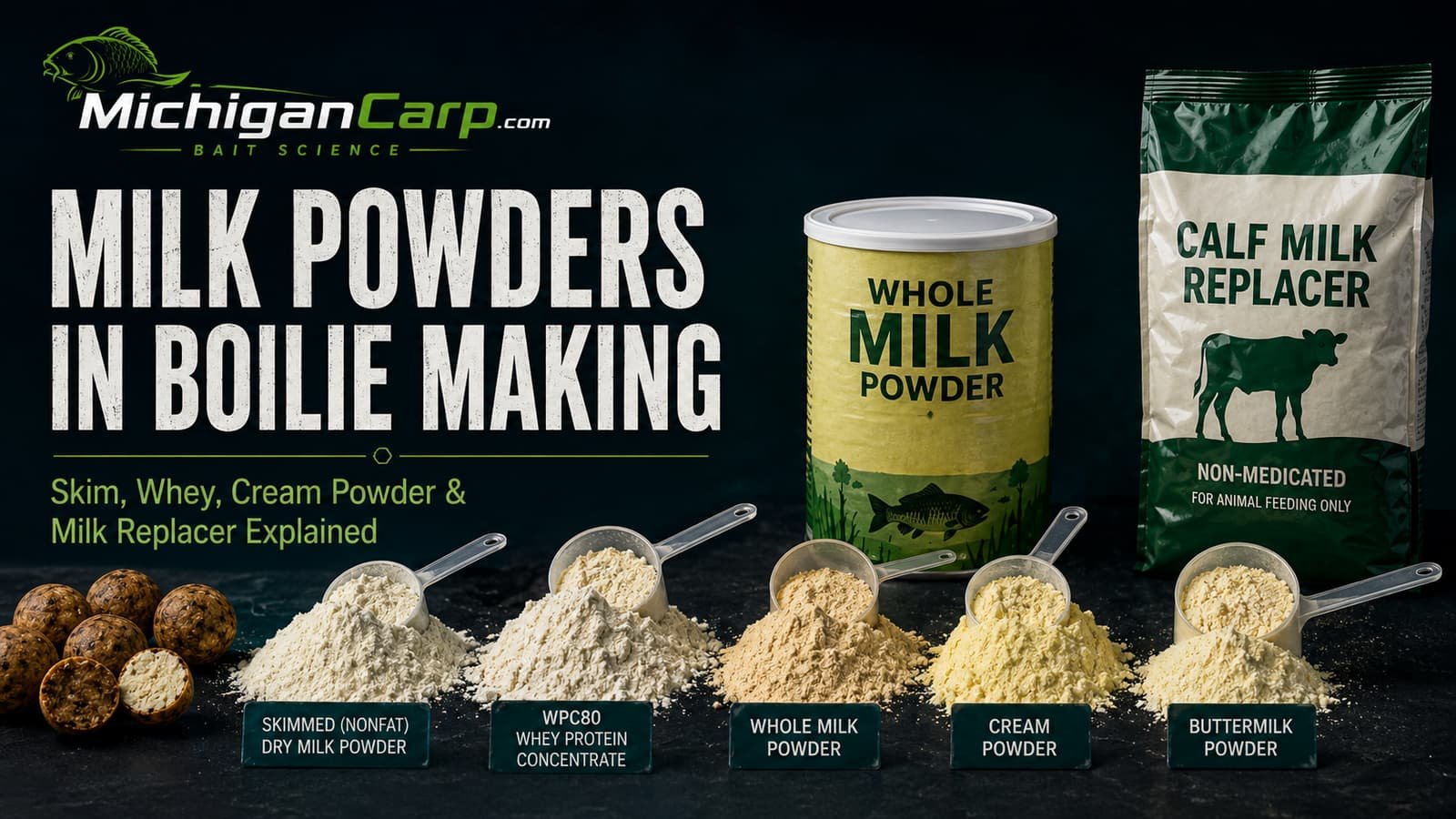
Milk powders in boilie making are often misunderstood.
Some bait makers treat every white dairy powder as if it does the same thing.
Others chase expensive milk proteins without understanding what ordinary milk powders can already do in a boilie.
The truth is more useful.
Skimmed milk powder, whole milk powder, buttermilk powder, cream powder, whey powder, WPC80, hydrolyzed whey, lactose, coconut milk powder and calf milk replacer all behave differently.
They affect:
ROLLING.
BINDING.
CREAMINESS.
LEAKAGE.
TEXTURE.
HARDNESS.
SOLUBILITY.
MILK IDENTITY.
FOOD VALUE.
HOOKBAIT CHARACTER.
A milk powder is not automatically a high-protein bait ingredient.
A whey powder is not the same thing as casein.
A calf milk replacer is not the same thing as grocery-store dry milk.
A full-cream milk powder does not behave like skimmed milk powder.
A milk/nut boilie is not built by throwing random dairy powders into semolina and hoping for creaminess.
Good milk-powder bait making starts with understanding what each ingredient actually contributes.
For the broader boilie ingredient foundation, read Boilie Ingredients Explained.
For boilie base-mix families, use Boilie Base Mix Families.
For deeper milk protein science, read Milk Proteins in Carp Bait.
For the practical comparison of casein, caseinate, WPC and skimmed milk powder, use Casein, Caseinate, WPC and Skimmed Milk Powder.
For milk/nut formulation, read How to Formulate a Milk, Nut and Birdfood Boilie Base Mix.
The clean rule is:
MILK POWDERS ARE NOT ONE INGREDIENT.
THEY ARE A FAMILY OF INGREDIENTS WITH DIFFERENT JOBS.
Table of Contents
Quick Start: Milk Powders in Boilie Making
Use this table as the basic decision guide.
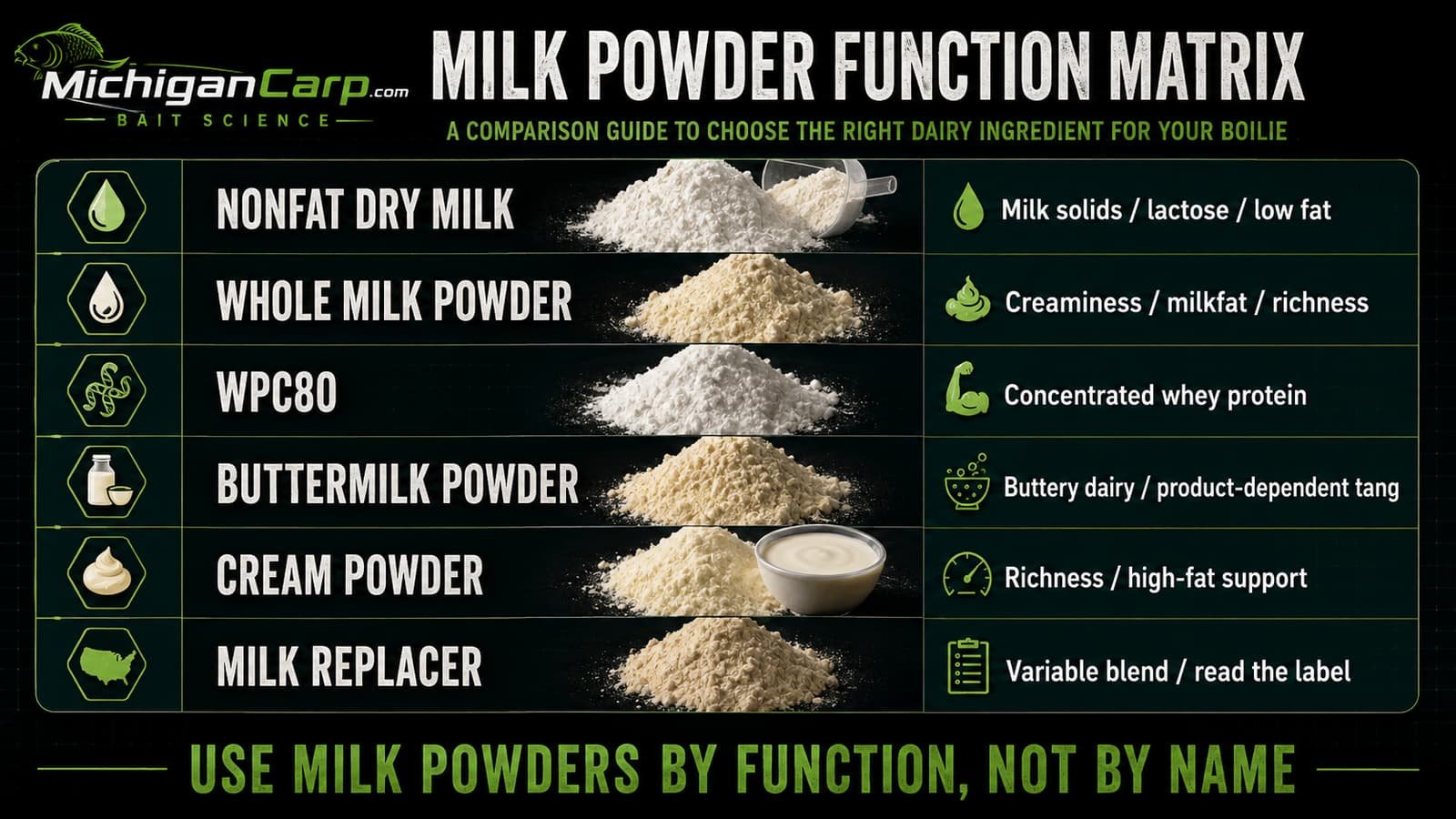
| Ingredient | Main Job in Boilies | Best Use | Starting Range |
|---|---|---|---|
| Nonfat dry milk / skimmed milk powder | Milk solids, lactose, light creaminess, structure | Basic milk/cream background | 5–20% |
| Whole milk powder / full-cream powder | Creaminess, fat, richer milk profile | Milk/nut, cream, maple, vanilla baits | 5–15% |
| Nido-style full-cream milk powder | USA-available whole milk powder option | Practical milk/nut boilies | 5–15% |
| Buttermilk powder | Tangy dairy, soft cream note, fermentation-style character | Birdfood, cream, savory blends | 3–10% |
| Cream powder | Fat-rich cream profile | Hookbaits, cream/nut boilies, small additions | 2–8% |
| Whey powder / sweet whey | Lactose-heavy dairy powder, mild solubility | Cheap milk background, limited use | 3–10% |
| WPC80 | High whey protein, lower lactose than sweet whey | Milk protein lift, soluble dairy signal | 3–12% |
| Hydrolyzed whey | More soluble, sharper amino/peptide style | Small trigger/support ingredient | 1–5% |
| Lactose | Milk sugar, mild sweetness, carbohydrate support | Cream profile, hookbaits, controlled use | 2–10% |
| Coconut milk powder | Fat, coconut cream profile | Milk/nut, tropical fruit, birdfood baits | 2–8% |
| Calf milk replacer | Blended dairy/fat/vitamin/mineral ingredient | USA practical milk-style bait support | 5–15% |
| Casein / caseinate | Structure, hardness, protein function | Specialist milk-protein bait work | See specialist casein guide |
These are starting ranges, not rules.
The correct level depends on:
- the rest of the base mix;
- egg level;
- rolling texture;
- boil time;
- desired hardness;
- shelf-life plan;
- hookbait vs freezer bait;
- water temperature;
- bait size;
- whether the bait is milk/nut, fruit/cream, birdfood or savory.
Milk Powder, Milk Protein and Milk Replacer Are Not the Same
This is the first thing to understand.
Anglers often use “milk powder” loosely.
That causes confusion.
Milk Powder
Milk powder usually means dried milk solids.
Examples:
- nonfat dry milk;
- skimmed milk powder;
- whole milk powder;
- full-cream milk powder;
- buttermilk powder.
These ingredients contain a mix of milk proteins, lactose, minerals and sometimes fat.
Whey Protein
Whey protein products are made from whey and are usually concentrated to different protein levels.
WPC34 and WPC80 are not the same as skimmed milk powder.
WPC80 is much higher in protein and much lower in lactose than ordinary sweet whey powder. The American Dairy Products Institute describes common WPC80 as roughly 80–82% protein with about 4–10% lactose, while WPC34 is far lower protein and much higher lactose. ADPI WPC Standard.
Casein and Caseinate
Caseins and caseinates are more specialized milk proteins.
They behave differently from milk powders and whey powders.
They can affect hardness, structure, elasticity, binding and long-term bait texture.
For that subject, use Milk Caseins for Boilie Making.
Calf Milk Replacer
Calf milk replacer is a manufactured animal-feed product.
It may contain milk ingredients, whey products, fats, vitamins, minerals, emulsifiers and sometimes medication or additives depending on the product.
It can be useful for USA bait makers, but the label matters more than the name.
The FDA warns that medicated milk replacers are medicated feed and must be handled according to their approved labels. FDA Medicated Milk Replacers.
That is why bait makers should avoid medicated replacers and read the tag carefully.
What Milk Powders Actually Do in a Boilie
Milk powders can do several different things in a boilie.
The mistake is assuming they only add protein.
They do much more than that.
They Add Milk Solids
Milk powders add a broad dairy base.
This can include:
- lactose;
- milk proteins;
- minerals;
- milkfat if whole or cream-based;
- creamy aroma;
- soft dairy taste profile.
They Change Rolling Texture
Milk powders can make dough:
- smoother;
- creamier;
- less gritty;
- more plastic;
- easier to roll at moderate levels;
- sticky if overused;
- slow to firm if the wet side is too heavy.
They Affect Leakage
Milk powders do not all leak the same.
Fine powders, lactose, whey fractions and soluble components may move out of the bait more readily than harder casein structures.
But boiling, drying, egg level and base-mix structure all change the finished bait.
They Affect Hardness
Some milk powders soften a bait.
Others tighten it.
Whole milk and cream powders can make a bait richer and softer if the rest of the mix cannot absorb the fat.
Caseins and caseinates can help structure and hardness, but they are not the same as general milk powders.
They Add Creaminess
This is one of their strongest practical jobs.
Milk powders help create:
- cream baits;
- milk/nut baits;
- maple/vanilla baits;
- fruit-and-cream baits;
- birdfood cream baits;
- soft sweet hookbait profiles.
They Can Support Food Value
Milk powders are not just flavor.
They bring nutrients, proteins, lactose, minerals and sometimes fat.
But their food value depends on the exact powder.
Do not treat all dairy powders as equal.
USA Terminology: Skimmed Milk Powder vs Nonfat Dry Milk
UK bait makers often say “skimmed milk powder.”
In the USA, the common grocery and ingredient term is usually:
nonfat dry milk.
That matters when buying ingredients.
USDA standards describe nonfat dry milk as the product made by removing only water from pasteurized skim milk, with not more than 5% moisture and not more than 1.5% milkfat. USDA Nonfat Dry Milk Standards.
For bait making, this means:
For practical bait buying, skimmed milk powder and nonfat dry milk are very similar products, although their formal manufacturing standards are not completely identical. In the USA, nonfat dry milk is usually the term you will encounter.
When you search in the USA, look for:
- nonfat dry milk;
- dry skim milk;
- instant nonfat dry milk;
- baker’s dry milk;
- low-heat nonfat dry milk if available;
- high-heat nonfat dry milk for baking-style use.
For carp bait, grocery-store nonfat dry milk is often the easiest starting point.
It is not exotic, but it is useful.
Nonfat Dry Milk / Skimmed Milk Powder
Nonfat dry milk is the basic milk powder.
It is probably the most practical starting dairy powder for US bait makers.
What It Does
Nonfat dry milk adds:
- milk solids;
- lactose;
- light creaminess;
- milk protein;
- fine powder structure;
- mild binding;
- smooth dough character;
- a familiar creamy bait profile.
What It Does Not Do
It does not behave like casein.
It does not create the same hardness as rennet casein or acid casein.
It does not replace WPC80 when you want a higher whey-protein ingredient.
It does not automatically make a bait “high protein.”
It is a broad milk-solid ingredient.
Best Uses
Use nonfat dry milk in:
- beginner milk boilies;
- milk/nut boilies;
- fruit-and-cream baits;
- birdfood cream baits;
- maple/vanilla/butter baits;
- low-cost dairy background blends;
- packbait matching milk/nut boilies.
Starting Range
A useful starting range:
5–20% of the dry base mix.
For a 1 kg dry mix:
- 50 g = light milk background;
- 100 g = clear milk contribution;
- 150–200 g = strong milk-powder role.
Above that, watch rolling, stickiness, drying and bait density.
Practical View
Nonfat dry milk is not glamorous, but it is dependable.
It gives you milk identity without pushing fat too high.
For USA bait makers, it is one of the easiest milk powders to buy and test.
Whole Milk Powder / Full-Cream Milk Powder
Whole milk powder is richer than nonfat dry milk because it contains milkfat.
USDA standards for dry whole milk describe a product made by removing water from pasteurized milk, with not more than 5% moisture on a milk-solids-not-fat basis and not less than 26% but less than 40% milkfat. USDA Dry Whole Milk Standards.
What It Does
Whole milk powder adds:
- creaminess;
- milkfat;
- softer mouthfeel;
- richer milk character;
- rounded dairy profile;
- improved milk/nut identity;
- better match to vanilla, maple, scopex and nut flavors.
What It Does Not Do
It does not replace structural casein.
It does not behave like WPC80.
It can make bait richer, but more fat is not always better.
Too much fat can affect rolling, drying, shelf-life and leakage.
Best Uses
Use whole milk powder in:
- milk/nut boilies;
- cream boilies;
- maple/vanilla/butter baits;
- coconut/nut baits;
- fruit-and-cream baits;
- hookbaits where richness matters.
Starting Range
A useful starting range:
5–15% of the dry base mix.
For a 1 kg mix:
- 50 g = light cream effect;
- 100 g = strong cream/nut support;
- 150 g = rich dairy role.
Above that, watch fat load and dough softness.
Practical View
Whole milk powder is excellent when you want real creaminess.
But it should be balanced with structure ingredients such as semolina, birdfood, nut meals, casein, WPC or albumen depending on the bait.
Nido and USA Full-Cream Milk Powder
In the USA, one practical full-cream option is Nido-style dry whole milk powder.
Nido Fortificada is widely sold through grocery and retail channels in the US market, and the product listing from Nestlé’s own GoodNes site identifies it as a fortified dry whole milk product. NIDO Fortificada Dry Whole Milk.
Retail ingredient listings commonly show Nido Fortificada as whole milk with small amounts of lecithin and added vitamins/minerals. NIDO Fortificada Ingredients Example.
Why It Matters for Bait Makers
Nido is useful because it is:
- easy to find in many US areas;
- richer than nonfat dry milk;
- practical for milk/nut boilies;
- good for creamy bait profiles;
- easy to test in small batches.
What to Watch
Because fortified dry whole milk powders may include vitamins, minerals and lecithin, read the label.
That does not automatically make them bad for bait, but it means they are not identical to plain industrial whole milk powder.
Practical View
For a US home bait maker, Nido-style powder is one of the most useful grocery-store dairy ingredients for milk/nut boilies.
It is not the same as specialist casein.
It is not the same as WPC80.
But as a practical full-cream milk powder, it can be very useful.
Buttermilk Powder
Buttermilk powder is a different dairy ingredient from nonfat dry milk.
It has a more tangy, cultured, buttery character.
USDA standards describe dry buttermilk as the product made by drying liquid buttermilk derived from churning butter, and the standard notes that dry buttermilk should have not less than 30% protein. USDA Dry Buttermilk Standards.
What It Does
Buttermilk powder adds:
- tangy dairy note;
- soft acidity;
- creamy background;
- buttery character;
- fine powder texture;
- fermentation-style bait identity;
- support for birdfood and cream baits.
Best Uses
Use buttermilk powder in:
- birdfood boilies;
- cream boilies;
- milk/nut baits;
- maple/vanilla baits;
- savory cream baits;
- cultured dairy-style profiles.
Starting Range
A useful starting range:
3–10% of the dry base mix.
For 1 kg:
- 30 g = light character;
- 50 g = noticeable buttermilk note;
- 100 g = strong dairy role.
Practical View
Buttermilk powder is underused.
It is not as neutral as skimmed milk powder.
That is the point.
It adds character.
Use it when you want a slightly tangy, creamy bait rather than a plain milk background.
Cream Powder
Cream powder is usually used for richness, fat and creamy mouthfeel.
It can be excellent in small amounts.
What It Does
Cream powder adds:
- rich dairy profile;
- fat;
- smoothness;
- softer bait character;
- cream signal;
- improved flavor rounding.
Best Uses
Use cream powder in:
- cream boilies;
- milk/nut boilies;
- fruit-and-cream boilies;
- hookbaits;
- small-batch high-attraction baits;
- maple, vanilla, butter and scopex-style profiles.
Starting Range
A useful starting range:
2–8% of the dry base mix.
For 1 kg:
- 20 g = subtle cream;
- 50 g = clear cream;
- 80 g = strong cream effect.
What to Watch
Cream powder can push fat level up.
Too much can affect:
- rolling;
- drying;
- bait hardness;
- shelf-life stability;
- leakage balance.
Practical View
Cream powder is a finishing ingredient more than a bulk ingredient.
It can make a milk/nut bait feel more rounded, but it should not dominate the base.
Whey Powder
Whey powder is often confused with whey protein concentrate.
They are not the same.
Ordinary sweet whey powder is much more lactose-heavy and much lower in protein than WPC80.
What It Does
Whey powder can add:
- lactose;
- mild dairy sweetness;
- solubility;
- low-cost dairy background;
- light milk signal;
- carbohydrate-heavy milk solids.
What It Does Not Do
It does not provide the protein lift of WPC80.
It does not replace casein.
It does not make a bait high protein.
Best Uses
Use ordinary whey powder in:
- low-cost milk baits;
- sweet cream profiles;
- fruit-and-cream baits;
- packbait;
- small additions to milk/nut mixes.
Starting Range
A useful starting range:
3–10% of the dry base mix.
For 1 kg:
- 30 g = small soluble dairy addition;
- 50–75 g = clear whey/lactose role;
- 100 g = strong carbohydrate/dairy role.
Practical View
Whey powder can be useful, but do not confuse it with WPC80.
If the label just says “whey powder,” assume it is not a high-protein whey ingredient unless the analysis proves it.
WPC80
WPC80 is one of the most useful milk-protein ingredients for modern home bait makers.
It is widely available through sports nutrition suppliers, ingredient suppliers and some online bulk-powder sources.
The U.S. Dairy Export Council defines WPC80 as whey protein concentrate obtained by removing non-protein constituents from pasteurized whey so the finished dry product contains more than 80% protein. ThinkUSAdairy WPC80.
What It Does
WPC80 adds:
- high-quality whey protein;
- soluble dairy signal;
- cleaner protein lift;
- lower lactose than ordinary whey powder;
- smooth milk-protein contribution;
- support for milk/nut and cream baits.
Best Uses
Use WPC80 in:
- milk/nut boilies;
- high-quality cream boilies;
- fruit-and-cream baits;
- hookbaits;
- balanced protein base mixes;
- bait where you want whey protein without adding huge lactose.
Starting Range
A useful starting range:
3–12% of the dry base mix.
For 1 kg:
- 30 g = light whey-protein support;
- 50–80 g = practical main contribution;
- 100–120 g = strong WPC role.
What to Watch
WPC80 can tighten dough and affect rolling.
It may also change how the bait sets during boiling.
Test in small batches before using high levels.
Practical View
WPC80 is one of the most useful USA-available milk ingredients for serious bait makers.
But buy unflavored, simple WPC80 whenever possible.
Avoid chocolate, vanilla shake blends and heavily sweetened gym powders unless you are intentionally testing them.
Hydrolyzed Whey
Hydrolyzed whey is whey protein that has been broken down to some degree.
In bait terms, it can be thought of as a more soluble, sharper, more reactive milk-protein support ingredient.
What It Does
Hydrolyzed whey may add:
- soluble peptide/amino-style signal;
- faster leakage potential;
- stronger taste impact;
- milk-protein breakdown character;
- hookbait or liquid-booster value.
Best Uses
Use hydrolyzed whey in:
- small amounts in milk/nut boilies;
- hookbaits;
- glugs;
- paste;
- packbait;
- short-session bait;
- cold-water or lower-feed testing.
Starting Range
A useful starting range:
1–5% of the dry base mix.
For 1 kg:
- 10 g = light support;
- 20–30 g = noticeable support;
- 50 g = strong hydrolyzed-whey role.
What to Watch
Hydrolyzed ingredients can taste bitter or sharp.
More is not always better.
Use it as a support ingredient, not a bulk powder.
Practical View
Hydrolyzed whey is useful when you want a soluble milk-protein edge.
It is not a replacement for the whole milk-powder system.
It is a trigger-style support layer.
Lactose
Lactose is milk sugar.
It is not a protein ingredient.
That distinction matters.
What It Does
Lactose can add:
- mild sweetness;
- milk identity;
- soluble carbohydrate;
- dairy background;
- support for cream baits;
- subtle hookbait profile.
Best Uses
Use lactose in:
- milk/nut boilies;
- fruit-and-cream baits;
- hookbaits;
- sweet cream baits;
- light soluble bait designs.
Starting Range
A useful starting range:
2–10% of the dry base mix.
For 1 kg:
- 20 g = light support;
- 50 g = noticeable milk-sugar role;
- 100 g = strong lactose contribution.
What to Watch
Lactose is not the same as skimmed milk powder.
It does not bring the same broad milk solids.
It does not bring the same protein.
Use it to support a milk profile, not to replace milk powder.
Practical View
Lactose can be useful, but it is usually more of a specialist support ingredient than a required base ingredient.
Coconut Milk Powder
Coconut milk powder is not dairy milk, but it fits well in milk/nut and creamy bait systems.
What It Does
Coconut milk powder can add:
- fat;
- creamy mouthfeel;
- coconut profile;
- sweetness perception;
- soft texture;
- tropical fruit support;
- nut bait support.
Best Uses
Use coconut milk powder in:
- milk/nut boilies;
- coconut boilies;
- tiger nut baits;
- fruit-and-cream baits;
- pineapple/coconut profiles;
- maple/vanilla/nut baits.
Starting Range
A useful starting range:
2–8% of the dry base mix.
For 1 kg:
- 20 g = light coconut cream support;
- 50 g = clear coconut role;
- 80 g = strong coconut cream profile.
What to Watch
Many coconut milk powders contain carriers such as maltodextrin or other processing aids.
Read the label.
Too much fat or carrier can change rolling, drying and breakdown.
Practical View
Coconut milk powder is excellent in the right bait, especially milk/nut and tropical cream profiles.
But it is not a direct replacement for dairy milk powder.
Calf Milk Replacer
Calf milk replacer is especially relevant for USA bait makers because it is available from farm stores, feed suppliers and agricultural outlets.
It can be a useful carp bait ingredient, but it must be handled carefully.
What It Can Contain
Depending on the product, calf milk replacer may contain:
- dried whey;
- whey protein concentrate;
- skim milk or milk solids;
- animal or vegetable fats;
- emulsifiers;
- vitamins;
- minerals;
- amino acid additions;
- probiotics or gut-support additives;
- medications in some products.
This is why the label matters.
What It Does in Bait
A good milk replacer can add:
- dairy character;
- fat;
- soluble milk/whey ingredients;
- creamy bait profile;
- vitamin/mineral background;
- economical dairy solids;
- useful milk/nut base support.
What to Avoid
Avoid milk replacers that are:
- medicated;
- unclear on ingredients;
- extremely high in salt;
- heavily flavored;
- designed for non-calf species with unsuitable additions;
- full of ingredients you do not understand;
- rancid, old or poorly stored.
FDA guidance also says consumers should use extreme caution when using animal milk replacer products in species other than the intended species named on the label. FDA Milk Replacer Safety Facts.
For carp bait, that translates into a simple rule:
The FDA guidance concerns animal feeding rather than carp-bait formulation, but the practical lesson still applies: read the tag carefully and avoid medicated or unsuitable products.
Ultra 24-Style Milk Replacer
Ultra 24 is one practical example of the kind of calf milk replacer US bait makers may encounter.
The point is not that one brand is magic.
The point is that a 24% protein-style calf milk replacer can be used as a dairy/fat/whey support ingredient if the label is suitable.
Use the label, not the name.
Starting Range
A useful starting range:
5–15% of the dry base mix.
For 1 kg:
- 50 g = light milk-replacer support;
- 100 g = practical working level;
- 150 g = strong milk-replacer role.
Practical View
Milk replacer can be very useful in North America because it solves an availability problem.
But it is not automatically better than milk powder, WPC80 or casein.
Treat it as a blended dairy ingredient and test it carefully.
USA Availability Guide for Bait Makers
This is one of the biggest practical differences between UK and USA boilie making.
UK bait makers often have easier access to bait-specific milk proteins.
US bait makers often have to build from grocery, sports nutrition, baking, restaurant supply and agricultural sources.
That is not a problem.
It just means you need to understand the label.
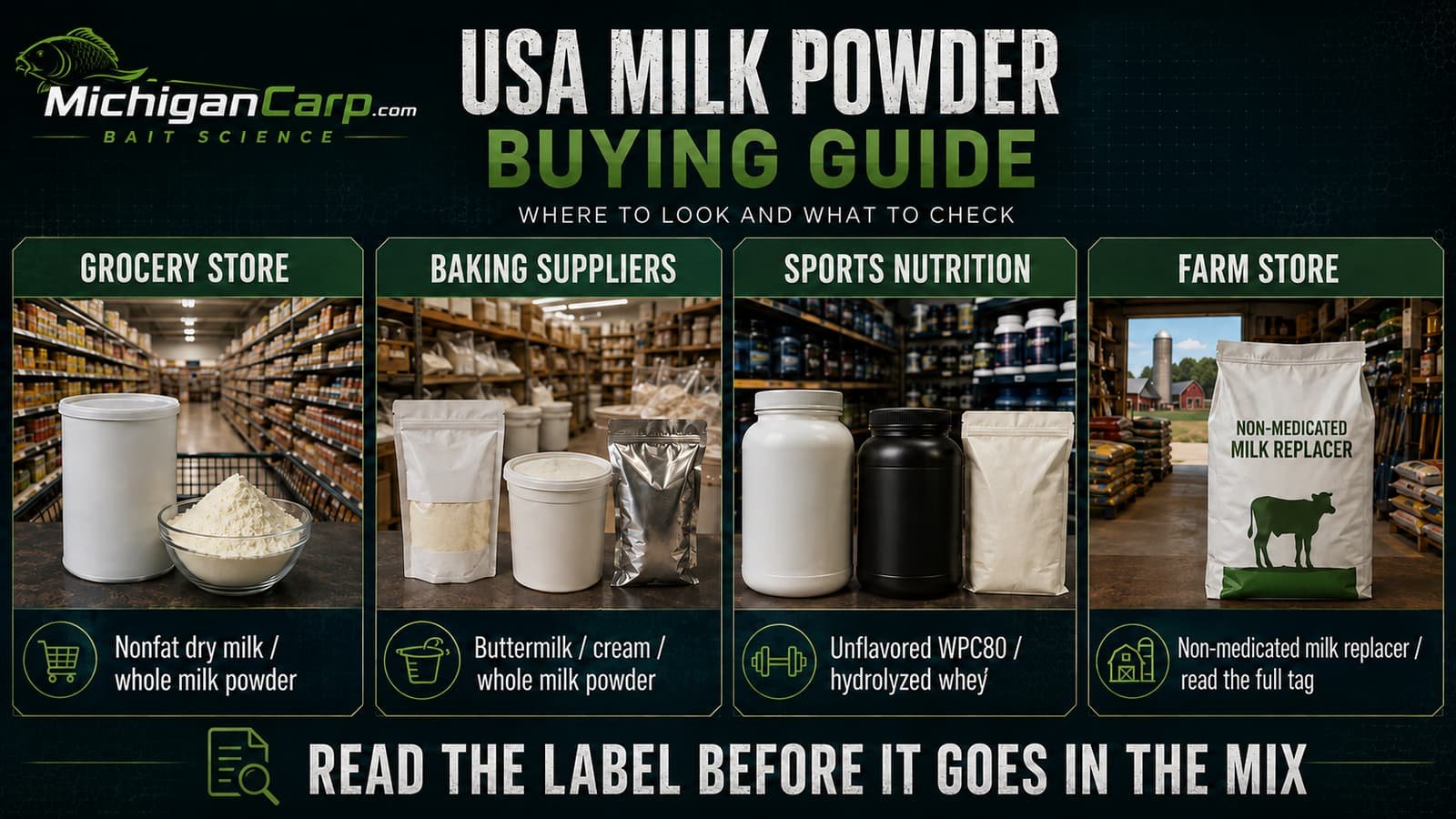
Grocery Stores
Look for:
- nonfat dry milk;
- instant nonfat dry milk;
- Nido-style dry whole milk;
- canned evaporated milk for liquids;
- canned condensed milk for packbait or liquid work;
- coconut milk powder where available.
Best use:
- simple milk boilies;
- milk/nut baits;
- packbait;
- test batches.
Baking Suppliers
Look for:
- whole milk powder;
- buttermilk powder;
- cream powder;
- dry milk powder;
- lactose;
- bakery dry milk.
Best use:
- better milk-powder variety;
- cream baits;
- fruit-and-cream baits;
- birdfood cream baits.
Sports Nutrition Suppliers
Look for:
- unflavored WPC80;
- unflavored whey protein concentrate;
- unflavored whey protein isolate;
- hydrolyzed whey;
- micellar casein;
- sodium caseinate;
- calcium caseinate.
Avoid:
- chocolate flavor;
- vanilla shake blends;
- sucralose-heavy formulas unless intentional;
- gums and thickeners;
- creatine blends;
- pre-workout blends;
- “mass gainer” powders;
- high-salt flavored products.
Best use:
- serious milk/nut boilies;
- hookbaits;
- higher-protein dairy systems.
Farm and Feed Stores
Look for:
- non-medicated calf milk replacer;
- dairy-based replacer;
- whey-based replacer;
- clear ingredient panels.
Avoid:
- medicated replacer;
- unclear tags;
- rancid product;
- very old bags;
- products with unsuitable additives.
Best use:
- practical USA milk/nut baits;
- economical dairy support;
- experimental bait making.
Online Dairy Ingredient Suppliers
Look for:
- WPC80;
- skim milk powder;
- whole milk powder;
- casein;
- caseinate;
- lactose;
- buttermilk powder;
- cream powder.
Best use:
- more precise bait design;
- repeatable formulations;
- serious bait development.
What Not to Buy
Some powders look useful but are poor bait-making choices.
Avoid or be very cautious with:
- flavored protein shakes;
- chocolate whey blends;
- vanilla fitness powders with gums;
- sweetened meal replacements;
- mass gainers;
- medicated calf milk replacers;
- unknown animal-feed blends;
- old rancid dairy powders;
- powders with strong artificial flavor systems;
- powders containing ingredients you cannot identify;
- protein blends with creatine, caffeine or stimulant ingredients;
- high-salt powders;
- powders with strong human-food flavoring that does not fit the bait.
A simple unflavored powder is usually better than a complicated human supplement.
For bait making, clean labels matter.
Inclusion Ranges by Bait Type
These are practical starting points.
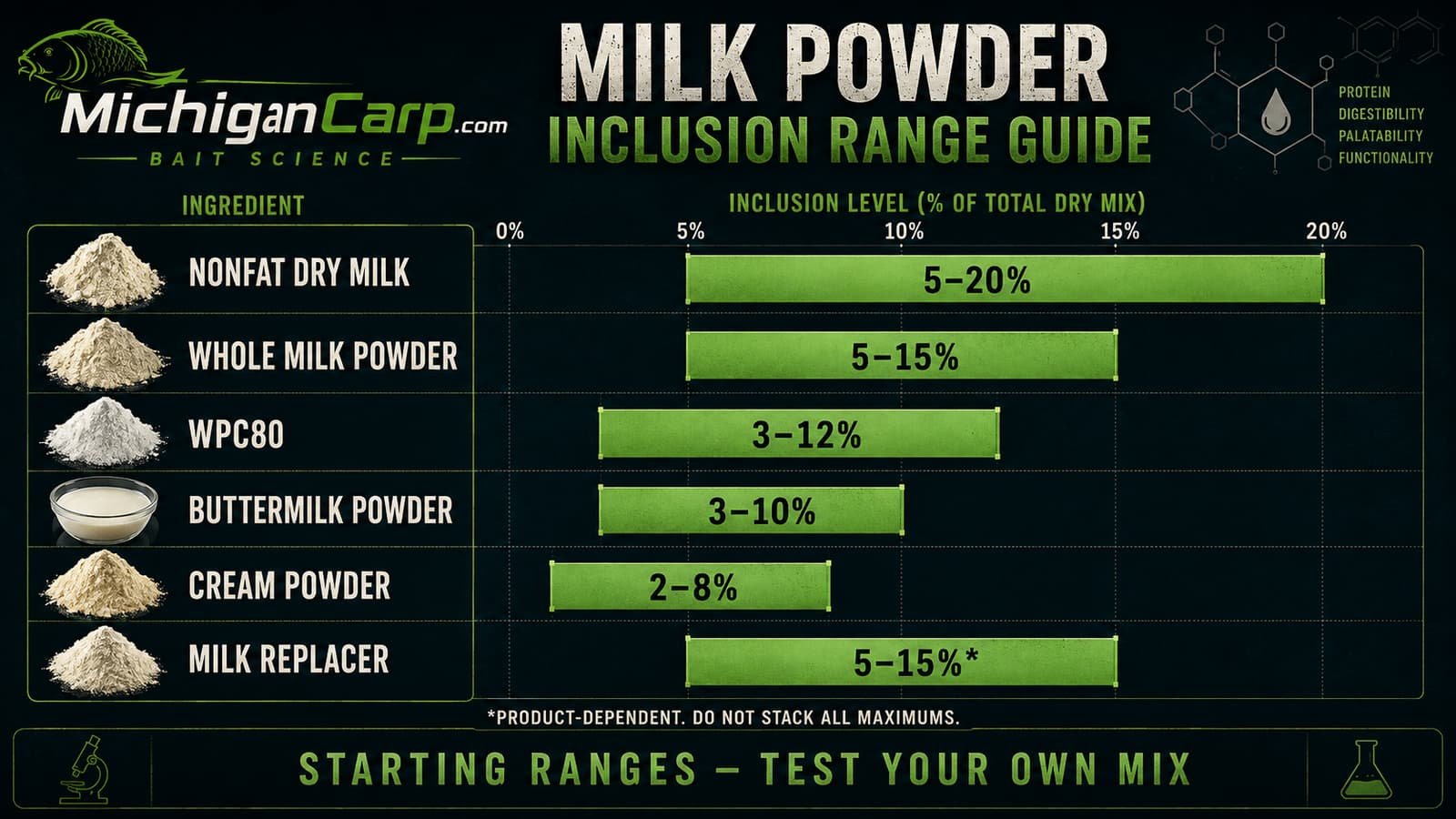
They are not fixed rules.
Do not combine every ingredient at the top of its range. These figures show workable ranges for each ingredient within a balanced base mix, not a formula that should be maxed out across every row.
Simple Beginner Milk Boilie
| Ingredient | Range |
|---|---|
| Nonfat dry milk | 5–15% |
| Whole milk powder | 0–10% |
| WPC80 | 0–5% |
| Buttermilk powder | 0–5% |
Goal:
simple cream background without making the bait hard to roll.
Serious Milk/Nut Boilie
| Ingredient | Range |
|---|---|
| Nido / whole milk powder | 5–12% |
| WPC80 | 5–10% |
| Nonfat dry milk | 5–10% |
| Milk replacer | 0–10% |
| Cream powder | 2–5% |
| Coconut milk powder | 2–5% |
Goal:
creamy dairy profile balanced with tiger nut flour, peanut protein, nut meals, birdfood and solubles.
Fruit-and-Cream Boilie
| Ingredient | Range |
|---|---|
| Nonfat dry milk | 5–12% |
| Whole milk powder | 3–8% |
| Buttermilk powder | 0–5% |
| Cream powder | 2–5% |
| Lactose | 2–5% |
Goal:
round fruit flavor with a creamy background.
Birdfood Cream Boilie
| Ingredient | Range |
|---|---|
| Nonfat dry milk | 5–10% |
| Buttermilk powder | 3–8% |
| Whole milk powder | 0–8% |
| WPC80 | 0–6% |
Goal:
soft dairy support without overwhelming birdfood texture.
Hookbait Milk Powder Boost
| Ingredient | Range |
|---|---|
| WPC80 | 5–12% |
| Casein / caseinate | 5–15% |
| Whole milk powder | 5–10% |
| Cream powder | 2–8% |
| Hydrolyzed whey | 1–5% |
Goal:
stronger profile, better durability and controlled hookbait identity.
Milk Powders in Milk/Nut Boilies
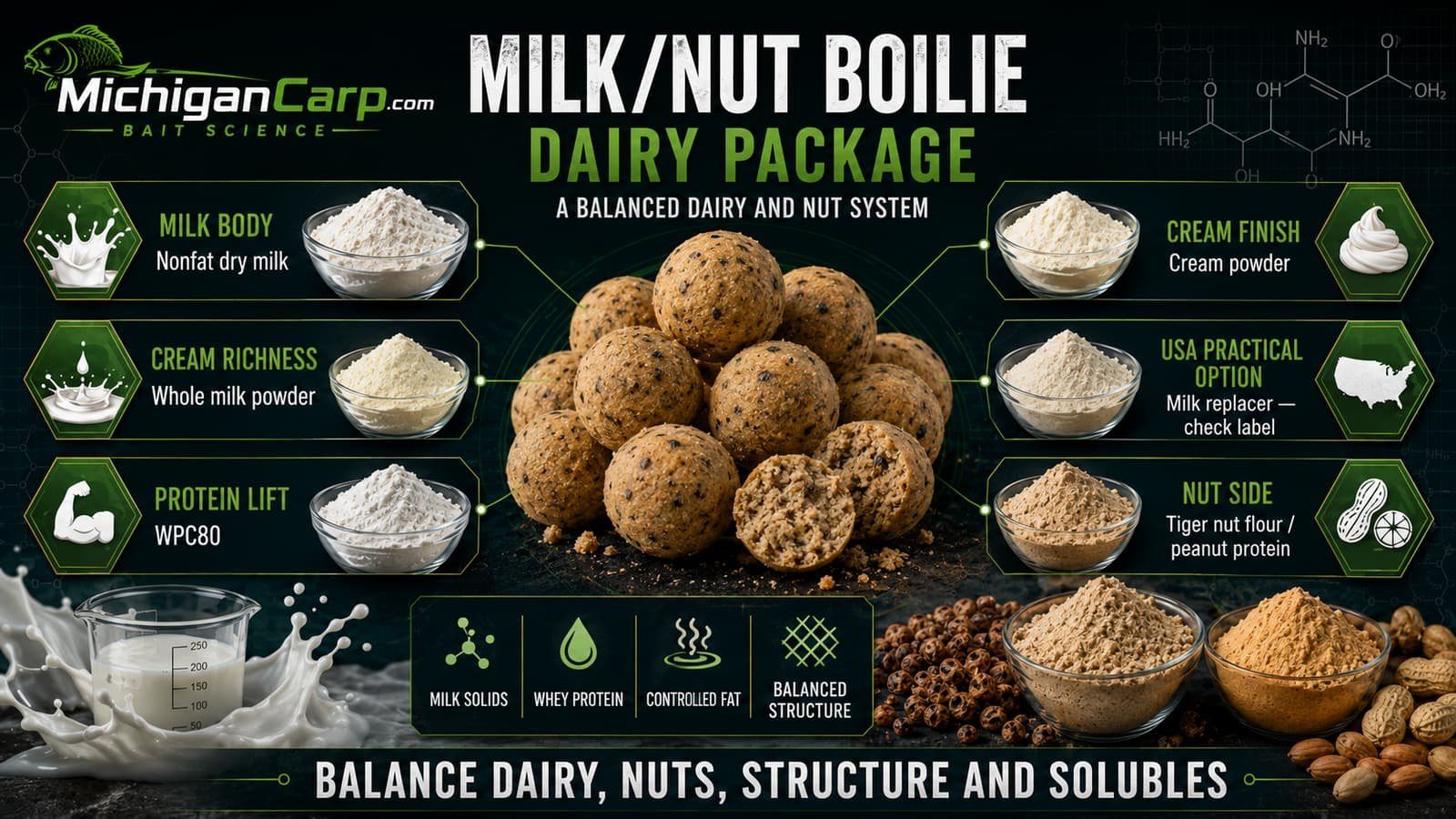
Milk powders are central to many milk/nut boilies.
They help create the creamy side of the bait.
The nut side may come from:
- tiger nut flour;
- peanut protein;
- peanut meal;
- almond meal;
- coconut meal;
- birdfood;
- seed meals.
The milk side may come from:
- whole milk powder;
- nonfat dry milk;
- WPC80;
- cream powder;
- buttermilk powder;
- lactose;
- milk replacer;
- casein or caseinate.
A strong milk/nut bait is not just milk powder plus nut meal.
It needs balance.
Practical Milk/Nut Structure
A useful milk/nut structure might include:
- base structure from semolina, maize meal or cereal;
- dairy body from nonfat dry milk or whole milk powder;
- protein lift from WPC80;
- creamy fat from whole milk powder, cream powder or coconut milk powder;
- nut identity from tiger nut flour or peanut ingredients;
- soluble support from yeast, hydrolysate or liquid attractors;
- binder support from egg, albumen or casein if needed.
Practical View
Milk powders help make a milk/nut bait feel like food.
They should not make the bait gummy, too soft or over-rich.
Milk Powders in Fruit-and-Cream Boilies
Fruit baits often benefit from milk powders because dairy softens sharp fruit flavors.
Good combinations include:
- peach and cream;
- plum and cream;
- strawberry and cream;
- pineapple and coconut cream;
- orange and milk;
- maple/vanilla/cream;
- scopex/cream/nut.
Milk powders can make fruit baits feel fuller.
They can also reduce the harshness of strong fruit flavors.
Best ingredients:
- nonfat dry milk;
- whole milk powder;
- cream powder;
- buttermilk powder;
- lactose;
- coconut milk powder;
- small WPC80 addition.
Avoid turning fruit baits into pure candy.
The bait still needs food structure.
Milk Powders in Birdfood Boilies
Birdfood boilies often work well with dairy powders.
Birdfood gives texture and openness.
Milk powders add creaminess and food identity.
Good ingredients:
- nonfat dry milk;
- buttermilk powder;
- whole milk powder;
- WPC80 in small amounts;
- cream powder in small amounts.
But do not overload the mix.
Birdfood baits need to roll and bind.
Too much fine milk powder can make the dough sticky or heavy.
A good birdfood/milk boilie should still have texture.
For birdfood structure, use Birdfood for Carp Boilies.
Milk Powders in Shelf-Life Boilies
Milk powders can work in shelf-life boilies, but you need to think about storage.
Whole milk powder, cream powder and coconut milk powder add fat.
Fat can affect long-term storage if the bait is not dried, preserved or stored properly.
Shelf-life bait needs:
- controlled moisture;
- clean drying;
- preservative plan if used;
- stable fat sources;
- proper packaging;
- testing over time.
Nonfat dry milk and WPC80 are often easier to manage than large amounts of high-fat powders.
That does not mean full-cream powders are wrong.
It means they should be used with shelf-life design in mind.
For shelf-life bait work, always test small batches before making a large batch.
Milk Powders in Freezer Baits
Freezer baits give more freedom.
You can use richer milk powders and softer profiles because long-term room-temperature storage is not the goal.
Good freezer-bait dairy ingredients include:
- whole milk powder;
- nonfat dry milk;
- WPC80;
- buttermilk powder;
- cream powder;
- coconut milk powder;
- milk replacer;
- hydrolyzed whey.
Freezer baits still need to dry enough to handle and fish properly.
They should not be so soft that they split, mold quickly or collapse on the hair.
Milk Powders in Hookbaits
Hookbaits often benefit from stronger milk-powder identity than free bait.
You may want:
- more cream powder;
- more WPC80;
- more casein/caseinate;
- more whole milk powder;
- a small hydrolyzed whey addition;
- stronger sweetener rounding;
- tougher finished texture.
But hookbait design is different.
The hookbait must:
- hold on the hair;
- resist nuisance fish;
- survive casting;
- maintain buoyancy if balanced;
- stay intact during long sessions;
- avoid going too soft after soaking.
Use milk powders to build identity, not just softness.
What Milk Powders Do to Rolling
Milk powders can make boilie dough easier or harder depending on the rest of the mix.
They Can Improve Rolling
At moderate levels, milk powders can:
- smooth the dough;
- reduce harsh grit;
- improve creaminess;
- help the sausage extrude cleanly;
- make bait feel more cohesive.
They Can Cause Problems
At high levels, they can:
- make dough sticky;
- make bait too soft;
- require less liquid;
- slow drying;
- make sausages slump;
- cause rolling-table drag;
- make bait dense.
Practical Fixes
If the dough is too sticky:
- reduce wet liquid;
- add semolina;
- add maize meal;
- add birdfood;
- add albumen;
- reduce high-fat milk powders;
- let the dough rest briefly.
If the dough is too dry:
- increase egg slightly;
- add a little liquid;
- reduce dry binders;
- reduce absorbent powders;
- rest before judging.
What Milk Powders Do During Boiling
Boiling changes the bait.
Milk powders do not remain exactly as they were in the dry mix.
Boiling can affect:
- surface texture;
- protein setting;
- starch gelatinization in the rest of the mix;
- soluble loss;
- skin formation;
- bait hardness;
- leakage pattern.
Milk powders can help create a creamy finished bait, but boiling and drying will change how that bait leaks.
This is why test batches matter.
Do not judge the bait only from dry mix smell or fresh dough.
Judge:
- rolled dough;
- boiled bait;
- air-dried bait;
- soaked bait;
- fished bait.
What Milk Powders Do to Leakage
Milk-powder leakage depends on the ingredient.
More Soluble / Fast Signal
Often includes:
- whey powder;
- lactose;
- hydrolyzed whey;
- some milk-replacer components;
- fine soluble milk fractions.
More Structural / Slower Role
Often includes:
- caseins;
- caseinates;
- cooked egg-bound matrix;
- dense base-mix structures.
Nonfat dry milk and whole milk powder sit in the middle as broad milk-solid ingredients.
They are not instant leak bombs, but they can contribute to a dairy signal.
WPC80 can support a stronger protein signal but is not simply the same as sugar dissolving.
Practical takeaway:
milk powders leak through the bait system, not by themselves.
The whole formula matters.
Milk Powders and Fat
Fat is important.
Whole milk powder, cream powder, coconut milk powder and milk replacers can all add fat.
Fat can help:
- creaminess;
- mouthfeel;
- bait richness;
- flavor carrying;
- nut bait identity.
But too much fat can hurt:
- leakage;
- drying;
- shelf-life stability;
- dough handling;
- cold-water performance;
- bait firmness.
In cold water, high-fat bait may not behave the way you want.
In warm water, richer baits may be more usable.
Do not overload fat because it smells good.
Use fat with purpose.
Milk Powders and Lactose
Lactose is important in milk powders.
It contributes mild sweetness and dairy identity.
But lactose is not protein.
This matters when calculating bait nutrition.
A powder high in lactose may smell and taste milky but not add much protein.
Nonfat dry milk contains both milk protein and lactose.
Sweet whey powder is often much more lactose-heavy.
WPC80 is much higher protein and lower lactose.
Lactose can be useful, but do not confuse it with protein value.
For the broader sugar and carbohydrate explanation, use Sugars, Sweeteners and Carbohydrates in Carp Bait.
Milk Powders and Protein Calculation
When calculating protein, use the actual label.
Do not guess.
Examples:
- nonfat dry milk is not 80% protein;
- whole milk powder is not 80% protein;
- whey powder is not WPC80;
- WPC80 is not casein;
- milk replacer varies by product.
A milk powder may be useful even if it is not high protein.
But if your target bait protein matters, the label matters.
For serious formulation, calculate:
- total dry mix protein;
- fat level;
- soluble ingredients;
- starch/carb contribution;
- binder level;
- moisture and egg requirement.
Practical bait making is part recipe and part arithmetic.
Building a Balanced Milk Powder Package
Instead of using one dairy ingredient at a huge level, build a balanced milk package.
Basic Milk Package
For 1 kg dry mix:
- 75 g nonfat dry milk;
- 50 g whole milk powder;
- 50 g WPC80.
This gives basic milk solids, richness and whey protein.
Cream/Nut Package
For 1 kg dry mix:
- 70 g whole milk powder or Nido;
- 50 g WPC80;
- 30 g cream powder;
- 30 g coconut milk powder;
- 20 g lactose or buttermilk powder.
This supports milk/nut and cream profiles.
USA Milk Replacer Package
For 1 kg dry mix:
- 100 g non-medicated calf milk replacer;
- 50 g WPC80;
- 50 g nonfat dry milk or Nido.
This uses practical USA ingredients while keeping control.
Hookbait Milk Package
For 1 kg dry mix:
- 80 g WPC80;
- 80 g casein/caseinate;
- 50 g whole milk powder;
- 30 g cream powder;
- 20 g hydrolyzed whey.
This is more specialist and should be tested for texture.
Example: Milk/Nut/Birdfood Boilie Direction
This is not a secret recipe.
It is a formulation direction.
A practical milk/nut/birdfood boilie might use:
- semolina or cereal structure;
- birdfood for texture;
- tiger nut flour;
- peanut protein or nut meal;
- whole milk powder or Nido;
- WPC80;
- nonfat dry milk;
- buttermilk or cream powder;
- yeast;
- small liver or hydrolysate support;
- sweetener used lightly;
- oil used carefully.
The milk powders should support the bait.
They should not make the bait sticky, weak or over-rich.
A good milk/nut/birdfood bait should:
- roll cleanly;
- boil without collapsing;
- dry properly;
- leak steadily;
- feel like food;
- keep the hookbait important;
- match the wider feed system.
For the full formulation approach, use How to Formulate a Milk, Nut and Birdfood Boilie Base Mix.
Milk Powders in Packbait and Method Mix
Milk powders are not only for boilies.
They can also work in packbait and method mix.
Useful packbait additions include:
- nonfat dry milk;
- whole milk powder;
- milk replacer;
- cream powder;
- WPC80 in small amounts;
- boilie crumb;
- blended tiger nuts;
- blended hemp;
- panko;
- oats;
- tinned milk-style liquids.
This is especially useful when fishing milk/nut boilies.
A packbait containing boilie crumb, milk powders and nut ingredients can support the hookbait instead of competing with it.
Keep the packbait mechanics right.
It still needs to bind, cast, sink and break down.
For that system, read Packbait for Carp Fishing.
Label Reading Checklist for USA Bait Makers
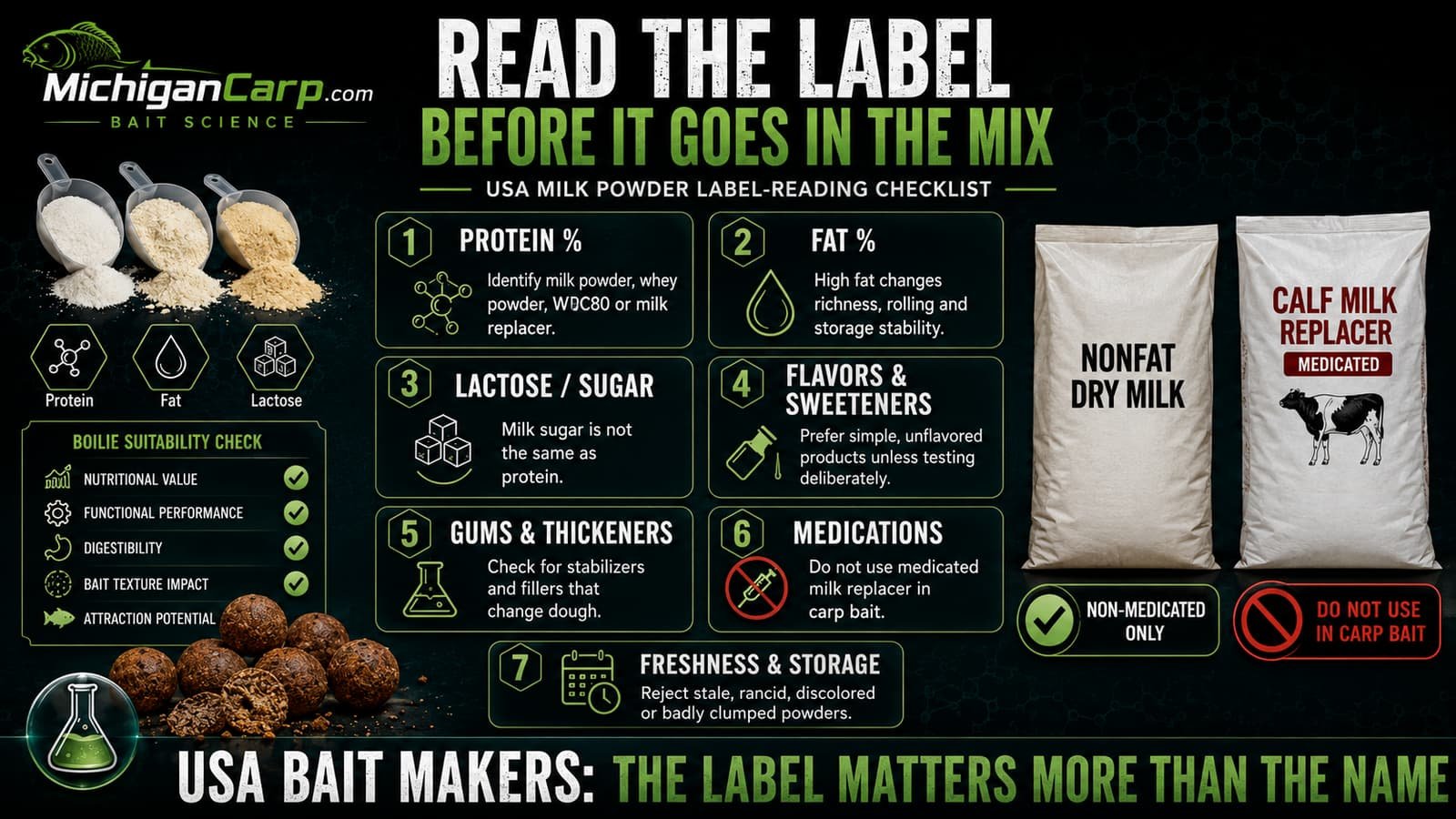
Before buying a milk powder, check the label.
Check Protein
Is it ordinary milk powder, whey powder, WPC80 or milk replacer?
Check Fat
High-fat powders can be useful but need control.
Check Sugar / Lactose
A powder can be very milky but mostly carbohydrate.
Check Flavor
Unflavored is usually best.
Check Sweeteners
Avoid hidden sweeteners unless you want them.
Check Gums and Thickeners
Some human shake powders contain gums that can affect bait texture.
Check Salt
High salt can change bait profile.
Check Medications
Avoid medicated animal products.
Check Freshness
Old dairy powder can go stale or rancid.
Check Storage
Powders should be dry, clean and free from clumping, insects or off smells.
Storage of Milk Powders
Milk powders need proper storage.
Keep them:
- dry;
- cool;
- airtight;
- away from sunlight;
- away from moisture;
- away from strong odors;
- labeled with purchase date;
- sealed after opening.
High-fat powders are more likely to go stale or rancid than nonfat powders.
Whole milk powder, cream powder and coconut milk powder should be treated carefully.
If a powder smells stale, rancid, cheesy in a bad way, sour in a spoiled way or dusty/off, do not use it.
Good bait starts with good ingredients.
Common Milk Powder Mistakes
Treating All Milk Powders the Same
Skimmed milk powder, WPC80, cream powder and milk replacer are different ingredients.
Confusing Whey Powder With WPC80
Ordinary whey powder is not the same as WPC80.
Using Too Much Full-Cream Powder
Richness can become softness, poor drying or excess fat.
Using Flavored Protein Powder
Chocolate gym powder is not a clean boilie ingredient.
Ignoring the Label on Milk Replacer
Milk replacer can be useful, but medicated or unsuitable products should be avoided.
Adding Milk Powder Without Adjusting Liquids
Milk powders absorb liquid and change dough feel.
Chasing Protein Numbers Only
Milk powder value is not only protein.
Ignoring Rolling
A bait that looks good on paper but rolls badly needs adjusting.
Ignoring Shelf-Life
High-fat dairy powders need careful storage planning.
Not Testing Small Batches
Never scale an untested dairy-heavy bait straight to a large batch.
My Practical View
Milk powders are central to the way I think about milk/nut boilies.
They give creaminess, food identity, rolling character and bait personality.
But they are not all the same.
For USA bait making, I like the practical route:
- nonfat dry milk for basic milk solids;
- Nido or whole milk powder for richness;
- WPC80 for protein lift and whey signal;
- buttermilk powder for tangy dairy character;
- cream powder for small rich additions;
- milk replacer when the label is suitable;
- hydrolyzed whey in small amounts when I want more soluble milk-protein edge.
I do not like random flavored protein powders.
I do not like medicated replacers.
I do not like pretending every white powder is equivalent.
The best milk-powder bait making is practical, label-driven and tested.
My rule is:
USE MILK POWDERS BY FUNCTION, NOT BY NAME.
That is how you build better boilies.
FAQ
What are the best milk powders for boilie making?
The best milk powders depend on the bait. Nonfat dry milk is a good basic milk-solid ingredient, whole milk powder adds richness, WPC80 adds higher whey protein, buttermilk powder adds tangy dairy character, cream powder adds richness, and milk replacer can be useful when the label is suitable.
Is skimmed milk powder the same as nonfat dry milk?
In practical USA buying terms, yes. UK bait makers often say skimmed milk powder, while US stores usually sell nonfat dry milk.
Is whole milk powder good in boilies?
Yes. Whole milk powder is very useful in milk/nut, cream, fruit-and-cream and hookbait profiles because it adds milkfat and richer dairy character.
Is Nido good for boilie making?
Nido-style dry whole milk powder can be useful for USA bait makers because it is easy to find and provides a full-cream milk powder option. Read the label because fortified versions are not identical to plain industrial whole milk powder.
Is WPC80 good in boilies?
Yes. WPC80 is very useful when you want a higher-protein whey ingredient and a stronger milk-protein contribution than ordinary whey powder.
Is whey powder the same as WPC80?
No. Ordinary whey powder is usually much lower in protein and higher in lactose than WPC80.
Is buttermilk powder useful in carp bait?
Yes. Buttermilk powder can add tangy dairy character and works well in birdfood, cream, milk/nut and savory cream baits.
Can I use calf milk replacer in boilies?
Yes, but only after reading the label carefully. Avoid medicated replacers and products with unsuitable additives.
What milk powder should USA bait makers start with?
Start with nonfat dry milk, Nido or another dry whole milk powder, and unflavored WPC80. Those three cover a lot of practical bait-making needs.
How much milk powder should I use in boilies?
A practical starting range is 5–20% for nonfat dry milk, 5–15% for whole milk powder, 3–12% for WPC80, 3–10% for buttermilk powder and 5–15% for milk replacer.
Can too much milk powder ruin boilies?
Yes. Too much milk powder can make bait sticky, soft, slow to dry, hard to roll or unbalanced.
Do milk powders make boilies more soluble?
Some milk-powder components can contribute to leakage, but solubility depends on the whole bait formula, boiling, drying and ingredient balance.
Are milk powders good in packbait?
Yes. Milk powders can work well in packbait, especially when fishing milk/nut boilies, but the mix must still break down correctly.
Should I use milk powders in shelf-life boilies?
You can, but high-fat powders such as whole milk powder and cream powder need careful shelf-life testing and storage planning.
Next Steps
Use these routes next:
- Boilie Ingredients Explained
- Boilie Base Mix Families
- Casein, Caseinate, WPC and Skimmed Milk Powder
- Milk Proteins in Carp Bait
- Milk Caseins for Boilie Making
- How to Formulate a Milk, Nut and Birdfood Boilie Base Mix
- Packbait for Carp Fishing
- Sweeteners for Boilies
- The Bait Shed
- Boilie School
- Michigan Carp Guide Library