

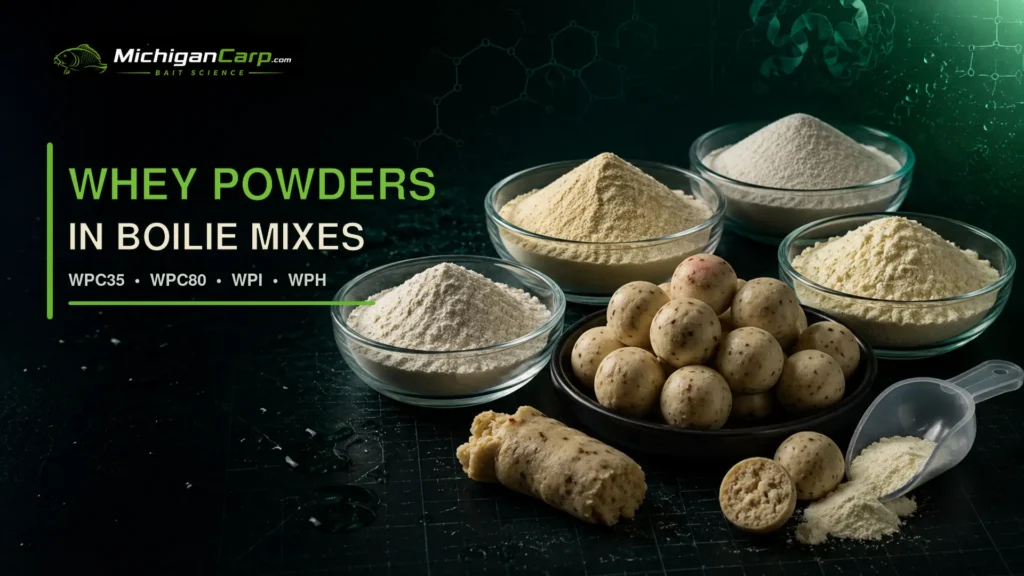
Whey powders in boilie mixes are useful only when the product is understood and given a defined job. Sweet whey powder, WPC35, WPC80, whey protein isolate and whey protein hydrolysate all come from whey, but they do not have the same composition or behave the same way in dough, during boiling or after the bait enters the water.
The biggest mistake is to treat the number on the bag as a simple quality score. WPC80 is not automatically a better choice than WPC35, WPI is not automatically a better bait ingredient than WPC80, and WPH is not simply an extra-powerful version of intact whey protein. Each product changes the balance between protein, lactose, minerals, water binding, heat response, cost and potential release from the finished boilie.
That whole-bait view matters. A powder that disperses readily in a drink before heating will not necessarily behave the same once it has been mixed with egg, cereal, casein, nut meal and birdfood, then boiled and dried. Whey proteins can denature, aggregate and sometimes contribute to a firmer network during heating. The structure and porosity of the finished bait then control how much material can leave it.
For most homemade milk, nut, cereal and birdfood boilies, WPC80 is the most useful concentrated whey protein to learn first. Sweet whey powder and WPC35 can still be very good ingredients when lactose-rich dairy solids and economy matter. WPI is usually difficult to justify on cost alone, while WPH is a specialist way to add smaller protein fractions and peptides at a low level. “Whey gel” needs extra caution because the name is not a single standardized ingredient.
This guide stays tightly focused on choosing and using whey ingredients. For the broader dairy package, use Milk Powders in Boilie Making. For the nutritional and solubility background, continue with Milk Proteins in Carp Bait.
Choose whey by composition and function—not by the most impressive name on the label.
Table of Contents
Quick Start: Whey Powders In Boilie Mixes What To Use
Use this as a starting guide, not as a substitute for the product label or a small test batch. WPC34 and WPC35 are commonly used names for the same general concentration band, but supplier specifications still vary. WPH and products sold as whey gel can vary much more, so the datasheet matters as much as the name.
| Ingredient | What It Usually Means | Best Practical Job | Starting Range | Main Caution |
|---|---|---|---|---|
| Sweet whey powder | Low-protein, lactose- and mineral-rich dried whey | Economical dairy solids, mild sweetness and open bait support | 5–12% | Not a concentrated protein; composition varies |
| WPC34/35 | About 34–36% protein with substantial lactose | Mid-level whey protein plus dairy body | 5–10% | Much more lactose than WPC80 |
| WPC80 | About 80% intact whey protein | Concentrated protein, heat functionality and milk-bait support | 3–8% | Can change hydration, rolling and firmness |
| WPI | At least 90% protein on a dry-matter basis | Very high-purity whey protein for specialist formulas | 2–5% if used | Often costs more without a clear angling advantage |
| WPH | Whey protein deliberately hydrolyzed into smaller fractions | Low-level peptide-rich, readily dispersible protein support | 1–4% | Bitterness, hygroscopicity and degree of hydrolysis vary |
| Whey gel | A supplier-specific functional whey product or blend | Texture, binding or hookbait structure when specified | Follow the datasheet | The name alone does not identify the product |
| Alpha-lactalbumin | A purified whey protein fraction | Specialist formulation rather than general boilie making | Usually omit | Expensive, difficult to source and not equivalent to WPC80 |
The practical default is straightforward. Start with WPC80 when you want a concentrated whey protein. Use sweet whey or WPC35 when you also want more lactose-rich dairy solids or need to control cost. Add WPH only when you have a reason to increase the hydrolyzed fraction, and do not buy WPI or a “whey gel” product simply because the name sounds more technical.
What the Whey Names Actually Mean
Whey is the liquid phase left when casein and fat are separated during cheese or casein production. Drying that liquid produces ordinary whey powder. Removing part of the lactose, minerals and other non-protein material concentrates the protein and produces WPC. Further purification produces WPI. Deliberately breaking whey protein into smaller peptide fractions produces WPH.
The number attached to WPC describes protein concentration, not bait strength. The U.S. Dairy Export Council’s typical WPC34 composition is 34–36% protein and 48–52% lactose. Its typical WPC80 composition is 80–82% protein and only 4–8% lactose. That difference explains why two powders from the same ingredient family can change a boilie in very different ways.
Concentrate, Isolate and Hydrolysate
Concentrate and isolate describe how much of the non-protein material has been removed. Hydrolysate describes what has happened to the protein itself. The American Dairy Products Institute definition of WPH requires deliberate chemical or enzymatic cleavage of peptide bonds beyond what occurs in ordinary whey, WPC or WPI. WPH is therefore a processing category, not a guarantee that one product has the same peptide profile, flavor or behavior as another.
Instantized Does Not Mean Hydrolyzed
Instantized whey has usually been agglomerated and may contain a small wetting aid such as lecithin so it mixes more easily into liquid. That can improve handling, but it does not turn WPC into WPH and does not prove that the powder will escape a cooked boilie faster. If buying a human supplement, choose an unflavored product and read the full label for sweeteners, gums, flavors and other additions.
What Whey Changes Inside a Boilie
Whey ingredients can change nutrition, hydration, dough handling, heat response, texture and the pool of water-dispersible material in a bait. Those effects overlap, but they are not interchangeable. A lactose-rich sweet whey may increase soluble solids without contributing much protein. WPC80 may add much more protein while also affecting water binding and the network that forms during cooking. WPH may contribute smaller peptide fractions but bring bitterness or hygroscopicity.
Solubility Before Cooking Is Not Leakage After Cooking
It is tempting to describe WPC80 as a soluble protein that simply leaks from a boilie. That is too crude. Whey proteins are susceptible to heat-induced denaturation and aggregation; depending on temperature, concentration, pH, minerals and the rest of the formula, they can also contribute to gel formation and firmness. Once the bait is boiled and dried, release depends on pore structure, cracking, ingredient distribution, water uptake and how tightly the protein has been held in the cooked matrix.
This is why What Boiling Does to Milk Protein Boilies is the correct companion article. The useful field interpretation is not that WPC80 always leaks quickly. It is that whey ingredients let us alter the dairy solids and protein system, then test how the finished bait releases material.
Food Value and Attraction Are Different Questions
Whey protein has recognized nutritional value in food and feed applications, but that does not prove that carp prefer a boilie because it contains WPC80. The scientific evidence describes the ingredient; the angling decision still has to be tested in a complete bait. In practice, whey fits particularly well with milk, nut, cereal and birdfood formulas because it strengthens their dairy side without forcing the mix toward a fishmeal profile.
Sweet Whey Powder and WPC35
Sweet Whey Powder
Sweet whey powder is the economical dairy-solid option. It is normally far lower in protein than WPC80 and much richer in lactose and minerals. In a boilie, that makes it useful for mild dairy sweetness, dry solids and a cream or milk background rather than as the main high-protein ingredient.
A starting range of 5–12% is sensible in many cereal, birdfood and milk/nut mixes. The higher end is most appropriate when the rest of the formula has enough structure and is not already overloaded with milk powder, sugars, syrups, caseinate or soluble liquids. Sweet whey can also work in crumb, method and stick mixes, where rolling and long water life are less restrictive.
WPC34 or WPC35
WPC34/35 occupies the middle ground. It supplies appreciably more whey protein than ordinary sweet whey while retaining much more lactose than WPC80. That makes it useful when the formulation needs both dairy body and moderate whey protein, particularly in economical milk, cream, cereal, nut and birdfood baits.
A 5–10% starting range is practical. Do not treat WPC35 as merely weak WPC80 and double the amount automatically. Raising WPC35 also raises lactose, minerals and total dairy solids, so the resulting dough and finished bait need to be judged on their own terms.
WPC80 and WPI
Why WPC80 Is the Practical Default
WPC80 gives a large protein contribution in a relatively small inclusion. At 3–5% it can support the dairy and protein side of a boilie without dominating the mix. At 5–8% it becomes an important part of the formula and its effect on hydration, rolling, boiling and texture should be measured carefully.
WPC80 is particularly useful alongside skimmed milk powder, whole milk powder, casein or caseinate, birdfood, cereal and nut meals. It should replace part of the dry mix rather than simply being added on top. The liquid requirement may change, but the direction is product- and formula-dependent: one mix may become tackier, another may tighten as the protein hydrates, and another may become firmer after cooking.
When WPI Makes Sense
WPI contains at least 90% protein on a dry-matter basis and less lactose and fat than WPC80. It is not a poor ingredient; it is simply difficult to justify for most boilie making. There is no established evidence that the extra purity catches more carp, while the cost can be substantially higher.
If plain WPI is already available at a reasonable price, it can be tested at about 2–5% in a specialist high-protein mix or hookbait. Do not assume it is a gram-for-gram upgrade. Its hydration and heat behavior may differ from the WPC80 used in the original formula, so it still requires a controlled replacement test.
WPH: Hydrolyzed Whey Protein
WPH begins with a whey protein source whose peptide bonds have been deliberately cleaved. The resulting product contains smaller protein fragments than intact WPC or WPI. That can make WPH useful when a bait maker wants a more readily dispersible peptide-rich fraction in a milk, nut or cream bait, especially in a paste, coating, crumb or lightly cooked bait.
The important qualifier is that WPH is not one uniform material. Degree of hydrolysis, starting protein, enzyme system, peptide-size distribution, flavor and carrier all vary. Some products are only mildly hydrolyzed; others are strongly hydrolyzed, hygroscopic and distinctly bitter. More hydrolysis is not automatically better for a boilie.
A useful starting range is 1–4% of the dry mix, with 1–2% being the more cautious first trial. WPH normally works as a support ingredient beside WPC80, milk powder, yeast or an appropriate liquid rather than as the whole whey section. For the wider subject—including liver, fish and yeast hydrolysates—use How to Use Hydrolysates in Carp Bait.
Whey Gel and Lactalbumin Reality
“Whey Gel” Is Not a Complete Specification
Whey gel is a trade description rather than one universal dairy standard. One product may be a heat-gelling whey protein; another may be a modified functional blend developed for binding, texture or water control. A generic 2–6% recommendation is therefore less reliable than it first appears.
Before using it, obtain the ingredient list or technical sheet and identify the intended function. If the supplier cannot explain what the product contains or how it is meant to behave under heat, treat it as an unknown. Replace a neutral dry ingredient with a small amount, test it beside a control, and only raise the level after checking rolling, boiled texture and water life.
Alpha-Lactalbumin Is Not the Same as “Lactalbumin” Bait Talk
Alpha-lactalbumin is a specific whey protein fraction. Older bait writing sometimes used “lactalbumin” more loosely for a dried or denatured whey-protein ingredient, so an old recipe may not be calling for purified alpha-lactalbumin at all. That distinction matters before making a substitution.
Purified alpha-lactalbumin is costly and rarely necessary for homemade Michigan carp bait. WPC80 is not chemically identical and should not be presented as a gram-for-gram substitute, but it is usually the more practical route when the real goal is simply to add a concentrated whey-protein component. Verify what the original ingredient was supposed to do, then reformulate and test rather than copying the old number.
Practical Inclusion Ranges and Whey Packages
The ranges in this article apply to the dry mix and are starting points, not validated optimum doses. Product composition, egg size, other milk ingredients, soluble liquids, cereal structure, boil time, bait diameter and drying method can all move the useful level. Start near the lower end when the mix already contains caseinate, milk powder, sugars, hydrolysates or a substantial liquid-food package.
| 150 g Whey/Dairy Section per 1 kg Dry Mix | Ingredients | Purpose |
|---|---|---|
| Budget dairy support | 70 g sweet whey powder + 80 g skimmed milk powder | Economical lactose-rich milk background |
| General milk/nut section | 50 g WPC80 + 70 g skimmed milk powder + 30 g calcium caseinate | Balanced protein, dairy solids and structure |
| Short-session/cool-water section | 50 g WPC80 + 15 g WPH + 30 g buttermilk powder + 55 g skimmed milk powder | More hydrolyzed support without making WPH dominant |
| Durable hookbait section | 30 g WPC80 + 80 g acid casein + 40 g calcium caseinate | Controlled whey level with stronger structural proteins |
These are dairy sections, not complete recipes. The remaining 850 g still needs a coherent base of cereals, birdfood, nut or seed meals, protein ingredients and texture control. Each section must be adjusted to the complete formula. For the complete formulation method, continue with How to Formulate a Milk, Nut and Birdfood Boilie Base Mix.
Cold Water, Warm Water and Hookbaits
Cool Water and Short Sessions
Whey-based dairy sections suit cool-water and short-session bait because they do not depend on a large oil load. That does not make WPC80 a guaranteed cold-water attractor, and diffusion will still slow as water cools. The practical advantage is that the bait maker can build a food-based milk signal using lactose, minerals, intact whey protein and, if required, a small hydrolyzed fraction.
Keep the bait open enough to take on water, but do not sacrifice rig life. WPC80 around 4–6% with a modest milk powder or buttermilk component is a sensible direction. WPH at 1–2% can be tested when a more hydrolyzed fraction is wanted, but it is not compulsory. If treating the finished bait as well, match the treatment to the actual job using When to Use Each Type of Carp Bait Liquid.
Warm Water and Nuisance Pressure
In warmer water, the whey level does not need to rise automatically. The bigger practical questions are water life, nuisance-fish activity and storage. Gobies, panfish, crayfish and turtles can punish a soft bait, while damp protein-rich bait also needs careful handling. A moderate WPC80 level supported by cereal, birdfood, casein, egg albumen or another proven structural component is usually more useful than an extremely soluble dairy package.
Hookbaits, Wafters and Pop-Ups
Hookbaits need to keep fishing after the easiest material has begun to leave. WPC80 and WPH can be used at lower levels within a stronger milk-protein structure, but they should not be allowed to make the hookbait fragile or change its buoyancy unnoticed. Test the finished bait with the actual hook, bait screw or hair, and repeat the balance check after soaking because water uptake can alter a wafter or pop-up.
How to Test Whey in a Base Mix
The cleanest first test is a replacement trial. Make two 250 g dry batches. Keep one as the control. In the second, replace 12.5 g of a neutral cereal ingredient with 12.5 g WPC80, giving a 5% inclusion. Use the same starting liquid system, then record any extra liquid required to reach the same workable dough. Do not quietly adjust one batch and compare it as if nothing changed.
Roll the same diameter, boil for the same time and dry under the same conditions. Compare surface tack, cracking, rolling pressure, cooked firmness, weight after drying and water uptake. Soak matched baits for 1, 4, 12 and 24 hours in separate jars. At each interval, inspect the water, smell, surface, internal texture and resistance to nuisance pressure. A bait that looks active but cannot remain on the rig is not a successful result.
If the WPC batch is different, change one variable on the next test. Reduce WPC80, alter the structural ingredient or adjust liquid—do not change all three. The same method can be used for WPC35, WPI or WPH, but their first inclusion should match the practical ranges above. For the full test sequence, read How to Test Boilies Before Fishing.
What Common Problems Usually Mean
| Observed Problem | Likely Direction to Check |
|---|---|
| Dough is tacky or smears on the table | Total hydration, fine protein load, sugars, caseinate and liquid foods—not WPC alone |
| Dough tightens or cracks while rolling | Protein hydration, insufficient resting, low liquid or too much firm structure |
| Boilie is unexpectedly hard after cooking | Heat-set protein network, egg albumen, casein, boil time and drying |
| Boilie softens too quickly | Excess soluble load, weak structure, undercooking, short drying or cracks |
| WPH gives a harsh taste | Product bitterness, high degree of hydrolysis or excessive inclusion |
| Wafter balance changes after soaking | Water uptake and ingredient release altered density |
For a deeper correction guide, use Fixing Milk-Protein Dough Problems. The point is to diagnose the whole formula. Blaming every sticky bait on whey—or assuming every hard bait needs more whey—usually hides the actual interaction.
FAQ
What is the best whey powder for carp boilies?
WPC80 is the best practical starting point when the recipe needs a concentrated whey protein. Sweet whey or WPC35 may be the better choice when the goal is economical dairy solids and lactose-rich milk character rather than maximum protein concentration.
Is ordinary whey powder the same as WPC80?
No. Ordinary sweet whey powder is usually much lower in protein and much higher in lactose and minerals. Read the guaranteed analysis or product specification instead of relying on the word “whey.”
How much WPC80 should I use in a boilie mix?
Three to eight percent of the dry mix is a practical working range. A 5% replacement test is a sensible first trial. Start lower when the formula already contains substantial milk powder, caseinate, hydrolysate, sugar or soluble liquid.
Does WPC80 make boilies harder or softer?
It can influence either direction depending on the product and the formula. WPC80 changes hydration and can participate in heat-induced aggregation or gel formation, but excessive liquid or a weak surrounding structure may still produce a sticky dough or soft bait. Test the finished recipe rather than assigning one universal effect.
Is WPH better than WPC80 for carp bait?
No universal ranking is useful. WPC80 supplies concentrated intact whey protein; WPH supplies deliberately hydrolyzed fractions and may disperse more readily, but it can also be bitter, hygroscopic and expensive. They often work better as complementary ingredients than as direct substitutes.
Can I replace lactalbumin with WPC80?
Not automatically. First determine whether the old recipe meant purified alpha-lactalbumin or used “lactalbumin” as a loose trade term for a whey-protein product. WPC80 is a practical way to add concentrated whey protein, but it is not chemically identical and should be reformulated through a controlled test.
Is unflavored human whey protein suitable for boilies?
It can be, provided the label identifies plain WPC or WPI and does not add flavors, strong sweeteners, gums or other ingredients that complicate the formula. “Instantized” usually describes easier wetting, not hydrolysis.
Next Steps
For the wider choice between skimmed milk, whole milk, cream powder, buttermilk, milk replacer and whey, continue with Milk Powders in Boilie Making. To understand how intact proteins, soluble fractions and digestibility fit together, read Milk Proteins in Carp Bait.
If WPH is the main interest, use How to Use Hydrolysates in Carp Bait. Before finalizing a WPC-heavy recipe, also read What Boiling Does to Milk Protein Boilies so the dry ingredient, cooking method and desired water life are designed together.
For most Michigan boilie makers, the useful question is not “Which whey is most advanced?” It is “Which whey does a necessary job in this complete bait—and can I prove that with a controlled batch?”