


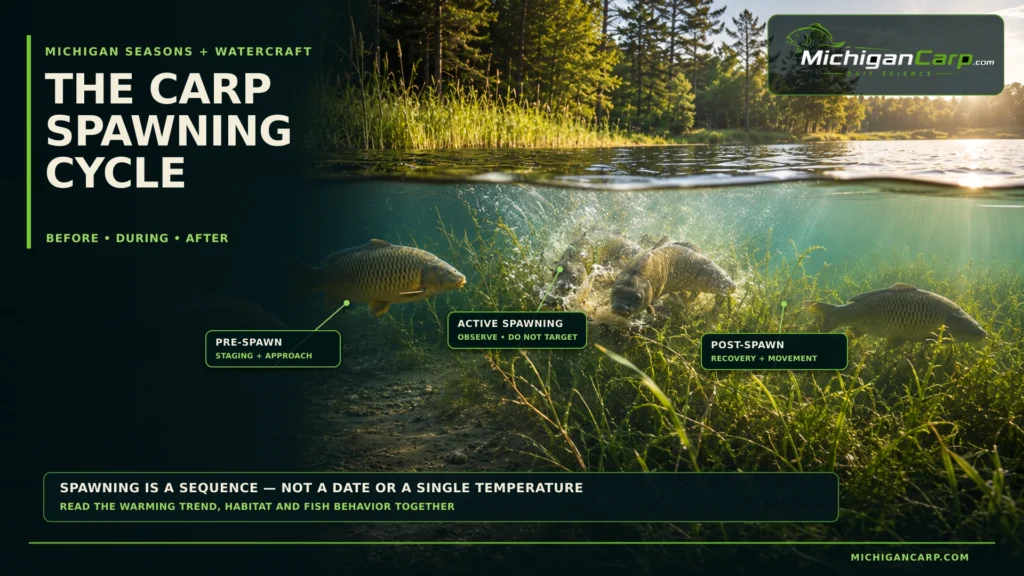
The carp spawning cycle in Michigan is better understood as a sequence than a date. Carp may first gather near suitable shallow habitat, then begin unmistakable active spawning, pause when conditions change, resume in another group or area, and finally move into an uneven recovery period. The same lake can contain staging fish, active spawners and fish returning to normal movement at the same time.
That is why one surface-temperature reading, one warm afternoon or one group of visible carp cannot tell the whole story. Water temperature matters, but habitat, water level, recent weather, fish readiness and behavior must line up. The practical angling decision comes from reading those clues together.
This guide separates reproductive biology from bank-side interpretation. Scientific and fisheries sources support the importance of warming water, shallow vegetated or flooded habitat, adhesive eggs and partial or multiple spawning in wild carp. They do not provide a universal Michigan date, a guaranteed temperature switch or a fixed number of post-spawn recovery days.
For the wider seasonal picture, pair this article with Carp Water Temperature Guide for Michigan Lakes and Seasonal Carp Movement in Michigan.
If carp are repeatedly chasing, rolling and thrashing through the same shallow vegetation, stop fishing that area. Observe them, protect the habitat and wait until behavior—not the calendar—shows that normal movement and feeding have returned.
Table of Contents
Quick Answer: How Should an Angler Read the Carp Spawning Cycle?
Read the cycle in three practical stages: stage, spawn and recover. The important decision is not merely whether it is “spawning season.” It is what the fish in front of you are doing now.
| Stage | What You May See | What It Does Not Prove | Best Decision |
|---|---|---|---|
| Pre-spawn staging | Groups gathering near warming shallows, reed edges, flooded grass or routes into bays; normal rolling and periods of feeding | Visible or grouped carp do not prove active spawning | Fish only when behavior is calm and feeding evidence is genuine; keep baiting controlled |
| Active spawning | Persistent chasing, several males pressing a larger fish, repeated rolling or splashing in very shallow cover and heavy vegetation disturbance | The activity is not a normal feeding signal | Reel in and stop fishing that area |
| Pause or mixed phase | Activity stops after cooling, wind, disturbance or darkness; another group may remain active elsewhere | A quiet hour does not prove the lake is finished | Reassess the whole area and avoid fish still gathered around spawning habitat |
| Post-spawn recovery | Fish leaving the shallows, resting or moving quietly, followed later by normal patrols, bottom feeding and repeatable feeding signs | No fixed number of hours or days applies to every fish | Wait for normal feeding behavior, then begin with modest bait and a simple presentation |
The ethical rule is deliberately simple. If there is genuine doubt between active spawning and feeding, give the fish space. A missed session is a smaller cost than targeting carp during a physically demanding biological event or placing tackle in dense spawning cover.
Spawning Is a Sequence, Not a Date
Anglers often talk about “the spawn” as though every carp in a lake switches at once. Wild populations are less tidy. Reproductive readiness develops before fish reach shallow habitat. Movement can begin before spawning. Active behavior can occur in bursts. Different groups may use different bays or wetlands. Some individuals may not participate in the first event, and wild carp can release mature eggs in portions rather than in one single event.
Maturation Happens Before the Visible Event
The visible commotion is the final field sign of a longer reproductive process. Seasonal temperature and food history influence gonadal development, while local warming and suitable habitat help shape the final movement and spawning opportunity. An angler arriving at the lake sees only the last part of that process.
Movement Can Precede Spawning
Midwestern telemetry research has documented spring reproductive migrations by common carp into interconnected wetlands. That supports the practical idea of staging routes: carp can travel toward suitable spawning habitat before the most obvious surface behavior begins. It does not mean every lake has a single predictable route or that every fish entering a bay is ready to spawn. Read the Chizinski and colleagues migration study for the research context.
The Visible Spawn Can Be Shorter Than the Full Cycle
On a given bank, the intense activity may last hours, stop, and later resume. Across a lake, the full sequence may extend much longer because habitat warms unevenly and individuals are not synchronized perfectly. This is why “they spawned yesterday” is not enough information. The correct follow-up is: where, which fish, and what are they doing now?
Recovery Is Part of the Cycle
The cycle does not end when splashing stops. Carp must leave the spawning area, settle, resume ordinary movement and eventually display feeding behavior that is different from reproductive chasing. Some fish may do that sooner than others. Treat recovery as an observed transition, not a countdown.
What Biology Says About Temperature, Habitat and Eggs
Temperature is important, but temperature advice needs boundaries. The FAO common-carp species account reports that European carp may begin spawning around 17–18°C (about 63–64°F), while an FAO propagation manual describes 18–22°C (about 64–72°F) as an optimal range in controlled production. These values are useful biological context—not a Michigan forecast.
| Factor | Supported Biological Role | What an Angler Should Not Claim |
|---|---|---|
| Water temperature | Seasonal warming contributes to maturation, movement and spawning opportunity | That one reading proves spawning will begin that day |
| Shallow vegetation or flooded grass | Provides attachment surfaces for sticky eggs and useful nursery habitat | That every reed edge contains active spawners |
| Water level and access | Flooded or connected habitat can open suitable spawning and nursery areas | That rising water alone triggers every population |
| Stable or changing weather | Can alter local temperature, water level, wind exposure and fish movement | That one warm day or one cold front resets the whole lake |
| Visible carp groups | Can show concentration, staging, migration or spawning | That grouping by itself identifies the reproductive stage |
| Behavior | Repeated chasing and vegetation disturbance provide the strongest bank-side evidence of active spawning | That one roll, splash or cloud proves it |
Why the Temperature Range Is Not a Switch
Published ranges come from different stocks, climates and study or culture conditions. The temperature at a shallow reed edge can also differ from the main lake and can rise during the day, then fall overnight. A fish-ready population with suitable habitat may respond differently from one whose seasonal development is behind. Use temperature to describe context and trend; use behavior to make the ethical decision.
Why Vegetation Matters
Carp eggs become adhesive in water and can attach to submerged plants and other wet surfaces. Shallow vegetation also provides complex habitat for early life stages. U.S. Fish and Wildlife Service material describes spawning migration toward backwaters and flooded meadows and emphasizes shallow submerged vegetation for larval survival. See the USFWS common-carp ecological review.
Do Not Disturb Eggs or Spawning Habitat
Do not wade through newly flooded grass, drag leads through an active reed edge or place a boat into a visibly spawning group. Even if the aim is only observation, propellers, feet, anchors and repeated casting can damage vegetation or disturb fish. Watch from a respectful distance.
Why Michigan Waters Do Not Spawn on One Schedule
Michigan contains shallow dark-bottom lakes, deep clear lakes, dam ponds, drowned river systems, connected wetlands, Great Lakes bays and channels. They do not warm or provide spawning habitat at the same rate. Northern latitude, cold nights, lake size, inflows, wind exposure, water level and vegetation development all change the local sequence.
| Michigan Water Type | Likely Timing Difference | What to Observe |
|---|---|---|
| Small shallow dark-bottom lake | Protected water may warm rapidly, but cold nights can still reverse the gain | Afternoon-to-morning temperature swing, shallow habitat and actual behavior |
| Large clear inland lake | Main basin can lag while one bay or marsh connection warms earlier | Local readings at the habitat—not one marina or surface number |
| Dam pond or reservoir | Water level, inflow and operational changes can alter access and temperature | Current, flooded margins, drawdown and safe access |
| Drowned river mouth or channel-connected water | Carp may move between main water, backwaters and protected margins | Travel routes, connected vegetation and boat traffic |
| Great Lakes embayment | Nearshore habitat can warm and support seasonal aggregations while exposed water remains cooler | Vegetation, protected corners and movement along shore |
| Northern Michigan lake | Long cold nights and later vegetation growth can delay local readiness compared with southern waters | Several-day trend rather than comparing calendar dates |
Measure the Water the Fish Are Using
A reading from sun-warmed surface water beside the bank may overstate the temperature where carp are holding. Take repeatable readings at the same location, depth and time, and compare them with the staging or spawning habitat when safe. The specialist method belongs in Carp Water Temperature Guide for Michigan Lakes.
Compare Trend, Not Venue Gossip
A reliable report that carp spawned on another lake can show that the regional season is developing. It cannot prove your lake is at the same stage. A shallow southern lake and a deep northern lake may be weeks apart, while two bays on one large lake can also differ. Record your own water and your own fish.
Water Clarity Changes What You Can Observe
In clear water you may see fish following, flank contact or vegetation use before the disturbance becomes dramatic. In turbid or tannin-colored water, the first reliable sign may be repeated reed movement, rolling and splashing. Visibility changes the evidence available to you; it does not necessarily change the biological stage. Use Water Clarity and Carp Fishing for that distinction.
Before Spawning: Staging, Movement and Feeding
Pre-spawn staging can produce excellent fishing, but only while the fish are behaving as feeding or traveling carp rather than active spawners. The most useful areas often connect normal holding water to shallow vegetated habitat: the mouth of a bay, an outside weed edge, a channel, a shelf near reeds or a patrol line beside deeper water.
Look for a Route, Not Only the Destination
The obvious reed-filled corner may eventually host spawning, but the safer and more productive fishing can be on the route into it. Carp can pause on an outer weed edge, cross a firm strip, use a channel or circle a bay entrance. This allows you to target genuine feeding or movement without casting into the habitat where spawning could begin.
Separate Normal Feeding From Restless Movement
Pre-spawn fish may roll, cruise and gather without feeding heavily. Look for stronger evidence: repeated bottom bubbles, persistent clouding from foraging, cleaned bait, liners along a defined route and bites that occur without chasing or thrashing. Use Signs Carp Are Feeding when surface activity and feeding evidence disagree.
Use Controlled Baiting
A modest, accurate feed lets you learn whether staged fish will stop and eat. Large baiting can be wasteful if the group is moving toward spawning habitat or if activity changes overnight. Start with enough bait to create a feeding decision, not enough to commit the whole session to yesterday’s stage.
Keep an Exit Rule
Decide before casting what will make you stop. The clearest rule is repeated reproductive chasing and vegetation disturbance. If that begins, reel in—even if you had a bite earlier. Fish can change stage during the session, and the angler’s decision must change with them.
How to Distinguish Staging From Active Spawning
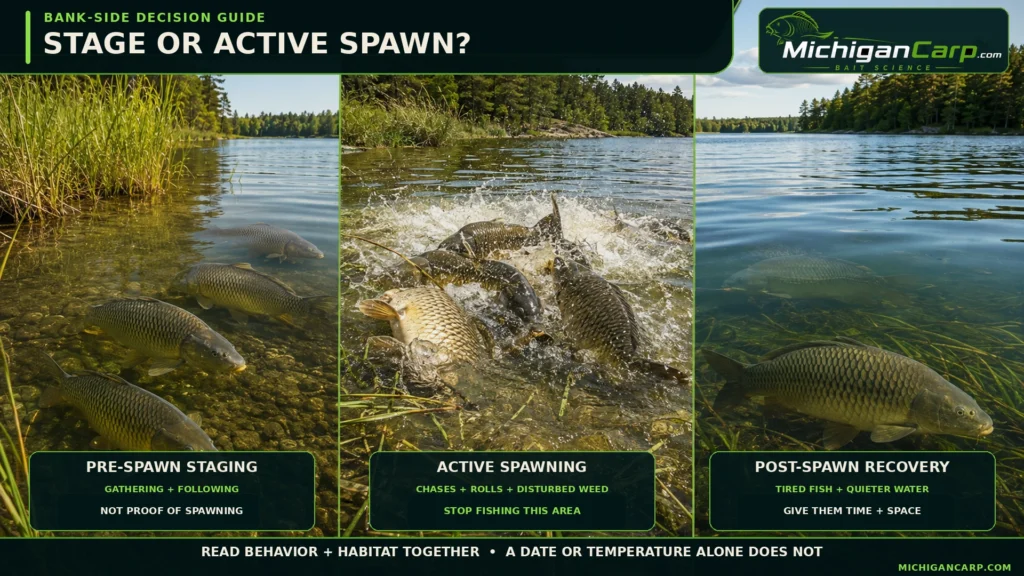
The difference between staging and active spawning is a pattern of behavior, not one sign. Use the whole scene: number of fish, persistence, interaction, water depth, vegetation disturbance and whether there is independent evidence of feeding.
| Observation | More Consistent With Staging or Feeding | More Consistent With Active Spawning |
|---|---|---|
| Movement | Fish cruise individually or in loose groups and revisit routes | Persistent chasing; several fish press closely around another fish |
| Surface signs | Occasional rolls or shows separated by quiet periods | Repeated rolling, splashing and bodies breaking the surface in one shallow zone |
| Vegetation | Fish pass an edge or feed beside it with limited disturbance | Reeds, grass, pads or submerged vegetation are repeatedly thrashed or pushed |
| Bottom evidence | Localized fizzing, pin bubbles, feeding clouds and bait response | Broad commotion driven by fish contact rather than steady bottom feeding |
| Area use | Fish enter and leave a route, shelf or outer edge | Fish remain concentrated in the shallow spawning cover |
| Angling response | A cautious test may be reasonable if feeding evidence is clear | Stop fishing that area |
One Roll Is Not Spawning
Carp roll while traveling, feeding, changing depth and for reasons an angler cannot diagnose from the bank. One splash can also be a predator, bird, boat wake or hooked fish elsewhere. Active spawning becomes credible when the interaction is repeated, concentrated and connected to shallow cover.
A Feeding Cloud Is Not the Same as Vegetation Disturbance
A carp rooting in soft bottom can create a localized turbidity cloud with bubbles and a slow-moving fish. Spawning disturbance is usually more physical and social: multiple fish, chasing, contact and repeated movement through vegetation. In dirty water, use persistence and group behavior rather than trying to read one patch of color.
If You Cannot Tell, Pause
Reel in, watch for fifteen or twenty minutes and let the pattern reveal itself. If the activity remains concentrated and reproductive, leave it alone. If the fish disperse and later return to ordinary bottom feeding outside the spawning habitat, you can reassess. The pause is an observation tool, not a loophole for casting back into active fish.
During Active Spawning: Observe and Stop Fishing That Area
Active spawning is the point at which MichiganCarp.com’s standard is firm: observe, do not target. The reason is not that common carp are legally protected from all fishing during a statewide closed season—they are not. It is an ethical catch-and-release and fish-care decision based on behavior, habitat and avoidable risk. Always check current regulations and site-specific rules separately.
What “Stop Fishing That Area” Means
- Reel in every rod whose bait, line or hooked fish could enter the active spawning group.
- Remove marker floats, bait boats or other equipment from the shallow habitat.
- Do not wade, anchor, net fish or run a propeller through the vegetation.
- If you move, choose genuinely separate water—not merely a cast length along the same active group.
- Return only after observation shows that active spawning has stopped and normal feeding behavior has resumed.
Do Not Turn Spawning Visibility Into an Opportunity
Spawning fish may be easier to see and approach, but visibility is not feeding confidence. Casting at a large fish being chased through shallow reeds is not the same as locating a feeding carp. It also increases the chance of foul-hooking, snagging vegetation or fighting fish through a crowded, physically active group.
Photography Is Not a Reason to Enter the Habitat
A distant photograph or short observation from a public bank can document the season. Do not push into reeds, fly a low drone over wildlife, chase fish with a boat or handle eggs and vegetation to improve the shot. The best record is one made without changing the event.
Move Only If the Alternative Is Truly Separate
On a large lake, fish may spawn in one protected bay while other carp feed normally on an outside route or distant area. Fishing elsewhere can be reasonable when the two areas and groups are clearly separate. On a small lake where activity surrounds the accessible margins, the right decision may be to leave.
Pauses, Batches and Repeat Spawning
Wild carp do not always release all mature eggs in one synchronized event. The FAO species account describes wild carp as partial spawners. Histological work on wild carp in Australia found asynchronous oocyte development and a prolonged season with multiple spawning. That study is useful evidence that spawning can occur in batches, though its climate and population should not be copied directly onto Michigan dates. See the Sivakumaran and colleagues reproductive-biology study.
A Weather Pause Is Not Necessarily the End
A cold night, wind shift, falling water, heavy boat traffic or simple daily timing can reduce visible activity. Fish may remain near the habitat and resume later. Do not interpret a quiet morning after an active evening as proof that every fish is finished. Scan the entire spawning area and connected routes before deciding.
Different Groups Can Be at Different Stages
One group may be actively spawning in a reed bay while another group cruises the outer lake. A second bay can warm later. Smaller fish and larger fish may not appear together. The practical consequence is that the lake needs a map of current behavior, not one label for the whole water.
Repeated Activity Does Not Create a Fixed Season Length
Multiple spawning potential explains why activity may recur, but it does not allow an angler to declare that Michigan carp always spawn for a set number of weeks. Population, climate and habitat matter. Record actual events and keep language specific: “active in the north reed bay on June 8,” not “the lake is spawning all June.”
After Spawning: Recovery, Movement and Feeding Return
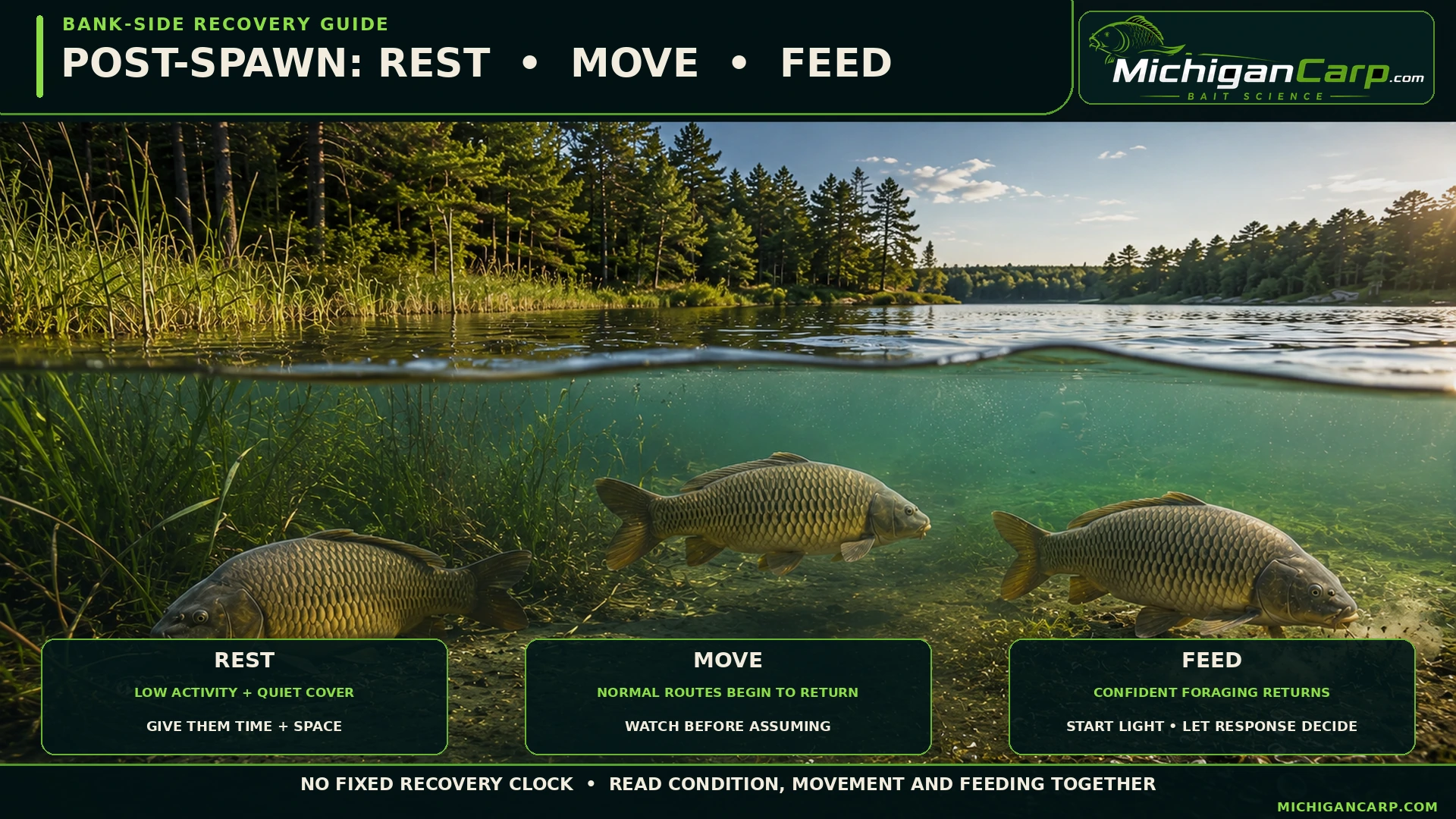
Post-spawn recovery is not a guaranteed feeding frenzy. Fish have completed an energetically demanding event, may show abrasions or split fins from shallow cover, and may leave the area in different condition and at different times. Some resume feeding quickly; others rest, move away or behave irregularly.
Step 1: Rest or Quiet Occupancy
Carp may remain near sheltered water, sit deeper, hold beside cover or move with less purpose. A fish lying or moving slowly is not an invitation to place a hookbait beside it. Give the area time and avoid crowding.
Step 2: Normal Movement Returns
The next useful sign is ordinary travel: carp leave the spawning vegetation, use recognizable routes, roll without chasing and spread out. Movement alone still does not prove feeding, but it shows the behavior is changing.
Step 3: Feeding Evidence Returns
Look for bottom-oriented activity, repeatable feeding bubbles, localized turbidity, liners along a route, accepted small bait and bites. These signs are more useful than counting days since the last splash. Begin with a light test and expand only when the response supports it.
No Fixed Recovery Clock
There is no defensible universal instruction to wait exactly one, two or three days. The lake may contain fish that did not spawn in the observed event, fish that finished earlier and fish that are still active elsewhere. Base the decision on the area and behavior in front of you.
Treat Visible Damage Conservatively
If carp appear heavily abraded, lethargic or otherwise compromised, leave them alone. When you later catch a post-spawn fish during normal feeding, keep the handling routine short, wet and organized. Skip weighing or photography when condition, heat or bank safety makes extra handling unwise. Use Carp Fish Care and Safety for the full standard.
A Bank-Side Decision Plan
Use a repeatable decision plan instead of guessing from the calendar. The aim is to identify the stage, protect active fish and gather enough evidence to fish responsibly before or after the event.
- Check the seasonal context. Record recent air temperatures, several-day water-temperature trend, water level and whether vegetation or flooded habitat is available.
- Watch before casting. Scan shallow habitat, the outer edge and access routes. Note individual rolls, group movement, chasing and vegetation disturbance separately.
- Classify the strongest behavior. Calm gathering or feeding can be staging; persistent group chasing in shallow cover is active spawning.
- Apply the stop rule. If active spawning is present, reel in and leave that area undisturbed.
- Reassess beyond the obvious bay. On large waters, determine whether other fish are feeding in genuinely separate water. On small waters, be prepared to end the session.
- Wait for normal behavior. Post-spawn fishing begins from feeding evidence, not elapsed time.
- Start with a small controlled test. Use modest bait, one repeatable area and a simple safe presentation. Expand only after a response.
A Useful Field Record
| Field | Example Entry |
|---|---|
| Date, lake area and time | June 12; north reed bay and outer point; 6:30–8:00 a.m. |
| Water-temperature trend | Bay 64°F yesterday afternoon, 61°F at dawn; main lake 58°F |
| Water level and habitat | Six inches above normal; flooded grass accessible |
| Observed behavior | Three groups chasing and rolling repeatedly inside grass |
| Feeding evidence | None on outside edge; no localized fizzing or bottom clouds |
| Decision | Active spawn—reel in and leave the bay |
| Next check | Observe outer lake on next visit; do not assume recovery date |
Record What You Saw, Not What You Assumed
“Six fish rolled” is a useful observation. “They were hungry” is an interpretation. “Repeated chasing by several fish through flooded grass for forty minutes” is stronger evidence of active spawning. Separating observation from interpretation improves future decisions and prevents a single dramatic morning becoming a permanent rule for that water.
Robert’s Practical View
On Michigan water I would rather miss a bite than fish into carp that are clearly spawning. The valuable fishing is normally on either side of the event: finding the route and genuine feeding before it begins, then waiting until the fish have left the spawning area and are behaving normally again. The water tells you more than the date.
Baiting Before and After Spawning
Spawning-cycle baiting should be responsive. The aim is to learn whether carp are feeding, not to force a response from fish whose priority has changed. Heavy bait placed before active spawning can remain uneaten, attract nuisance species or tempt the angler to keep fishing an area that should be left alone.
| Situation | Starting Baiting Approach | When to Increase | When to Stop |
|---|---|---|---|
| Calm pre-spawn staging route with feeding signs | Small accurate patch, crumb, particles or a few boilies matched to the presentation | After repeatable feeding, liners or a bite | When chasing or active spawning begins |
| Visible fish gathering but no feeding evidence | Single hookbait or very light test away from spawning cover | Only after real feeding response | If fish concentrate into reproductive behavior |
| Active spawning | No baiting | Do not increase | Reel in and leave the area |
| Uncertain pause after activity | Wait and observe; do not rebait the spawning zone | Only after normal feeding returns in separate or recovered water | If spawning resumes |
| Early post-spawn with quiet movement | Very small test on a safe route or natural food area | After accepted bait and repeatable signs | If fish appear distressed or activity is still reproductive |
| Normal post-spawn feeding established | Build gradually to the venue, fish numbers and session length | Based on consumption and results | Reduce if signs fade or uneaten bait remains likely |
Do Not Feed the Spawning Cover
Avoid baiting reed interiors, flooded grass or shallow vegetation when carp are gathering to spawn. Even if the bait is not fished immediately, it can encourage repeated disturbance and creates a reason to cast into an area that should remain quiet. Keep pre-spawn tests on safe routes or outside edges.
Use a Hookbait That Tests Feeding, Not Curiosity Alone
A single bright bait can be taken by a moving carp, but one pickup does not prove a stable post-spawn feeding pattern. A small amount of safe feed and repeatable bottom signs tell you more. Keep the presentation simple enough that you can compare response without changing bait, rig and location at once.
Expand From Evidence
When post-spawn carp begin returning to natural-food areas and accepting bait, increase slowly. Large Michigan waters can contain many fish, but the group visible in one bay may disperse widely after spawning. Bait should follow the fish’s new route rather than remain tied to the old event.
Fish Care, Habitat Protection and Michigan Rules
Spawning-cycle decisions sit inside wider fish care, habitat care and legal access. Common carp regulations and public attitudes differ from carp-specific catch-and-release culture, so the angler must check the current rules while maintaining a higher practical standard for handling and habitat.
Check Current Michigan and Site-Specific Rules
Use the Michigan Carp Fishing Regulations guide as a route to current Michigan DNR information, then verify the official fishing guide and the property rules for the access site. State parks, campgrounds, refuges, city property, Great Lakes harbors and managed wetlands can impose different access, hours, wading, boat or seasonal restrictions.
Protect Shallow Habitat
- Do not trample flooded grass, reed beds or submerged vegetation used by spawning fish.
- Do not drag marker leads, anchors or boats through active groups.
- Keep pets and spectators out of the shallow spawning area.
- Avoid clearing vegetation to create a cast or camera angle.
- Clean, drain and dry wet gear between waters to reduce the spread of invasive organisms.
Prepare for Warm-Weather Handling
Spawning often overlaps warming weather. Set up the landing net, wet mat, sling, forceps and camera before casting. Keep fish low, wet and supported. Minimize air exposure and skip optional weighing or photographs if the fish is in poor condition or the bank is hot. A carp that has returned to feeding still deserves an efficient release routine.
Do Not Fish an Unsafe Weed or Reed Swim
Spawning habitat can be the worst possible landing habitat. Dense reeds, pads, flooded brush and shallow timber increase break-off and tethering risk. Even outside active spawning, fish the safe edge rather than an impossible interior. The protected Weed Beds and Carp Fishing guide owns the detailed presentation and landing decisions.
Common Spawning-Cycle Mistakes
| Mistake | Why It Fails | Better Decision |
|---|---|---|
| Using a calendar date as proof | Michigan waters and bays warm differently | Track the local trend and behavior |
| Treating 64°F or any other number as a switch | Published ranges are context, not a field guarantee | Use temperature with habitat, readiness and behavior |
| Calling every roll a spawning sign | Rolling also occurs during travel and feeding | Look for persistent group chasing and vegetation disturbance |
| Calling every shallow group a feeding opportunity | Concentration can be staging or spawning | Confirm bottom-oriented feeding before casting |
| Fishing because the active fish are visible | Visibility does not equal feeding and increases disturbance risk | Reel in and observe |
| Assuming one quiet period means spawning is finished | Wild carp can spawn in batches and groups | Reassess the whole habitat and connected areas |
| Waiting a fixed number of days post-spawn | Recovery is uneven among fish and waters | Wait for normal movement and feeding evidence |
| Baiting heavily before the stage is clear | Fish may leave or stop feeding as spawning begins | Start with a controlled test |
| Moving fifty yards along the same spawning group | The lines and hooked fish can still enter active habitat | Choose genuinely separate water or end the session |
| Ignoring habitat damage | Wading, anchors and repeated casting can disturb eggs and vegetation | Protect the shallow zone and observe from outside |
Most errors come from wanting one simple answer: a date, a temperature or a number of recovery days. The better system accepts uncertainty but still produces clear decisions. Watch behavior, identify the stage, protect active fish and wait for ordinary feeding to return.
Frequently Asked Questions
So when is the carp spawning cycle in Michigan?
Usually during the spring-to-early-summer warming period, but the exact timing varies among lakes, regions, bays and years. Use local temperature trend, suitable habitat and behavior rather than one statewide date.
What water temperature do carp spawn at?
FAO sources commonly place the beginning or optimal range for European/common carp around 17–22°C (about 63–72°F), depending on source and context. Treat that as biological context, not a switch. Active behavior is the decisive bank-side evidence.
Can carp spawn below or above those temperatures?
Populations, strains, climate and measurement location differ, and local temperatures change through the day. Do not rule spawning in or out from one reading alone.
How do I know carp are actively spawning?
Look for a persistent combination: several fish chasing closely, repeated rolling or splashing in shallow water, physical contact and sustained disturbance of reeds, grass, pads or other vegetation.
Are grouped carp always spawning?
No. Carp can group while traveling, staging, feeding or using warm water. Grouping becomes stronger spawning evidence when it combines with repeated chasing and shallow vegetation disturbance.
Should I fish for carp during active spawning?
No. Reel in and stop fishing that area. Observe from a respectful distance or move to genuinely separate water where other carp are behaving normally.
Can I fish another part of the same lake?
Possibly on a large lake if the water and fish are genuinely separate from the active spawning group. Do not move a short distance while your line, bait or hooked fish can still enter the spawning habitat.
How long should I wait after spawning?
There is no universal number of days. Wait until active behavior has stopped, fish have left the spawning cover and normal movement plus independent feeding evidence have returned.
Do carp always spawn only once each year?
Wild carp can be partial or multiple spawners, and different groups can spawn at different times. That does not create a fixed number of events for every Michigan water.
Are post-spawn carp always hungry?
No. Some may resume feeding quickly while others rest, disperse or feed irregularly. Begin with a small test and expand only after accepted bait, feeding signs or bites.
Should I bait a likely spawning bay before the fish arrive?
Avoid baiting the shallow spawning cover itself. If pre-spawn fishing is appropriate, target a safe route or outer edge with controlled bait and stop as soon as active spawning begins.
What is the most reliable spawning clue?
A repeated pattern of social chasing and physical disturbance in shallow spawning habitat. Temperature and dates provide context; behavior provides the strongest field evidence.
Next Steps
Use this guide to identify the stage and make the ethical decision. Then move to the specialist article that owns the next question:
- Carp Water Temperature Guide for Michigan Lakes — measure local temperature and interpret the trend without treating one number as a command.
- Seasonal Carp Movement in Michigan — connect pre-spawn travel and post-spawn dispersal to the whole year.
- Weed Beds and Carp Fishing — read vegetation, safe edges and landing risk outside active spawning.
- Signs Carp Are Feeding — separate genuine feeding from surface activity.
- Carp Fish Care and Safety — prepare the bank and minimize handling when fishing resumes.
- Michigan Carp Fishing Regulations — verify current state and property-specific rules.
Final rule: fish the stage, not the date. Pre-spawn and post-spawn opportunities must be supported by normal feeding evidence. Active spawning gets space.