

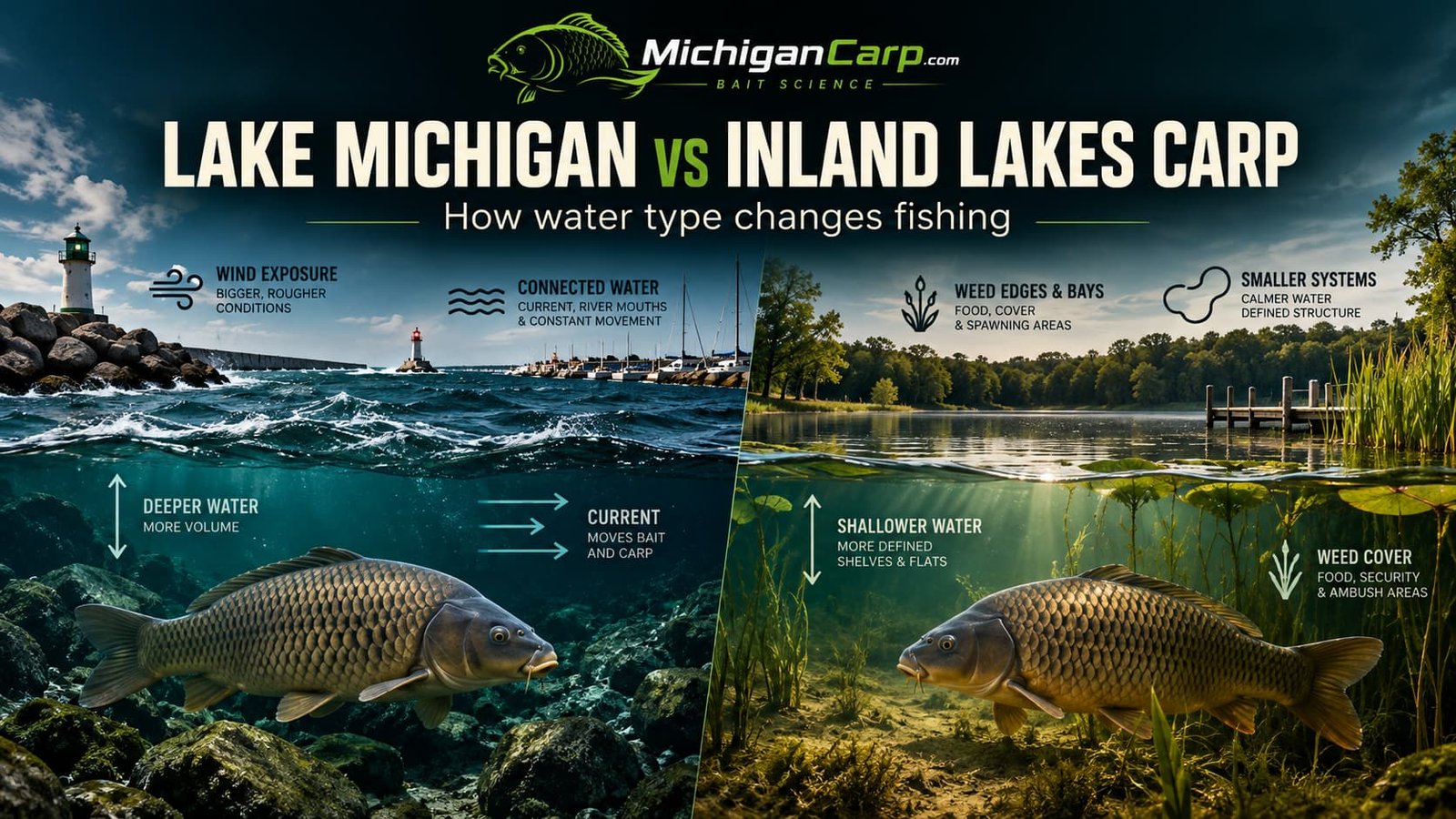
Lake Michigan vs inland lakes carp fishing is really a comparison between two different types of water rather than two different types of carp.
A common carp living in a Lake Michigan-connected harbor, drowned river mouth or channel is still the same species as one living in a 500-acre inland lake. What changes is the physical system around it: the amount of connected water available, the scale of movement possible, the influence of current, the effect of wind, the temperature structure, the distribution of natural food and the amount and type of human disturbance.
That difference matters because anglers often carry the logic of one water directly onto another. A productive reed margin or weed edge on an inland lake can encourage us to think in small, repeatable areas, while a Great Lakes-connected system may demand that we first decide which harbor arm, channel, river mouth or protected section is currently worth fishing.
The useful rule is therefore not that Lake Michigan carp always roam and inland carp always stay local. That would be too absolute.
The better rule is:
READ THE PHYSICAL SYSTEM FIRST, THEN DECIDE HOW MUCH SPACE THE CARP ACTUALLY NEED TO USE.
For the full large-water fishing system, use Advanced Big-Lake Carp Tactics for Michigan Waters. For the broader location framework that applies to either type of water, start with How to Find Carp in Lakes.
Table of Contents
Quick Start: Lake Michigan vs Inland Lakes Carp
| Factor | Lake Michigan-Connected Water | Inland Lakes |
|---|---|---|
| Scale | Often part of a much larger connected system | Usually more physically contained |
| Movement options | Harbors, channels, river mouths, lake shoreline, backwaters | Bays, shelves, weed edges, margins and basin routes |
| Current | Can be important around rivers, channels and entrances | Usually limited except around inflows, outlets and wind-driven movement |
| Temperature | Can be strongly influenced by large-lake water, wind and mixing | Often responds more locally to depth, sun, shelter and basin shape |
| Wind | Can reorganize nearshore conditions substantially | Important, but effects depend heavily on lake size and orientation |
| Natural food | Often distributed across several connected habitats | Frequently easier to associate with specific lake features |
| Pressure | Often mixed recreational and angling disturbance | Can become concentrated around limited public access |
| Best first question | Which section of the system is useful today? | Which feature or zone gives carp a reason to be here? |
| Angling approach | Stay open-minded about movement between connected zones | Build knowledge of repeatable local routes and feeding areas |
These are working tendencies, not biological rules. A huge inland lake can behave more like big water than a protected Great Lakes harbor, while a small connected marina basin may fish almost like an inland lake.
The Biggest Difference Is the Water, Not the Carp
Common carp are remarkably adaptable fish. The USGS Common Carp Species Profile records the species using lakes, ponds, slower rivers, backwaters and bays, illustrating how broad its habitat tolerance can be.
That adaptability is important here because it means we should resist creating two artificial categories of carp behavior.
A carp does not know that one water is officially Lake Michigan and another is an inland lake. It responds to conditions such as food availability, temperature, oxygen, cover, current, spawning requirements, disturbance and safety.
The angler’s job is therefore to understand how the water changes those opportunities.
A sheltered Great Lakes harbor with extensive weed and little current may produce very local carp patterns. A large inland reservoir with major inflows, long arms and substantial wind exposure may create much wider movement.
Think in terms of system characteristics, not labels.
Scale Changes the Location Problem
The biggest practical difference in Lake Michigan vs inland lakes carp fishing is often the scale of the location problem.
On a typical inland lake, even a relatively large one, the number of realistic carp zones may be manageable. Bays, weedbeds, shelves, reed margins, points, inflows and deeper holding areas can often be mapped and revisited until recognizable patterns begin to appear.
A Lake Michigan-connected system may contain several different environments within one fishery. An angler might have:
- open Great Lakes shoreline;
- a harbor basin;
- a navigation channel;
- marina arms;
- a river mouth;
- tributary influence;
- breakwalls;
- dredged water;
- shallow protected bays;
- and deeper connected water.
The first decision is therefore sometimes not which spot should I cast to?
It is:
Which part of this connected system is currently being used by carp?
That difference in scale is why I prefer to think in zones first, spots second on larger connected waters.
[IMAGE 2 — WATER-TYPE COMPARISON INFOGRAPHIC HERE]
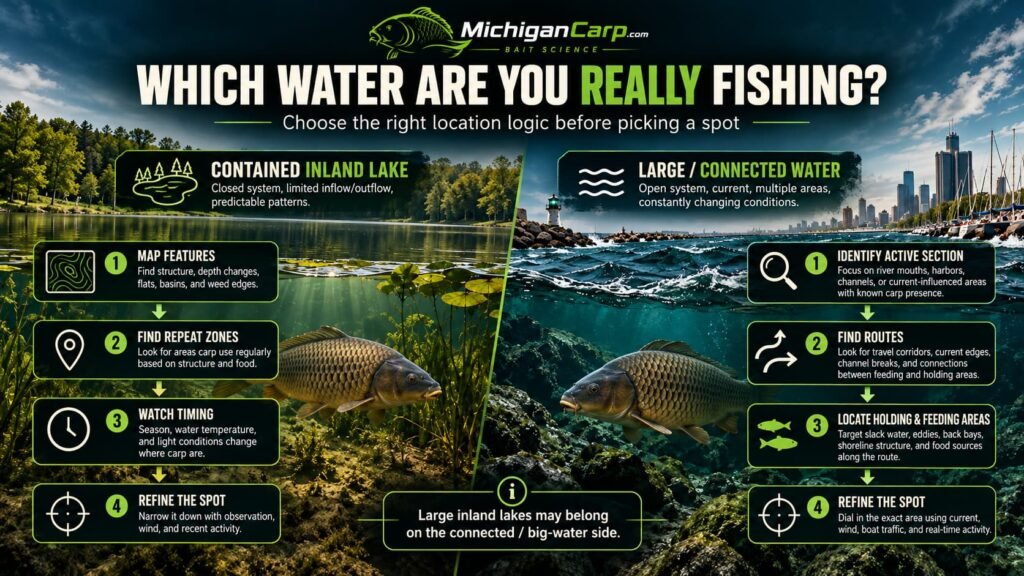
Connected Water Creates More Possible Routes
The greatest practical difference in many Great Lakes-connected fisheries is connectivity.
Carp may have access to a main lake, harbor, river, tributary, marina, backwater or channel without leaving the overall system.
That does not prove individual fish are constantly making huge movements. In fact, telemetry research on common carp shows considerable individual variation, with many fish remaining relatively local for long periods while others move more widely.
A recent telemetry study in a large connected river system found that common carp often remained stationary from week to week, although movement probability increased with environmental conditions such as discharge. Research on common carp movement in connected river habitat provides a useful reminder that access to connected water creates movement opportunities without forcing every fish to use them constantly.
For anglers, that means we should not assume that carp have disappeared ten miles away simply because they could.
Instead, look for connections that provide a reason to move.
Rivers and Tributaries Can Turn Movement Into a Route
River mouths and tributary connections are particularly important because they create defined pathways between different habitat types.
Flow, channel shape, depth change and current breaks can concentrate movement in ways that a featureless open shoreline cannot.
Common carp have been tracked moving through navigational structures and interconnected waterways, confirming that channels and pinch points can genuinely function as movement routes. USGS research on common carp movement in a navigation lock provides one example.
Michigan also has direct research demonstrating seasonal fish movement between Great Lakes-connected water and tributary habitat. The USGS FishPass assessment of the Boardman River included common carp among the species monitored in the lower river and documented seasonal entry and exit behavior within the connected system.
That does not mean every river mouth contains a reliable carp migration.
It means connectivity is real and should be treated as part of the location puzzle.
For the specialist guide, use Carp in Rivers & Tributaries: Migration Patterns and Staging Areas.
Inland Lakes Can Produce More Repeatable Local Patterns
A physically contained inland lake often gives the angler fewer possible zones to eliminate.
Once you know the main weedbeds, shallow bays, deeper basin, shelves, inflows, outlets and natural food areas, patterns may begin to repeat more clearly.
A productive weed edge may remain relevant throughout much of the season even if the exact feeding window changes.
A spring bay may repeatedly become attractive during stable warming weather.
A deeper edge may repeatedly function as holding water before carp move onto a nearby feeding area.
That does not mean inland carp stay in one place.
They can move substantial distances within a lake.
The practical advantage is simply that the system is usually more bounded, allowing repeated observation to build a clearer map of how the carp use it.
This makes historical notes especially valuable.
Big Inland Lakes Are an Important Exception
Do not let the phrase “inland lake” make you think “small.”
Michigan contains very large inland waters and reservoirs, and those systems can require exactly the same zone-based thinking as Great Lakes-connected fisheries.
Long travel distances, several basins, major weedbeds, river inflows, submerged channels, islands and large differences in depth can all create a big-water location problem.
That is why this article should not be used as:
Lake Michigan = difficult roaming fish
Inland lake = easy predictable fish
A better distinction is:
How open, connected and environmentally complex is the water I am actually fishing?
Large inland waters belong in Advanced Big-Lake Carp Tactics for Michigan Waters just as naturally as Great Lakes-connected systems do.
Lake Michigan Has a Different Temperature Scale
Temperature is another area where scale matters.
Lake Michigan is deep enough to develop strong seasonal thermal stratification. NOAA’s long-term Lake Michigan temperature measurements show summer separation between warmer surface water and colder deep water, followed by seasonal mixing as the lake cools. NOAA GLERL’s Lake Michigan temperature profile provides a clear visualization of that cycle.
Nearshore fishing adds another complication because wind can alter local temperature rapidly.
NOAA notes that wind mixes Great Lakes water and can also create coastal upwelling, where persistent wind moves warmer surface water offshore and colder deep water rises near shore. NOAA’s Great Lakes Water Temperature FAQ explains that mechanism.
That means a protected Lake Michigan-connected area can sometimes experience a temperature situation very different from the exposed coast only a short distance away.
For carp anglers, this is important because one temperature reading from one location should not be treated as the temperature of the whole connected system.
Inland Lake Temperatures Can Be More Local
Inland lakes also stratify, particularly deeper ones, so they should not be treated as uniformly warm bowls of water.
The difference is often scale.
A shallow sheltered bay can warm faster than the main basin.
A dark-bottomed margin can temporarily gain temperature.
A cold night can reverse some of that advantage.
A deep inland lake may retain a very different temperature structure from a small shallow lake only a few miles away.
This is why the practical question on inland water is often:
Which part of this particular lake is improving?
Rather than:
What is the temperature of Michigan lakes today?
For the full framework, use Carp Water Temperature Guide for Michigan Lakes.
Wind Should Be Interpreted Differently by Water Type
Wind is important almost everywhere in carp fishing, but the same wind speed can have very different consequences depending on water size, orientation, depth and exposure.
On a large Great Lakes-connected fishery, wind may affect wave action, current at entrances, turbidity, surface-water distribution and nearshore temperature.
On an inland lake, wind may primarily improve one bank, push surface water into a bay, disturb a shallow feeding area or create undertow.
Neither response should be reduced to the old rule:
Fish the windward bank.
Sometimes the windward water is excellent.
Sometimes it becomes cold, dirty, dangerous or physically unfishable.
The better approach is explained in Wind, Waves and Current for Michigan Carp Fishing.
Current Is a Bigger Part of Some Connected Systems
Most inland lakes are dominated by standing-water processes, although inflows, outlets, undertow and wind-driven circulation can still matter.
Great Lakes-connected areas can add genuine river or channel current to that picture.
That can influence:
- where drifting food settles;
- where carp can conserve energy;
- how bait moves after introduction;
- where soft-current edges form;
- which side of a channel is more usable;
- and how fish move between connected habitats.
The strongest current is not automatically the best fishing water.
Carp often have reasons to use softer water beside it rather than sitting directly in the most powerful flow.
That is why river mouths and harbor entrances should be read as systems of current and slack water, not single casting targets.
Harbors and Marinas Create Artificial Structure
Lake Michigan-connected carp fishing often involves structures that many inland anglers encounter less frequently.
Breakwalls, marinas, dredged channels, pilings, riprap, seawalls and harbor entrances all change the underwater environment.
They can create:
- depth changes;
- shade;
- hard substrate;
- sheltered water;
- current boundaries;
- food attachment surfaces;
- and travel edges.
They also introduce hazards such as ropes, propellers, sharp zebra mussels and restricted access.
For that reason, these environments deserve their own tactical treatment rather than being reduced to “fish near docks.”
Use Man-Made Structures: Harbors, Marinas and Urban Hotspots for the full system.
Natural Food Still Drives Both Types of Water
It would be a mistake to describe inland lakes as natural-food fisheries and connected Great Lakes waters as movement fisheries.
Carp still need food in both.
Weedbeds, insect-rich sediment, snails, mollusks, crustaceans and other food opportunities can influence where carp spend time regardless of the name of the water body.
The difference is how those food sources sit within the larger physical system.
On a compact inland lake, one productive weedbed may become a major repeated feeding area.
On a connected system, an equally productive feeding area may sit along a larger route between holding and movement water.
The food is still important.
The spatial context has changed.
For that subject, use How to Find Natural Carp Feeding Areas in Michigan Lakes.
Lake Michigan-Connected Carp Are Not Automatically More Mobile
This point deserves stating clearly because the old article leaned too heavily in this direction.
It is tempting to assume that fish living in a huge connected system must constantly move huge distances.
That does not follow automatically.
Telemetry work on common carp has repeatedly shown substantial variation between individuals and seasons. Some fish use relatively restricted areas for long periods, while others make broader movements when environmental or biological conditions change.
Research on common carp in the Lake Winnipeg drainage found the largest movements during the open-water period, but also demonstrated spatial aggregation and seasonal patterns rather than constant random roaming. Spatial ecology of common carp in Lake Winnipeg is a useful large-lake example.
The practical lesson is:
Large water gives carp more options. It does not prove that every carp uses all of them.
Observation still has to establish the actual pattern.
Inland Carp Are Not Automatically More Predictable
The reverse assumption is equally risky.
An inland lake can produce frustratingly mobile carp, especially when natural food, spawning activity, temperature, oxygen, weed growth or angling pressure changes rapidly.
One week a bay may be full of fish.
The next week it may appear empty.
A summer weedbed may dominate the fishing until oxygen or weed condition changes.
A heavily pressured public-access swim may stop producing during daylight even though carp continue using the general area.
Repeatability is something we earn through observation.
It is not guaranteed by the word “inland.”
Pressure Can Be Concentrated or Distributed
Pressure is another area where Lake Michigan vs inland lakes carp fishing can differ sharply because access and disturbance are distributed differently.
On an inland lake with limited public access, a small number of bank areas may receive most of the carp angling. Repeated casting, lines, baiting and captures can therefore become highly concentrated.
A Great Lakes-connected harbor may have much more overall disturbance but spread across boating, walkers, marina activity, lure fishing, pleasure craft and urban traffic.
Neither is automatically easier.
The practical question is:
Where and when does the carp experience the greatest disturbance?
Your modern Fishing Pressure and Carp: How They Learn and How to Adapt guide covers that in detail.
Daily Timing May Be Spot-Based or Section-Based
On an inland lake, a specific feature can develop a very recognizable daily rhythm.
A shallow margin may produce at first light.
A sunny spring bay may improve in the afternoon.
A weed edge may become strongest at dusk.
On a connected big-water system, the timing can sometimes belong to a larger zone rather than one exact casting spot.
A harbor arm may receive fish once boat traffic declines.
A river-mouth section may become active when conditions change.
A sheltered basin may become useful during one wind but poor during another.
The distinction is subtle but useful.
Instead of asking only:
When does this spot switch on?
also ask:
When does this entire section become usable to carp?
How I Would Scout an Inland Lake
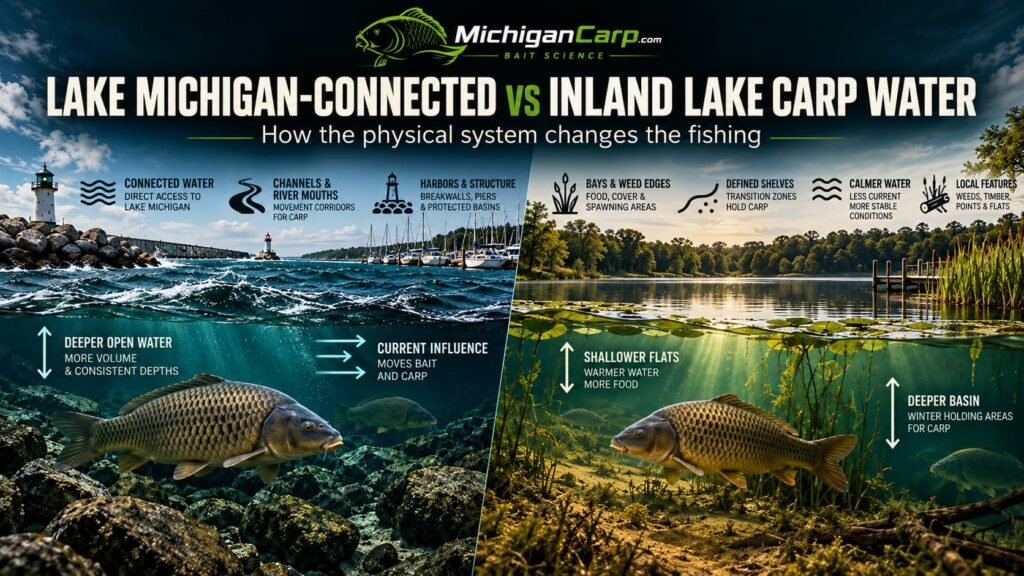
On an inland lake, I usually want to reduce the water into a manageable set of meaningful areas.
I would identify:
- shallow warming water;
- weed;
- natural food;
- shelves and depth transitions;
- inflows and outlets;
- quiet margins;
- deeper holding water;
- and routes connecting those areas.
Then I would watch for repeated evidence.
Where do fish show?
Where does fizz appear?
Which areas repeatedly produce at similar times?
Where does wind improve the fishing rather than simply make casting difficult?
The objective is to build a working map of the lake.
How I Would Scout Lake Michigan-Connected Water
On connected water I would start one level farther out.
Before choosing a precise spot, I want to know which section deserves attention.
That means comparing:
- harbor arms;
- river-mouth influence;
- protected water;
- channel edges;
- current-softened areas;
- deeper holding zones;
- marinas;
- breakwalls;
- and connections to the main lake.
Only once the section makes sense do I begin narrowing it into an actual rod position.
That approach prevents one of the most common big-water mistakes: spending an entire session refining a beautiful presentation in the wrong part of the system.
[IMAGE 3 — DECISION SYSTEM HERE]
Baiting Should Follow the Size of the Problem
The water type does not automatically determine how much bait should be used.
A small inland lake can hold a large biomass of feeding carp.
A vast connected system may give you only a handful of fish passing through a narrow window.
Bait quantity must follow:
- carp numbers;
- feeding activity;
- water temperature;
- natural food;
- competition from other species;
- session length;
- and how reliably fish return.
The main difference is strategic.
On an inland lake, prebaiting a proven feeding zone may build on a repeatable pattern.
On connected water, baiting heavily before proving the correct section can simply leave a lot of food where very few carp are currently passing.
Location comes first in both cases.
Rig Choice Does Not Change Because the Water Has a Name
A Lake Michigan carp does not require a Lake Michigan rig.
An inland carp does not require an inland-lake rig.
Rig choice should follow:
- lakebed;
- hookbait;
- weed;
- snags;
- line angle;
- current;
- casting requirement;
- and fish safety.
On connected water, current and sharp structure may increase the importance of abrasion resistance and secure lead arrangements.
On weedy inland water, presentation above debris may become the bigger problem.
For the complete system, use Complete Carp Rigs Guide for Michigan.
Michigan Notes
The most useful lesson from fishing different types of Michigan water is that the state does not offer one universal “Michigan carp lake.”
A small inland lake, a large reservoir, a dam pond, a Great Lakes harbor and a drowned river mouth may all hold common carp, yet they can require very different location strategies.
From my practical perspective, inland lakes often become easier to read once repeat feeding areas and routes are identified. On larger connected waters, I am usually more cautious about committing too quickly because a good-looking swim may represent only a tiny part of the available system.
But those are field tendencies, not biological laws.
I would never reject a small, repeatable pattern on Lake Michigan-connected water simply because the system is large, and I would never assume an inland-lake carp cannot move far because the lake is contained.
Watch what the fish actually do.
Common Mistakes
Treating Every Great Lakes-Connected Water as One Huge Open Lake
Harbors, backwaters and river mouths can behave as partially distinct zones.
Assuming Lake Michigan Carp Always Travel Huge Distances
Connected habitat provides options, but individual carp can remain relatively local.
Assuming Inland Carp Are Always Predictable
Food, temperature, spawning, pressure and oxygen can reorganize an inland lake quickly.
Applying One Temperature Reading to the Whole System
Large waters can contain several thermal situations at once.
Automatically Fishing the Windward Side
Wind must improve the water you are actually fishing; direction alone is not enough.
Ignoring Current in Connected Water
Even moderate flow can change routes, bait behavior and holding water.
Treating Big Inland Lakes Like Small Ponds
Some inland waters require exactly the same zone-based thinking as connected Great Lakes systems.
Trying to Solve a Location Problem With a Rig Change
If the carp are using another part of the water, terminal tackle is not the answer.
My Practical MichiganCarp View
In my experience, Lake Michigan vs inland lakes carp fishing becomes easier to understand once you compare the physical water rather than trying to compare the fish themselves.
The species has not changed.
The environment has.
Once you look at it that way, the subject becomes much easier to understand. A large connected system gives carp more possible habitats, more transitions and potentially longer routes. A contained inland lake often lets the angler build a more detailed map of repeatable features and timing. Large inland lakes can sit somewhere between those two extremes.
I therefore start with the water rather than the fish.
How big is the usable system?
How connected is it?
Where does current matter?
How exposed is it to wind?
How quickly can different sections change temperature?
Where is the natural food?
Where can carp hold safely?
Where are the routes between those areas?
Once those questions are answered, the carp become much less mysterious.
The most important rule is:
DO NOT FORCE THE LOGIC OF ONE WATER ONTO ANOTHER.
FAQ
Are Lake Michigan carp different from inland-lake carp?
No. They are common carp. The important differences come from the physical environment, connectivity, habitat and conditions of the water they inhabit.
Do Lake Michigan-connected carp move farther?
They may have the opportunity to use a larger connected system, but that does not mean every individual carp routinely makes long movements. Common-carp telemetry studies show considerable variation between fish and seasons.
Are inland-lake carp easier to locate?
Sometimes, because the system is more contained and repeated feeding areas can become easier to identify. Large or complex inland lakes can still create a very difficult location problem.
Does wind matter more on Lake Michigan-connected water?
Wind can have particularly large effects on exposed Great Lakes water, including waves, mixing and nearshore temperature changes. However, wind is also an important location factor on inland lakes.
Can Lake Michigan nearshore water suddenly become colder?
Yes. NOAA documents wind-driven coastal upwelling in the Great Lakes, where warm surface water can move offshore and colder deep water rises near shore.
Should I use different bait in Lake Michigan?
Not simply because it is Lake Michigan. Bait choice should follow carp activity, natural food, temperature, nuisance species and the fishing situation.
Are harbors easier than the open lake?
They can be easier to read because structure, depth, current and shelter create more defined zones, but boat traffic, snags and access can make them difficult in other ways.
Are large inland lakes more like Lake Michigan?
In strategic terms they can be. A large inland lake with several basins, strong wind exposure, major inflows and long movement routes often requires zone-based big-water thinking.
Does current matter for carp?
Yes, where meaningful current exists. It can influence movement routes, energy expenditure, food distribution and where quieter holding water forms.
Which water type is better for learning carp location?
Both teach different skills. Inland lakes can be excellent for learning repeat features and local timing, while large connected systems force you to think more strongly about scale, movement and environmental change.
Next Steps
For the main large-water framework, continue with Advanced Big-Lake Carp Tactics for Michigan Waters.
For the universal location system, use How to Find Carp in Lakes.
For connected rivers and movement routes, read Carp in Rivers & Tributaries: Migration Patterns and Staging Areas.
For harbors, marinas and built structure, use Man-Made Structures: Harbors, Marinas and Urban Hotspots.
For natural feeding habitat, continue with How to Find Natural Carp Feeding Areas in Michigan Lakes.
For temperature interpretation, read Carp Water Temperature Guide for Michigan Lakes.
For moving-water conditions, use Wind, Waves and Current for Michigan Carp Fishing.
For angling and recreational disturbance, read Fishing Pressure and Carp: How They Learn and How to Adapt.