
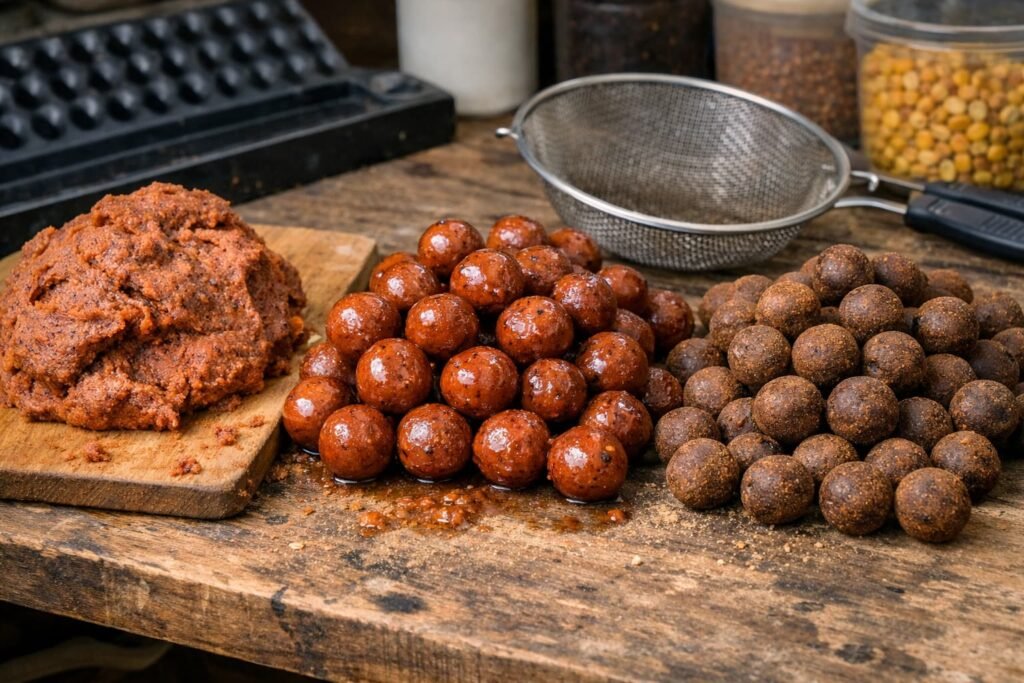
Boilies are not “magic bait” — they are simply a reliable, controllable food source that allows you to build consistent, repeatable feeding results on big waters.
On pressured Northern Michigan lakes, consistency, digestibility, and preparation matter far more than trends, flavors, or hype.
This guide is not just about making boilies.
It’s about understanding:
- What boilies actually do in a carp’s feeding cycle
- How they fit alongside particles, and liquids.
- And how to use (or make) them in a way that builds long-term confidence
Whether you eventually roll your own bait or use quality ready-mades, knowing how boilies are constructed makes you a better angler.
This page is the foundation of the Michigan Carp boilie system.
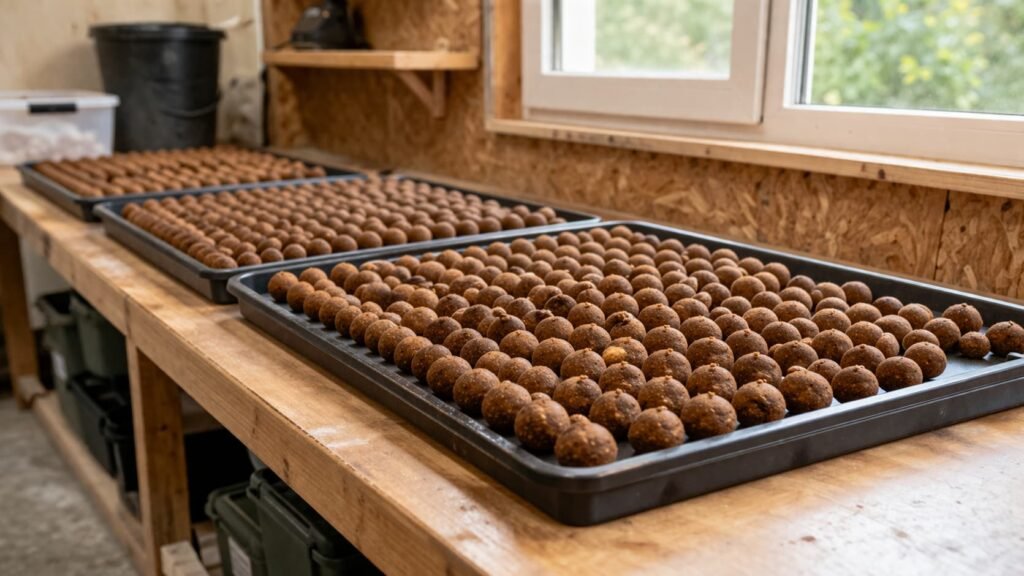
Homemade boilies for carp are more than just bait. Instead, they are a long-term feeding tool and, therefore, a powerful way to condition carp to feed confidently in an area.
Buying boilies is easy. However, making homemade boilies for carp gives you full control over ingredients, quality, and cost. As a result, you also control what actually works in your water.
In big, natural Michigan lakes, carp grow old and cautious. Consequently, that control can make a huge difference.
Read: Bait Storage & Prep Guide
Read: Particles Guide
Start Here: The Boilie School
If you are new to boilies, or you want to understand them properly instead of just copying recipes, start with these in order:
Boilie School BS-01 — Boilie Basics: What They Are, Why They Work, and When to Use Them
Boilie School BS-02 — Ingredients 101: Proteins, Binders, Solubles, Oils, and Additives
Boilie School BS-03 — Base Mix Templates (Fishmeal, Milk, Bird food, Nut
Boilie School BS-04 — Liquids & Additives: Marine and Non-Marine Options
Boilie School BS-05 — Rolling, Boiling/Steaming, Drying, and Storage
Boilie School BS-06 — How to Use Boilies on the Bank (Strategy & Seasonality
These guides turn “boilies” from a recipe into a system.
How Boilies Fit Into the Michigan Carp Bait System
Boilies are not meant to replace particles, corn, or natural baits.
They play a specific role:
- Particles = the bulk feed
- Boilies = the long-term food signal
- PVA = precision placement
- Hookbaits = the trigger
- Liquids = the amplifier
Used correctly, boilies:
- Help control feeding spots
- Allow accurate baiting at range
- Hold fish in an area long-term
- And let you build repeatable results session after session
They work best as part of a system — not as a standalone trick.
Related Bait Shed Guides
- Carp Bait Storage & Preparation (how to store, freeze, and manage bait safely)
- Liquids & Glugs: A Simple Liquid Food System
- The Ultimate Carp Particles Guide (Michigan Edition)
- Tiger Nuts for Carp Fishing
- PVA Bag Fishing for Carp
All of these work together with your boilie approach.
What are homemade boilies for carp, really?
In short, a boilie is a dough-based bait that is rolled and cooked. However, the real power of boilies for carp is not the shape. Instead, it is the base mix, the nutritional profile, and the message it sends to carp over time.
Why make boilies for carp?
First of all, boilies for carp let you:
- Avoid cheap fillers
- Choose your own proteins
- Control solubility and breakdown
- Tune the bait to your lake, your season, your fish
- Save money long-term
Most importantly, you always know exactly what you are fishing with and why it should work.
This guide is not just a single recipe — it’s the front door to the Michigan Carp Boilie School.
Instead of guessing, copying random mixes, or endlessly tweaking things that don’t matter, Boilie School teaches you a simple, repeatable system for making effective carp bait using ingredients you can actually get in the USA.
If you follow this in order, you’ll understand:
- What boilies really do in a feeding campaign
- How to build simple, digestible base mixes
- How to use liquids and additives without ruining bait
- How to roll, cook, dry, and store bait properly
- How to use boilies in real Michigan fishing, not just in theory
- How to diagnose and fix bait problems when things go wrong
Think of this page as your roadmap. The lessons are below.
The Boilie School Course (Follow in Order)
Lesson 1 — Boilie Basics
Boilie School BS-01: Boilie Basics — What They Are, Why They Work, and When to Use Them
→ Explains what boilies actually do in a feeding plan, when to use them, and when not to.
Link to:Boilie SchoolBS-01: Boilie Basics — What They Are, Why They Work, and When to Use Them
Lesson 2 — Ingredients 101
Boilie School BS-02: Ingredients 101 — Proteins, Binders, Solubles, Oils, and Additives
→ Breaks down every ingredient category in plain English so you understand what each part does.
Link to:Boilie SchoolBS-02: Ingredients 101 — Proteins, Binders, Solubles, Oils, and Additives
Lesson 3 — Base Mix Templates
Boilie School BS-03: Base Mix Templates — Marine, Birdfood, and Milk/Nut Styles
→ Gives you reliable starting templates instead of “mystery recipes”.
Link to:Boilie School BS-03: Base Mix Templates — Marine, Birdfood, and Milk/Nut Styles
Lesson 4 — Liquids & Additives
Boilie School BS-04: Liquids & Additives — Marine and Non-Marine Options (And How Not to Overdo It)
→ Shows how to use liquids properly without wrecking your bait or your swim.
Lesson 5 — Rolling, Cooking & Storage
Boilie School BS-05: Rolling, Boiling/Steaming, Drying, and Storage — The Repeatable Method
→ Covers the mechanics that make or break bait consistency.
👉 Link to: Boilie School BS-05: Rolling, Boiling/Steaming, Drying, and Storage — The Repeatable Method
Lesson 6 — Using Boilies in Real Fishing
Boilie School BS-06: Using Boilies on the Bank — Strategy, Hookbaits, and Seasonal Adjustments
→ Shows how boilies actually fit into real Michigan sessions and campaigns.
Link to: Boilie School BS-06: Using Boilies on the Bank — Strategy, Hookbaits, and Seasonal Adjustments
Troubleshooting & Fixes
Boilie Troubleshooting: Split Baits, Soft Baits, Floaters, Skin Issues (Fixes That Work)
→ When something goes wrong, this is where you diagnose and fix it.
Link to:Boilie Troubleshooting: Split Baits, Soft Baits, Floaters, Skin Issues (Fixes That Work)
How This Guide Should Be Used
If you’re new to making bait:
- Start at Lesson 1
- Read them in order
- Don’t skip ahead
- Don’t overcomplicate things
By the time you reach the end, you’ll understand why your bait works — not just what’s in it.
The three types of homemade boilies for carp
Freezer boilies
These are the highest quality. However, they must be frozen.
Shelf-life boilies
These are convenient. Nevertheless, they use preservatives.
Hookbait-only boilies
These are highly attractive. Therefore, they are not meant for heavy feeding.
Understanding a base mix for boilies for carp
A base mix is always a balance of proteins, carbohydrates, binders, and solubles. Consequently, a good bait is about structure, digestion, and leakage, not hype ingredients.
The three main styles of homemade boilies for carp
Birdfood / seed-based boilies for carp
These offer texture and excellent digestion. As a result, they work all year.
Milk / nut boilies for carp
These are creamy and subtle. Therefore, they excel in clear or pressured water.
Fishmeal boilies for carp
These give a strong food signal. However, they are best in warm water.
The simple 50/50 base for homemade boilies for carp
Firstly, a classic 50/50 is easy to source and easy to roll. Secondly, it is easy to adapt. Finally, it is proven worldwide.
50/50 Base (1 kg)
- Semolina — 500 g
- Soya flour — 500 g
On its own, this already catches fish. However, it becomes far more powerful when you aim it toward a style.
Turning the 50/50 into three proven homemade boilies for carp
Birdfood / seed-based
- Semolina — 350 g
- Soya flour — 350 g
- Birdfood — 200 g
- Ground seed / wheatgerm — 100 g
Milk / nut based
- Semolina — 350 g
- Soya flour — 300 g
- Milk powders — 200 g
- Nut meal — 150 g
Fishmeal based
- Semolina — 300 g
- Soya flour — 200 g
- Fishmeal — 400 g
- Birdfood or wheatgerm — 100 g
Liquids: the engine of boilies for carp
Typically, liquids include eggs, sweeteners, liquid foods, and oils. Therefore, the dry mix is the body, while the liquid mix is the personality.
How to mix and roll homemade boilies for carp
- First, mix all dry ingredients
- Then, beat eggs and liquids
- Next, combine into stiff dough
- After that, roll sausages and balls
- Finally, cook and air-dry
Wafters and pop-ups for boilies for carp
Because carp inhale balanced baits more easily, wafters and pop-ups are extremely effective.
Cork-ball pop-ups
Wrap your normal paste around a cork ball. Then steam or boil gently and test buoyancy. As a result, you get a perfectly balanced hookbait that matches your freebies.
(Read: PVA Bag Fishing Guide)
(Read: Hair Rig Setup Guide)
How to store homemade boilies for carp
(Read: Bait Storage & Prep Guide)
- Freeze in session bags
- Keep hookbaits separate
- Avoid repeated freeze/thaw cycles
Using homemade boilies for carp with particles
On the one hand, particles keep fish feeding. On the other hand, boilies give them a bigger mouthful. Therefore, the combination is extremely powerful.
(Read: Particles Guide)
Flavour is not the foundation
In fact, a good mix of homemade boilies for carp will catch fish without flavour. Consequently, flavour should enhance, not replace, good bait design.
Boilie School: going deeper with boilies for carp
Here we will cover synergy, advanced ingredients, and real bait science. Ultimately, the goal is to make the Michigan Carp bait shed the go-to place online.
FAQ
Are homemade boilies for carp better than shop bought?
Often yes, because you control freshness and ingredients.
Can I freeze boilies for carp?
Yes. In fact, freezing is the best storage method.
Do I need expensive ingredients?
No. Instead, focus on structure and digestion.